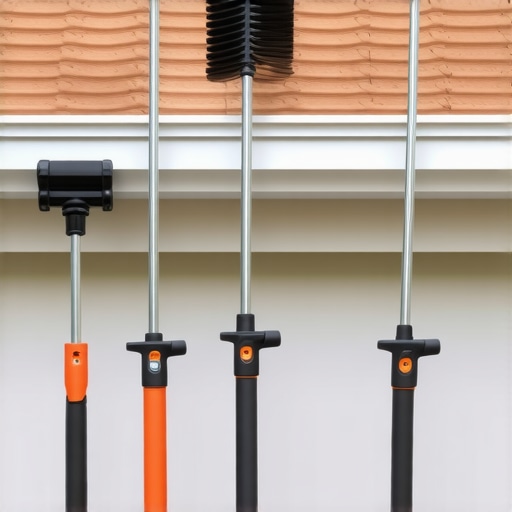
The Gravity-Fed War Against Your Foundation
I have spent over twenty-five years watching water destroy houses. Most homeowners treat their gutters as an afterthought, a piece of trim that occasionally needs a ladder and a bucket. That is a dangerous mistake. Rain is a persistent, destructive force. When a storm hits, your roof becomes a massive collection surface, funneling thousands of gallons of water toward your fascia and soffit. If that water cannot move through the leader and out to a splash block or underground outlet pipe connection, it will find another way down. Usually, that way involves rotting your wood or eroding your foundation. This is why professional ladder safety is the first thing I teach my apprentices. Falling from a two-story height while wrestling with a clogged miter is a life-changing event. To stay on the ground while keeping the system flowing, you need to understand the physics of the telescopic tool. These are not toys; they are engineered extensions that allow you to manage hydraulic flow without risking your neck.
The November Slush Disaster: A Narrative of Neglect
I remember a call I took in late November, just as the first deep freeze hit the region. The homeowner had neglected his gutter winterization. He had a 50-foot run of seamless gutter installation that was packed tight with wet oak leaves and pine needles. When the temperature dropped, that organic sludge turned into a solid block of ice. Because he had an old-school spike and ferrule setup, the weight was too much. The ice expanded, the spikes pulled out of the rotted fascia board, and the entire 50-foot length of aluminum came crashing down in the middle of the night. It took the soffit and the decorative trim with it. If he had used a telescopic cleaning tool a week earlier, that $4,000 repair would have been a twenty-minute chore. This is why I advocate for weather-ready gutter materials and consistent maintenance. Water is heavy. Ice is heavier. Your hangers need to be spaced every 12 inches in northern climates to handle that load, but even the best brackets cannot save a system that is choked with debris.
“Downspouts shall be sized based on the rainfall intensity of the region and the roof surface area.” – International Plumbing Code, Section 1106
The Physics of the Telescopic Water Wand
The first tool in my arsenal is the high-pressure water wand. This is not about just spraying water; it is about flow velocity and breaking the surface tension of the sludge. When leaves sit in a gutter, they create a mat. Water hits that mat and slows down, causing more sediment to drop out of suspension. A telescopic wand with a curved neck allows you to reach over the edge of the gutter and blast that sediment toward the outlet. You are looking for that specific sound of the water hit the bottom of the leader. If the water backs up, you have a clog in the elbow. In these cases, you are not just cleaning; you are performing a hydraulic flush of the entire system. This is critical for preventing the standing water that leads to mosquito breeding and premature rust on sectional metal seams.
The Vacuum Extension Pole: Suction vs. Gravity
For those who live under a heavy canopy of maples or oaks, a vacuum system is the only way to go. Standard sweeping often just pushes the mess further down the line toward the end cap. A telescopic vacuum pole uses static pressure to lift the debris out entirely. This is the gold standard for gutter winterization because it leaves the trough bone-dry. Any moisture left behind in a northern climate will freeze and expand, slowly prying the gutter away from the fascia. When I see a homeowner using a vacuum, I know they understand that even a thin layer of silt can disrupt the pitch of the system. Remember, a gutter must have a slope of at least 1/4 inch for every 10 feet of run. If silt builds up, it creates level spots where water pools, leading to the dreaded drip-drip-drip that rots out your door frames.
The Rotary Brush Attachment: Breaking the Biofilm
Sometimes, water and suction are not enough. If you have neglected your system for a few seasons, a biofilm or “gutter sludge” develops. This stuff is like glue. A telescopic rotary brush allows you to scrub the interior of the aluminum without needing a ladder. This is vital for maintaining weather-ready gutter materials. Modern coatings on seamless gutters are designed to shed water quickly, but they cannot do their job if they are coated in organic slime. Using a brush also allows you to inspect the hangers from the ground. If you see the brush catching on a loose spike and ferrule repair site, you know it is time to upgrade to heavy-duty screw-in hangers that won’t back out when the wind kicks up.
“Gutter systems must be designed to withstand the maximum potential snow load and thermal expansion of the material used.” – SMACNA Architectural Sheet Metal Manual
The Claw and Scoop: Manual Control from a Distance
The most basic but effective telescopic tool is the claw. This is for the heavy lifting—the pine cones, the branches, and the occasional tennis ball. When you use a claw, you are mimicking the manual cleaning process but with the safety of two feet on the pavement. I always tell people to start at the downspout and work away from it. This ensures that you do not accidentally pack a large obstruction into the outlet pipe connection. Once the large debris is cleared, you can follow up with a wash. This tool is also great for checking the kickout diverter installation. A kickout diverter is that small piece of flashing that directs water away from where a roof line meets a vertical wall. If that area is clogged, water will go behind the siding and destroy your wall studs before you even know there is a leak.
The Pressure Washer J-Hook: For the Stubborn Clogs
Finally, for the most stubborn corrugated downspout repair jobs, a telescopic pressure washer attachment is the heavy hitter. Corrugated pipes are a nightmare because the ridges catch every little twig. A J-hook attachment allows you to fire a high-pressure stream directly down the leader. This force can break up even the most compacted clogs. However, you have to be careful. Too much pressure can blow apart a weak elbow or a loose miter joint. You want enough force to clear the line, not enough to dismantle the plumbing. This is why I prefer seamless gutter installation; there are fewer joints to fail under pressure. If you have sectional gutters, every seam is a potential leak point that requires constant vigilance and sealant.
Winterization and the Long-Term Strategy
Gutter maintenance is not a one-off task; it is a seasonal obligation. In the north, gutter de-icing services are often needed if the pitch was installed incorrectly. If water cannot drain, it will freeze. If it freezes, it will form an ice dam. These telescopic tools are your first line of defense against the structural failure of your home. By staying off the ladder, you ensure that you can perform this maintenance frequently without the dread of a fall. Check your fascia board repair needs while you are at it. If you see dark stains on the wood behind the gutter, your system is failing, and water is bridging the gap. No tool can fix a poorly engineered system, but these five tools will keep a well-built system running for thirty years. Keep your feet on the ground, keep your pitch correct, and never underestimate the power of a single gallon of water. Your foundation depends on it.