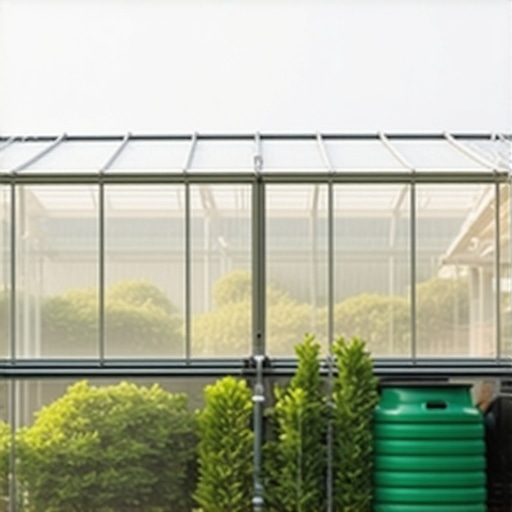
The Algae Jungle: Why Greenhouse Drainage Often Fails
I remember walking onto a property in Oregon where the homeowner had spent six months building a beautiful 12×20 cedar-frame greenhouse. They called me because the structure was already showing signs of wood rot at the base. I took one look at the eaves and found what I call an Algae Jungle. They had installed those thin, sectional plastic gutters from a big-box store, and because they hadn’t accounted for the unique surface tension of glass, the water was simply curling around the bottom edge of the glazing and soaking the wood frame instead of entering the trough. The gutters were packed with a thick, gelatinous sludge of pollen and pine dust that had literally sprouted moss. This is what happens when you treat a greenhouse like a house. A greenhouse roof, whether it is glass, polycarbonate, or polyethylene film, has a runoff coefficient near 1.0. That means every single drop of rain that hits that surface is headed for your gutters instantly. There is no shingle grit to slow it down, no organic absorption. You are dealing with high-velocity sheet flow, and if your gutters aren’t engineered for it, your rain barrels will stay dry while your foundation turns into a swamp.
The Physics of High-Velocity Collection
To capture water effectively from a greenhouse, you must understand the fluid dynamics at play. On a standard shingle roof, the texture of the asphalt creates friction that breaks the water’s speed. On a greenhouse, the water accelerates. By the time it reaches the eave, it has enough kinetic energy to overshoot a standard five-inch gutter if the pitch of the roof is steep. This is where many DIYers fail. They mount the gutter too high or too low. If it is too high, the water hits the back of the gutter and splashes back onto the fascia. If it is too low, the water launches over the front lip. [IMAGE_PLACEHOLDER] You need a pitch of at least 1/4 inch for every 10 feet of run to ensure that the water doesn’t sit and stagnate. Standing water is the enemy: it breeds mosquitoes and accelerates the breakdown of the end cap seals.
“Downspouts shall be sized based on the rainfall intensity of the region and the roof surface area.” – International Plumbing Code, Section 1106
The Drainage Hierarchy: Moving Water with Intent
In the world of water management, we follow a strict hierarchy. First, you collect. Second, you transport. Third, you store. For a greenhouse, the leader (what most folks call a downspout) needs to be oversized. While a 2×3 inch downspout is standard for small sheds, I always recommend 3×4 inch commercial-grade leaders for greenhouses. Why? Because greenhouse roofs are prone to shedding large amounts of debris like pollen and sap which can quickly bridge a 2×3 opening. We are looking for high-flow capacity. When you are installing these, professional ladder safety is non-negotiable. You are often working over glass or fragile panels. Never lean a ladder against the greenhouse frame itself; use a ladder standoff that spans the built-in gutter systems or rests on the structural rafters. This prevents cracking the glazing or bending the aluminum tracks.
Selecting the Right Gutter Material
When building for longevity, skip the vinyl. Vinyl expands and contracts at a different rate than your greenhouse frame, leading to cracked joints and leaking miter corners. Seamless aluminum is the gold standard, but for a greenhouse, you might be looking at a DIY installation. If you are using sections, you must use high-grade silicone sealant at every joint and hanger point. If you are replacing an old system, remember eco-friendly gutter disposal: aluminum is 100% recyclable. Don’t just toss it in the landfill. If you are dealing with a commercial flat roof gutter or a membrane roof gutter on a lean-to greenhouse, your drainage strategy shifts to internal drains or scuppers, but the principle of volume remains. You must account for the square footage. A 1,000-square-foot roof will produce 623 gallons of water during a single inch of rainfall. If your rain barrels are only 55 gallons, you need an overflow strategy that involves downspout installation leading to a French drain or a splash block positioned at least five feet from the structure.
“Gutters and downspouts should be designed to handle the 10-year return frequency storm.” – SMACNA Architectural Sheet Metal Manual
Climate-Specific Engineering
If you are in the North, you are fighting ice dam prevention. Snow slides off glass roofs with incredible force. If your gutters are in the path of a snow slide, they will be ripped off the soffit. In these climates, we mount the gutters lower than the roof line so the snow can jump over the gutter while the water, moving slower at the start of a melt, drops in. We use heavy-duty hangers spaced every 12 inches rather than the standard 24. For those in the South dealing with hurricane-rated installations, every component must be mechanically fastened. No friction-fit elbows allowed. Use stainless steel zip screws at every connection point. If you have a wood shake gutter flashing setup on a rustic greenhouse, ensure the flashing extends at least three inches into the gutter to prevent capillary action from drawing water back into the wood.
The Rain Barrel Connection: Beyond the Hose
Connecting your leader to a rain barrel isn’t just about sticking the pipe in a hole. You need a diverter. A proper diverter will allow the first “flush” of water (which contains the most bird droppings and debris) to bypass the barrel. This keeps your irrigation water cleaner. If you have solar panel gutter avoidance issues where panels are mounted on the greenhouse, ensure the water coming off the panels doesn’t create a concentrated stream that erodes the pitch of your gutter. Finally, consider the ice dam prevention for the barrels themselves. In winter, an undrained rain barrel will crack when the water freezes and expands. Your system must be modular enough to be disconnected during the hard freeze months. Managing water isn’t about stopping it; it is about respect. You respect the volume, you respect the gravity, and you engineer for the worst-case scenario. That is how you keep your greenhouse standing for 30 years instead of five.