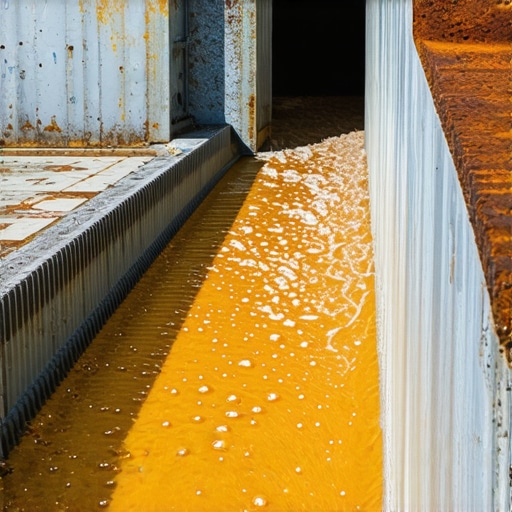
When you are managing an industrial facility, the sky is not just a source of water. It is a delivery system for corrosive elements that can compromise your entire structural integrity. In twenty-five years of engineering drainage systems, I have seen standard residential logic applied to commercial buildings with disastrous results. Industrial gutters are not just about catching rain. They are the first line of defense against chemical-laden runoff and massive water volumes that can liquefy a foundation’s sub-base in a single season.
The $200,000 Foundation Oversight
I once walked a site in an industrial park where the northwest corner of a 50,000 square foot warehouse had settled nearly three inches. The owner was panicking about structural steel failure. When I got on the roof, the culprit was obvious. A single 4×5 rectangular downspout had become disconnected at the base. For two years, every heavy rain sent a concentrated blast of water directly into the soil at the corner of the building. This was not just a sagging gutter fix issue. This was a total hydraulic failure. The water had eroded a massive void under the concrete slab because the underground downspout drainage system was never properly tied in. One missing elbow and a lack of maintenance led to a six-figure repair bill. That is the reality of industrial water management.
“The size of gutters and leaders shall be determined by the maximum intensity of the rainfall that is local to the site, and the area of the roof surface to be drained.” – International Plumbing Code, Section 1106
The Chemistry of Corrosive Runoff
In industrial zones, the rainwater reacts with airborne particulates from manufacturing processes. Whether it is sulfur, salt spray, or metallic dust, your roof becomes a collection plate for chemicals. When the rain hits, it creates a low-pH solution that sits in your gutters. This is why a standard vinyl gutter repair often fails in these environments. Vinyl cannot handle the thermal expansion of a 200-foot run, and it certainly cannot handle the chemical load. We look at gutter replacement services through the lens of material science. For industrial sites, we often specify heavy-gauge Kynar-coated aluminum or stainless steel to resist this caustic sludge. If you see white powdery residue or pinhole leaks, your gutters are being eaten from the inside out. This requires a professional gutter sealant application using high-grade tripolymer sealants that can withstand chemical exposure and extreme temperature swings.
Hydro-Zooming: The Physics of High-Volume Drainage
Let us talk about flow velocity. On a massive industrial roof, water does not just trickle. During a heavy downpour, water moves with incredible kinetic energy. If your pitch is even slightly off, you get standing water. A common rule of thumb is a 1/4 inch of slope for every 10 feet of run. However, in long industrial spans, you must account for the weight of the water itself. Water weighs about 8.34 pounds per gallon. A 60-foot run of 7-inch gutter filled with water and industrial grit can weigh over 500 pounds. This is why we hate the old spike and ferrule method. They pull out of the fascia under the sheer weight. We use heavy-duty internal hangers spaced every 12 to 18 inches, screwed directly into the structural rafters. This prevents the sagging gutter fix from becoming a recurring nightmare. When we perform a rectangular downspout install, we are calculating the Cubic Feet per Second (CFS) to ensure the leader can evacuate the trough faster than the roof can fill it.
“Expansion joints shall be provided for all gutter installations where the length of the gutter exceeds 50 feet to prevent damage from thermal movement.” – SMACNA (Sheet Metal and Air Conditioning Contractors’ National Association)
The Necessity of Expansion Joint Gutters
One of the most overlooked components in industrial drainage is the expansion joint. Steel and aluminum expand and contract significantly as they heat up in the sun. On a long two-story gutter services project, a gutter that is 100 feet long can move over an inch. If that gutter is pinned at both ends without expansion joint gutters, it will buckle, tear its miters, or pull the end cap right off. We engineer these systems with floating hangers and neoprene-lined joints to allow the metal to breathe without leaking. Without this, the structural stress will eventually cause the gutter to pull away from the soffit, allowing water to rot the fascia and enter the building envelope.
Managing Debris and Integrated Automation
Industrial sites are magnets for debris. From plastic scraps to heavy dust and bird nests, gutter debris removal is a safety-critical task. Clogged gutters lead to internal leaks that destroy inventory. We are now seeing the rise of integrated home automation principles applied to commercial sites. This includes moisture sensors in the troughs and flow meters in the downspouts that alert facility managers via a smartphone app when a blockage is detected. It is no longer about just cleaning gutters once a year. It is about real-time monitoring of your building’s primary drainage health.
Underground Drainage and Site Safety
The job is not done when the water leaves the gutter. In an industrial setting, you cannot have water dumping onto a parking lot where it creates slip hazards or ice patches. Every rectangular downspout install should ideally terminate into an underground downspout drainage system. We use heavy-walled PVC to carry that water away from the foundation and into a retention pond or storm sewer. This protects the asphalt from hydraulic lifting and ensures that your loading docks stay dry and safe for forklift traffic. Water is the most destructive force a building faces. If you treat your drainage as an afterthought, the building will eventually pay the price.