When you walk up to a 120-year-old Queen Anne Victorian, you are looking at a masterclass in architectural detail. But if you look closer at the foundation, you might see the beginning of the end. I remember a specific restoration project in Savannah where the homeowner had just spent eighty thousand dollars on interior plaster work. Two years later, that plaster was bubbling. The culprit? A single six-inch section of the original built-in box gutter that had been improperly patched with roofing tar. Because the installer didn’t understand the thermal expansion of metal, the tar cracked, and water began a slow, rhythmic march behind the fascia, down the interior of the balloon-framed wall, and right into the new parlor. This is why historic water management is an engineering discipline, not a handyman chore.
The Water Management Audit: Why Historic Homes Fail
The first step in any restoration is a comprehensive audit of how the structure handles hydraulic loads. Historic homes were often designed with complex rooflines, including turrets, gables, and dormers that concentrate water into specific valleys. When these valleys meet the gutter line, the velocity of the water during a heavy downpour is immense. If the Pitch or Slope of the gutter is off by even an eighth of an inch, you don’t just get a puddle; you get a breeding ground for mosquitoes and a heavy load of standing water that pulls the Hanger away from the Fascia. In many old homes, we see the results of spike and ferrule repair jobs from the 1980s. The spike is essentially a giant nail driven through the gutter and into the wood. Over time, as the house breathes and the metal expands, that spike works its way out, leaving a hole that allows water to rot the wood from the inside out. We replace these with heavy-duty internal hangers and stainless steel screws that bite into the rafter tails, ensuring the system stays put for another fifty years.
“Downspouts shall be sized based on the rainfall intensity of the region and the roof surface area.” – International Plumbing Code, Section 1106
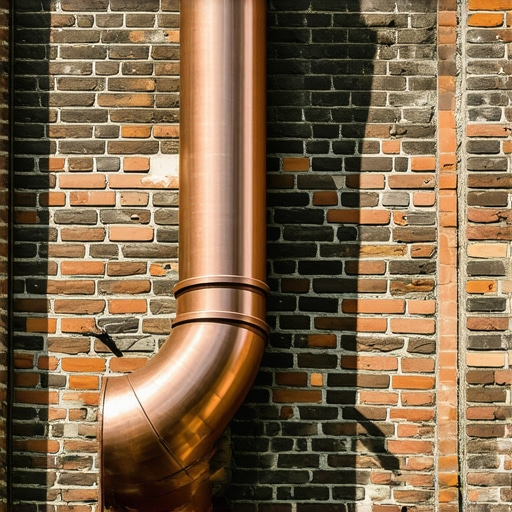
When we talk about round downspout services, we are talking about more than just aesthetics. A round Leader is actually more efficient than a rectangular one of the same width. In a rectangular pipe, water tends to cling to the corners due to surface tension, which can lead to a slower flow and the accumulation of organic silt. A round pipe allows for a vortex effect during high-volume events, moving the water faster through every Elbow and toward the Splash Block or underground drainage system. In historic contexts, these are often paired with copper patina finishes that evolve over time. The chemistry is fascinating: the initial bright orange copper reacts with oxygen to form a brown oxide layer, which then interacts with sulfur and carbon dioxide to create that classic green verdigris. This isn’t just for show; that patina is a sacrificial layer that protects the underlying metal from corrosion, making it a permanent solution for the home.
Hydro-Zooming: The Physics of High-Volume Drainage
In regions prone to heavy storms, such as the coastal South, hurricane-rated installations are a necessity. This involves calculating the wind uplift and the sheer volume of water during a tropical event. During a “gully washer,” a standard five-inch gutter can be overwhelmed in minutes. The water hits the roof, gains velocity, and instead of dropping into the gutter, it shoots right over the edge. This is why we often recommend six-inch or seven-inch oversized gutters for historic restorations in these climates. We also look at roof scupper drains on masonry buildings. If a scupper is too small, water backs up on the roof, adding thousands of pounds of weight that the original timber framing was never meant to support. Our box gutter installation process involves custom-bending metal to fit the architectural profile of the house while ensuring the interior lining is seamless to prevent the very leaks that destroyed the Savannah parlor I mentioned earlier.
“The selection of materials for gutters and downspouts must consider the corrosive nature of the environment and the compatibility of dissimilar metals.” – SMACNA Architectural Sheet Metal Manual
Managing the transition from the roof to the ground requires a multi-step approach. First, we perform old gutter demolition, which must be done carefully to avoid damaging original Soffit woodwork. Once the old, heavy steel or rotting wood gutters are removed, we can inspect the underlying structure. If the wood is sound, we move to the installation of color-matched gutters that respect the historic palette of the building. For homes with secondary structures, we also handle patio cover gutters to ensure that the guest house or veranda isn’t dumping water back toward the main foundation. This is a holistic system where every Miter and End Cap must be sealed with high-grade solar-resistant tri-polymer sealants rather than cheap silicone that will peel away in three years.
Maintenance and Modern Extraction Techniques
The biggest threat to a historic drainage system is neglect. Leaves, twigs, and roofing granules create a dense, acidic sludge that eats through metal and clogs the downspouts. For historic properties with delicate landscaping, we use vacuum gutter extraction. This method avoids the mess of traditional cleaning. Instead of blowing debris onto the garden or the siding, we use high-suction industrial vacuums to pull the sludge out of the gutters and the Leader pipes. This is especially important for round downspout services where an Elbow might have a tight radius that a traditional snake can’t clear. After the system is clear, we test the Pitch with a high-volume water test to ensure there are no “dead spots” where water can sit and stagnate.
Securing Your Legacy with Expert Engineering
Choosing the right contractor for a historic project means finding someone who respects the math as much as the history. We don’t just provide a number; our free gutter quotes processing involves a full site analysis, including roof square footage calculations and an assessment of the local tree canopy. If your home is surrounded by oaks or pines, the drainage strategy must change. We look at the distance between the downspout and the foundation, often recommending extensions or underground piping to move the water at least ten feet away from the crawlspace or basement. Water is the primary enemy of structural integrity. It rots the sills, attracts termites, and can eventually cause the soil to expand and contract so much that the foundation cracks. By installing a high-capacity, historically accurate round downspout system, you are not just beautifying the exterior; you are dry-proofing the future of the home. Whether it is a simple repair or a full-scale replication of 19th-century copper work, the goal remains the same: move the water, save the house, and do it with materials that will outlast the current generation.