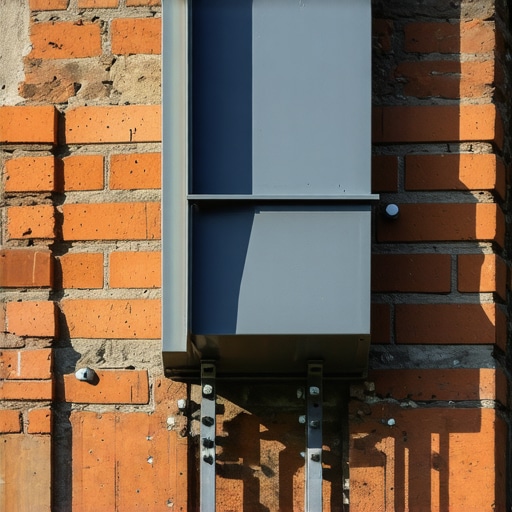
When you have been in the rain management game for over twenty-five years, you stop looking at rain as a natural phenomenon and start seeing it as a relentless hydraulic battering ram. Commercial buildings are particularly vulnerable because of their massive roof surface areas. If you are not engineering your drainage, you are just inviting a slow-motion demolition of your property. I walked around a commercial facility in New Orleans where the corner of the loading dock had dropped three inches into the delta mud. Why? A single 4×5 leader was disconnected at the bottom, dumping five years of tropical rainfall directly into the soil next to the footer. That is thousands of tons of water over time, liquefying the bearing soil. This is exactly why the proper way to secure heavy duty commercial downspouts is not just about keeping a pipe on a wall; it is about protecting the structural integrity of the building. We are talking about total water management, from the starter strip services at the roof edge down to the landscape integration services at the ground level. Any weak link in that chain, and the water wins. Always.
The Physics of High-Volume Water Weight
Most building owners fail to understand the sheer weight of the liquid they are moving. Water weighs roughly 8.34 pounds per gallon. During a standard Gulf Coast storm, a 10,000 square foot roof can shed thousands of gallons in a matter of minutes. When that water enters a 4×5 or 5×6 commercial leader, the column of water inside that pipe becomes a massive, vibrating weight. If your hangers are spaced too far apart or if you are using flimsy retail-grade straps, that kinetic energy will eventually shear the fasteners right out of the masonry.
“Downspouts shall be sized based on the rainfall intensity of the region and the roof surface area.” – International Plumbing Code, Section 1106
We do not just slap these on. We use heavy-duty, two-piece wrap-around straps that encircle the entire pipe. Unlike the thin aluminum straps used in residential aluminum gutter installation, commercial-grade hardware is typically made of thick-gauge galvanized steel or heavy aluminum. In high-wind zones, we double the fastener count. If you are mounting to brick or tilt-up concrete, you need expansion anchors that penetrate at least two inches. Anything less and the wind-load during a hurricane will vibrate those leaders loose, turning them into 20-foot aluminum projectiles.
Old Gutter Demolition and Fascia Integrity
Before we can even talk about the new system, we have to deal with the ghost of the old one. My team often provides old gutter demolition services where we find the real damage hidden behind the metal. When a gutter system fails, water bridges the gap between the back of the gutter and the fascia. Over time, that water rots the wood or corrodes the metal fascia. You cannot secure a heavy-duty downspout to a rotten base. We look for signs of wood rot, failing soffit panels, and compromised rafters. If the fascia is mush, your new storm-resistant gutters will be on the ground before the first season is over. This is also the time to look at the roof edge. Our starter strip services ensure that the transition from the roof deck to the gutter is seamless. If the drip edge is not properly overlapping the back of the gutter, water will track back into the building, causing mold in the wall cavities that you will not see until the drywall starts to soft-spot on the inside. This is why I get grumpy when people ask for a quick install. There is no such thing as a quick install that is also a correct install.
The Role of Conductor Heads in Pressure Regulation
One of the most misunderstood components in commercial drainage is the conductor head. You have probably seen these decorative boxes at the top of downspouts on older buildings or high-end modern designs. They are not just for show. In our conductor head services, we explain that these boxes act as a vacuum break. When a heavy-duty downspout fills completely with water, it can create a siphon effect, literally pulling water off the roof faster than the pitch of the gutter intended. This sounds good, but the resulting pressure can cause the pipe to vibrate violently. A conductor head allows air into the system, breaking the vacuum and ensuring a smooth, gravity-fed flow. It also acts as an overflow point. If the leader becomes clogged with debris, the water spills out of the conductor head and away from the building, rather than backing up onto the roof and into the soffit. When we perform half-round gutter installation on commercial properties, the conductor head is a critical junction for managing the transition from the horizontal run to the vertical leader.
Modern Trends and Aesthetic Durability
Just because a system is heavy-duty does not mean it has to be ugly. We are seeing a rise in bold color gutter trends where the drainage system is a primary architectural feature. But here is the catch: bold colors show every dent and scratch. That is why we use high-build Kynar finishes that resist fading and chalking. Whether it is a deep bronze or a sharp charcoal, the finish must be able to withstand the UV radiation and the abrasive nature of the silt and grit that washes off the roof.
“The design and installation of gutters and downspouts shall comply with the SMACNA Architectural Sheet Metal Manual for sizing and attachment.” – Architectural Standards Reference
This is why we prefer aluminum or copper for these high-visibility projects. They provide the strength needed for storm-resistant gutters while offering a lifespan that exceeds galvanized steel. We also integrate attic vent installation during these phases to ensure that the moisture being managed on the outside is not being matched by condensation on the inside. A building is a breathing organism; you have to manage the airflow just as carefully as the water flow.
Final Integration: From Leader to Landscape
The job does not end at the bottom elbow. One of the biggest mistakes in commercial construction is dumping the leader right onto a splash block next to the foundation. You are just moving the problem three feet away. Our landscape integration services focus on getting that water into a controlled underground system. We use heavy-wall PVC or HDPE pipe to carry the water to a dry well, a retention pond, or the municipal storm sewer. We often install pop-up emitters in the turf that remain flush until the water pressure from a storm forces them open. This prevents the swampy yard effect and keeps the soil around the foundation at a consistent moisture level. This prevents the soil from shrinking and swelling, which is the primary cause of foundation cracking. From the mitered corners of the gutters to the end cap on the last run, every detail matters. If you ignore the science of water, you are just waiting for a disaster. Secure your leaders with the right hardware, ensure your pitch is a minimum of 1/4 inch per 10 feet, and never, ever trust a plastic strap to hold up 160 pounds of moving water.