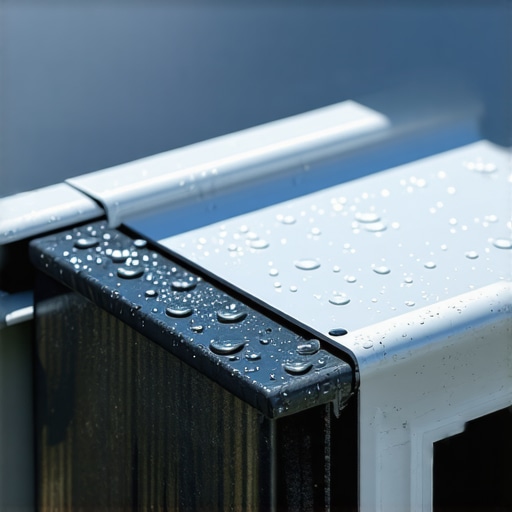
The Invisible Enemy Behind Your Fascia Board
In my 25 years of standing on ladders, I have seen more foundations destroyed by a five cent gap in a gutter joint than by any hurricane or flood. Most homeowners think a gutter is just a trophy piece of metal hanging from the roof, but it is actually a high-precision hydraulic channel. When that channel fails at the joints, the results are catastrophic. Most contractors will slap some cheap thermoplastic or silicone caulk into a miter and call it a day. That is a temporary patch, not a solution. Within two seasons of thermal expansion, that caulk will peel away like a dead sunburn, leaving your home vulnerable to rot.
The $40,000 Leak: A Cautionary Tale from the Field
I once inspected a property in the humid Appalachian corridor where the owner complained of a musty smell in the basement. I walked around the northwest corner and saw the telltale sign: a faint, dark stain running down the fascia board directly behind a corner miter. A single joint had been ‘repaired’ three times with standard joint sealant repair tubes. Because the metal expands and contracts at a different rate than the sealant, the bond had sheared. This allowed water to travel via capillary action behind the gutter, through the soffit, and down the interior of the wall cavity. By the time I arrived, the corner of the foundation had settled by nearly three inches because the soil was perpetually saturated. One failed joint turned into a forty thousand dollar structural repair. This is why I refuse to use anything other than EPDM gaskets for professional storm-resistant gutters.
“Joints and seams in metal gutters should be mechanically fastened and sealed to prevent leakage and allow for thermal movement.” – SMACNA Architectural Sheet Metal Manual
The Physics of Failure: Why Sealants Peel
To understand why EPDM (Ethylene Propylene Diene Monomer) is superior, you have to understand the physics of a gutter run. A 50-foot stretch of aluminum can expand or contract by over half an inch depending on the temperature swing between a freezing night and a direct-sun afternoon. When you use a liquid-applied sealant, you are asking a thin film of chemicals to act as both a glue and a bridge. As the metal moves, it exerts ‘shear stress’ on that film. Eventually, the bond fails at the edges. Once a microscopic gap opens, water surface tension pulls moisture into the crack. In cold climates, that water freezes, expands, and rips the joint further apart. This is why recycled plastic gutters often fail even faster; their expansion coefficient is even more volatile than metal.
Hydro-Zooming: The EPDM Molecular Advantage
EPDM is not a glue; it is a synthetic rubber gasket used in high-pressure industrial applications. When we install EPDM seals in a gutter miter or end cap, we are creating a mechanical compression seal. Instead of relying on adhesion to a surface that is constantly moving, the EPDM stays flexible down to negative 40 degrees Fahrenheit. It does not crack, and it is largely immune to UV degradation, which is the primary killer of powder-coated gutter finishes and their underlying seals. If you are serious about rainwater harvesting gutters, you need a seal that won’t leach chemicals into your collection barrels and won’t leak your precious resource into the ground. EPDM provides a watertight lock that actually tightens as the metal moves against it.
“Downspouts shall be sized based on the rainfall intensity of the region and the roof surface area.” – International Plumbing Code, Section 1106
The Total Water Management Audit
A gutter system is only as strong as its weakest link. While EPDM solves the joint issue, you must look at the entire drainage hierarchy. This includes proper kickout diverter installation at any roof-to-wall intersection. Without a kickout diverter, water bypasses the gutter entirely and dives straight into your siding. Furthermore, the pitch must be precise. I aim for a slope of 1/4 inch for every 10 feet of run. If the pitch is off, you get standing water, which leads to sludge buildup and mosquito breeding grounds. Even the best EPDM-sealed system will fail if it is weighed down by fifty pounds of wet oak leaves. This makes regular gutter debris removal and roof gutter sweeping non-negotiable parts of home ownership. If you have heavy tree cover, you might also consider bird spike gutter protection to prevent nesting in the leaders, which can cause immediate backups during a heavy downpour.
The Leader and the Splash Block: The Final Exit
The water’s journey does not end at the end cap. The leader (downspout) must be able to handle the velocity of a heavy storm. I always recommend 3×4 inch oversized downspouts over the standard 2×3 versions. Once the water hits the ground, it needs to be moved at least six feet away from the foundation using a splash block or an underground extension. If you are tired of chasing leaks every spring, it is time to stop buying tubes of caulk and start looking at engineered solutions. Our free gutter quotes processing includes a full evaluation of your current joint integrity and slope accuracy. Remember, water is a patient predator; it only needs one small gap to start eating your home. Don’t give it that chance by settling for anything less than a mechanical EPDM seal.