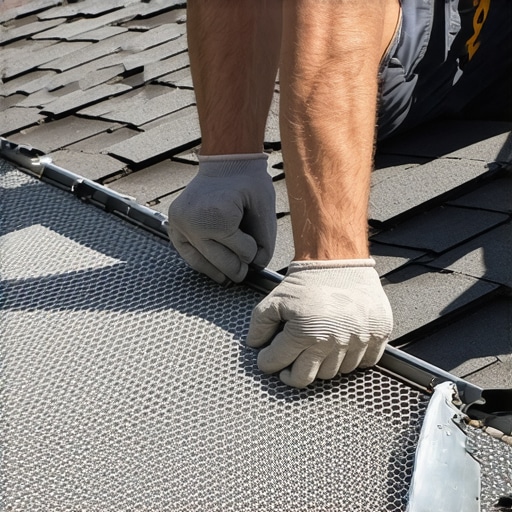
The False Promise of Zero Maintenance and the Reality of Water Management
I have spent over two decades climbing ladders and inspecting the damage caused by poorly conceived drainage systems. The industry is flooded with marketing that promises you will never have to clean your gutters again once you install a specific screen or guard. This is a dangerous lie. As a specialist who focuses on the engineering of water management, I view your gutters as the primary defense mechanism for your foundation. When we talk about installing gutter screens, we are not just talking about keeping leaves out. We are talking about maintaining the structural integrity of your fascia and ensuring that the hydro-dynamics of your roof remains intact. If you install these screens incorrectly, you risk more than just a clog. You risk voiding the warranty of your roof and inviting rot into your soffit. I have seen countless homeowners lose thousands of dollars because an amateur installer shoved a screen under the shingles, breaking the seal of the starter course and inviting capillary action to draw water directly into the roof deck.
“Gutter systems must be designed to withstand the anticipated snow load and wind forces for the local climate zone, with particular attention to the fastening schedule.” – SMACNA Architectural Sheet Metal Manual
The Micro-Mesh Peat Moss Farm: A Cautionary Tale
Last autumn, I was called out to a residence where the homeowner had invested heavily in a high-end micro-mesh system. They were told it was the ultimate solution. When I got up there, I didn’t find the usual handful of leaves. Instead, I found a thriving ecosystem of pine needle silt and organic decomposition that had formed a literal carpet of peat moss. This organic sludge had blocked the apertures of the mesh entirely. During a heavy downpour, the water didn’t enter the gutter at all. Instead, it hit the mesh, followed the path of surface tension across the top of the guard, and cascaded over the edge like a waterfall. This sheet-flow was hitting the ground with such velocity that it had eroded a trench three inches deep right next to the foundation. This is why the selection of your guard must match your specific tree cover. A perforated plate might handle oak leaves, but it will fail miserably against the fine needles of a white pine or the sticky pollen of a birch tree. When we talk about professional ladder safety, we aren’t just talking about not falling. We are talking about the ability to safely access these systems for the inevitable spring gutter startup and periodic maintenance that every system requires.
Hydro-Zooming: The Physics of the Flow
To understand why most screens fail, you have to understand the physics of moving water. During a standard rain event, water moves down your roof slopes at a relatively low velocity. It enters the trough easily. However, during a severe storm, the flow velocity increases exponentially. This is where surface tension becomes your enemy. If a screen is installed with too steep of a pitch, the water will simply bridge the gap and overshoot the gutter entirely. This is why hidden hanger systems are so critical. Unlike the old-fashioned spikes and ferrules which eventually pull out of the wood as the fascia expands and contracts, hidden hangers provide a mechanical lock that maintains the correct pitch of the gutter even under heavy snow loads. In northern climates, the weight of ice and snow can easily reach several hundred pounds per linear foot. If your hangers aren’t spaced every twelve inches, the weight will pull the gutter away from the house, creating a gap. Water will then find its way behind the gutter, rotting the fascia and eventually the rafter tails. We often integrate snow melt gutter solutions like heat cables directly into the trough before the screen is installed to prevent the formation of ice dams that could otherwise tear the entire system off the building.
The Technical Integration: TPO Roof Gutter Flashing and Scuppers
On more complex residential designs involving flat roof sections, the interface between the roofing material and the gutter is a common point of failure. Proper TPO roof gutter flashing is a surgical procedure. You cannot simply overlap materials and hope for the best. The TPO membrane must be heat-welded or properly terminated into the gutter flange to ensure a watertight seal. This is especially true when dealing with scupper installation. A scupper is essentially a transition point that directs water through a parapet wall into a leader or a collector box. If the scupper is not lined correctly, water will seep into the wall cavity, causing hidden rot that you won’t see until the drywall inside your home starts to bubble. When we perform old gutter demolition on these structures, we often find that the previous contractors skipped the flashing entirely, relying on caulk that dried out and cracked within two seasons. This is why a professional gutter maintenance plan is worth every penny. It includes the inspection of these critical transition points before they become five-figure repairs.
“Roof drainage systems shall be installed in accordance with the plumbing code and this section. Flashings shall be installed in a manner that prevents moisture from entering the wall and roof through joints in copings, through moisture-permeable materials and at intersections with dissimilar materials.” – International Building Code, Section 1503.4
Material Selection: Copper Patina Finishes and Aesthetics
For high-end homes, the choice often comes down to aluminum versus copper. While seamless aluminum is the workhorse of the industry, nothing beats the longevity of copper. Over time, copper develops a beautiful patina that protects the metal from further corrosion. However, installing screens on copper systems requires specialized knowledge. You cannot mix metals. If you put an aluminum screen on a copper gutter, galvanic corrosion will eat through the materials in a matter of years. We use copper or stainless steel mesh to ensure compatibility. The miter joints in these systems must be soldered, not just caulked. A soldered miter is a permanent bond that will never leak, unlike the common corner pieces found at big-box stores. This attention to detail extends to the end cap and the splash block at the bottom of the leader. Every component of the system must be engineered to move water away from the structure as efficiently as possible. This includes considering automated cleaning systems that use high-pressure air or water to clear the mesh from the ground, though these are still a developing technology in the residential sector.
Protecting Your Warranty During Installation
The most important part of installing gutter screens is where they touch the roof. Most roofing manufacturers will void your warranty if you drive fasteners through the shingles or lift the starter course in a way that breaks the adhesive seal. The correct way to install these guards is to use a system that attaches only to the gutter and the fascia, or one that slides under the shingles without requiring nails or screws into the roof deck. We look for systems that maintain the original drip edge profile. The drip edge is there to ensure that water falling off the roof shingles is directed into the center of the gutter trough. If your screen interferes with this flow, you are looking at a failure. By sticking to a rigid installation protocol that respects the building envelope, you ensure that your home stays dry and your warranties remain valid. It is about the long-term health of the building, not just the convenience of avoiding a ladder for a few months. Professional drainage is an investment in your home’s future, and cutting corners with cheap screens is the fastest way to undermine that investment.