The Gravity Problem Beneath Your Downspout
As a veteran drainage specialist who has spent more than twenty-five years diagnosing saturated foundations, I view every rainstorm as an engineered assault on your home. When rain hits your roof, it concentrates into a raging torrent. By the time that water travels down your downspout, it has accumulated mass, velocity, and destructive kinetic energy. What happens when that concentrated stream hits the ground determines whether your basement stays dry or your foundation begins to crack and sink.
I walked around a house in Ohio last spring where the northeast corner of the foundation had settled nearly two inches, cracking the interior drywall and jamming the basement door shut. The culprit was not a complex geological shift. It was a single, lightweight green plastic splash block that had been flipped over by a leaf blower three years prior. With every heavy rain, thousands of gallons of water shot directly out of the leader, drilling a deep hole into the clay soil right against the foundation wall. Over thirty-six months, that water saturated the subgrade soil, stripped its load-bearing capacity, and caused the structural footings to sink.
“Stormwater management systems shall be designed to direct water away from the foundation of the structure to prevent soil saturation and structural settlement.” – International Building Code, Section 1804
The Physics of Water Dispersion: Rock vs. Plastic
Most homeowners purchase plastic splash blocks because they cost ten dollars at a big-box store. But from an engineering standpoint, plastic is a complete failure under hydraulic stress. Plastic blocks are light. They migrate during heavy downpours, they flip over from wind, they degrade from ultraviolet radiation, and they offer zero friction to slow down high-velocity water. When a storm-resistant gutters system dumps fifty gallons of water per minute down a leader, a plastic splash block simply floats or moves, allowing water to pool right next to your crawlspace or basement.
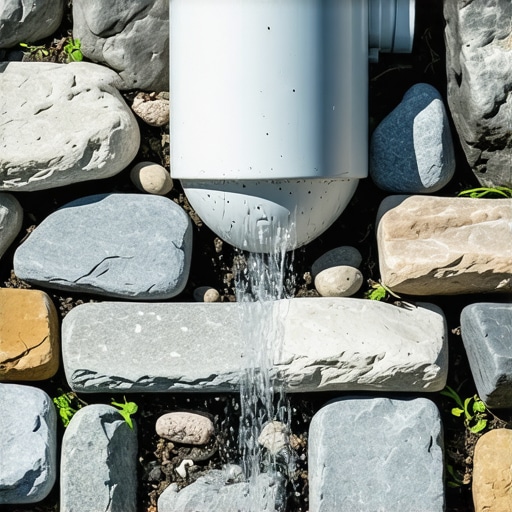
Natural stone or heavy concrete rock splash blocks rely on mass and surface texture. A thirty-pound stone block cannot be displaced by wind, lawnmowers, or heavy downpours. The natural, rough texture of split stone or aggregate concrete creates turbulent flow. Instead of allowing water to shoot off the end in a unified, erosive stream, the irregular surface of the rock breaks the surface tension of the water, scatters its kinetic energy, and diffuses the velocity. The water is transformed from a destructive jet into a gentle, sheet-like flow that spreads harmlessly over the surrounding turf or soil.
The Critical Role of Proper Downspout Installation and Extension
A splash block is only as good as the system feeding it. During a professional downspout installation, we calculate the roof area to ensure the leader size can handle peak rainfall intensity without backing up. If you have a complex roofline, such as a metal roof gutter transition, the velocity of the runoff is even higher. Metal roofs shed water instantly compared to asphalt shingles, meaning your gutters must handle a massive volume of water in a fraction of the time. In these scenarios, a standard plastic splash block is completely useless.
For homes with massive roof sections or steep pitches, standard downspout extension services are required to carry water at least six to ten feet away from the foundation before it even touches a splash block. When we install these systems, we often integrate a gutter apron aluminum strip at the roof edge to prevent water from backing up behind the fascia. If you are dealing with historic materials, such as slate roof gutter care, you must ensure that the heavy volume of water draining from these dense roofs is managed with heavy-duty hangers and robust stone dispersion points at the ground level.
“Roof drainage water shall be discharged to a dedicated drainage system or to the ground surface at least 5 feet from the foundation walls.” – International Residential Code, Section R401
Solving Complex Drainage Scenarios
Every home has unique structural challenges that affect how water behaves at the foundation line. If you have a sagging gutter fix that has recently been completed, you might find that water is now rushing toward a downspout that previously received very little flow. This sudden increase in water volume can overwhelm your old landscaping. Similarly, when handling an awning gutter integration, water is often discharged into tight pathways or near patios where soil erosion must be prevented at all costs. Using a heavy rock splash block in these tight zones keeps the water on its proper path.
In colder northern climates, drainage systems face the threat of freezing. When using heated gutter cables, water is kept liquid as it travels down the fascia and through the downspout, preventing ice dams. However, once that liquid water hits a freezing cold plastic splash block, it instantly pools and freezes into a dangerous sheet of ice. A dark, natural stone splash block absorbs solar heat during the winter, helping to melt ice and keep the discharge path clear. For homes with heavy tree canopies, organic debris can clog downspouts, leading to localized overflows. Routine vacuum gutter extraction is necessary to keep the system flowing, ensuring water actually exits through the downspout onto your heavy rock splash block rather than spilling over the sides of your gutters.
The Long-Term Foundation Protection Plan
To protect your home from hydrostatic pressure and structural shifting, you must treat your gutter and drainage system as a single cohesive unit. The journey of a raindrop starts at your ridge cap, flows down your shingles, enters your gutters, flows through the miters and elbows of your leaders, and must be deposited safely away from your crawlspace. Upgrading your ground-level dispersion from cheap plastic to heavy rock splash blocks is the simplest, most effective insurance policy you can buy to protect your foundation from water damage.