The Myth of the Maintenance-Free Guard and the Physics of Liquid Adhesion
For twenty-five years, I have listened to homeowners complain about the relentless chore of scaling ladders to scoop out rotting sludge. They are lured by slick marketing promises of permanent, maintenance-free gutter protection. The truth is quite different. No system is completely self-cleaning, but there is a massive difference in how different designs handle debris over time. While mesh filters and perforated screens frequently clog with pollen paste, surface tension screens rely on a fluid dynamic principle that keeps them remarkably clean without the need for high-pressure blasting.
I went up on a roof in Portland where the homeowner had spent nearly six thousand dollars on micro-mesh guards under a canopy of dense Douglas firs and maples. Within three years, the micro-mesh was completely sealed over by a hard, baked-on crust of pollen, fine evergreen needles, and tree sap. The water could not penetrate the mesh; instead, it cascaded over the edge like a waterfall, rot-staining the fascia and eroding the landscaping below. Had they installed a system based on liquid adhesion, the water would have followed the curved nose of the guard while the debris fell clear over the edge. Understanding the physics of how water behaves on metal surfaces explains why these specialized guards are so resilient.
“Where leaf-guzzling guards or screens are utilized, they must be designed and installed so as not to impede the flow of water into the gutter system or cause overflow during design storm events.” – International Building Code, Section 1503
The Science of Surface Tension: How Water Clings and Debris Drops
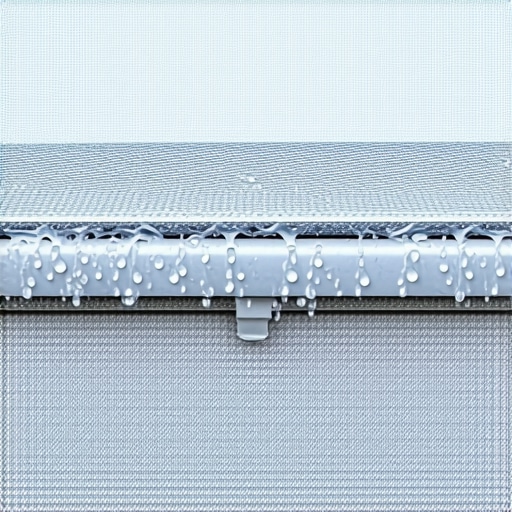
Surface tension screens, often referred to as solid hood guards, operate on the principle of fluid dynamics known as the Coandă effect. Water naturally clings to the curved metal surface as it flows down the roof. As the stream reaches the nose of the guard, it wraps around the radius, slipping through a precise horizontal slot and dropping into the gutter trough below. Leaves, pine needles, and heavy twigs, however, do not possess the same surface tension. Their momentum carries them straight off the edge, falling harmlessly to the ground.
Because the top surface of a solid hood guard is solid metal or heavy aluminum rather than a porous screen, organic matter cannot become woven into the material. On a standard mesh guard, tiny fibers from seed pods and organic debris get trapped in the microscopic openings. This creates a perfect scaffold for moss and algae to take root, requiring regular, aggressive cleaning. Solid hoods do not present these anchoring points, keeping the water path clear with minimal intervention.
The Menace of High-Pressure Washing on Gutter Systems
When homeowners see built-up dirt on their gutter guards, their first instinct is to pull out a pressure washer. This is a critical mistake. Blasting a high-pressure water stream at your roofline can cause severe damage. The force easily blows past the starter strip services, forcing water backward under the shingles and saturating the roof deck. It can also warp the aluminum panels, ruin the pitch of your gutter runs, and break the seals at your miters.
Furthermore, high-pressure water can strip the protective paint coating off the metal or force grit inside the gutter machine forming joints, creating premature wear points. Because surface tension screens are non-porous on their top surface, any light pollen or dust that accumulates is naturally washed away by the next heavy rainfall. If cleaning is ever required, a simple rinse with a garden hose and a soft-bristle brush is more than enough to restore the system to peak performance.
“Gutter systems shall be secured to the structure with approved hangers spaced at intervals not exceeding 36 inches, or closer where snow load or heavy rainfall intensity dictates.” – SMACNA Architectural Sheet Metal Manual, Section 1.3
Optimizing Your Water Management System: Beyond the Guards
A high-performing gutter guard is useless if the underlying drainage system is poorly engineered. Proper water management requires a holistic approach that starts at the roofline and ends far from your home’s foundation. During heavy storms, water volume can overwhelm poorly sized systems, making gutter overflow prevention a top priority for protecting your crawlspace or basement.
- Correct Pitching: Gutters must be sloped precisely at one-quarter inch of drop for every ten feet of run. Poorly pitched systems allow standing water to accumulate, leading to rust, mold growth, and mosquito breeding grounds.
- Oversized Downspouts: Standard two-by-three-inch downspouts are easily choked by small debris. Upgrading to three-by-four-inch leaders increases water carrying capacity significantly and prevents back-ups.
- Leader Box Gutters: These boxes act as catch basins at the top of your downspouts, helping to regulate water velocity and prevent airlocks within the drainage line.
- Rock Splash Blocks & Relocation: Water exiting a downspout must be directed away from the foundation. Using heavy rock splash blocks prevents soil erosion, while professional downspout relocation ensures runoff is directed toward natural drainage swales.
Professional Installation and Structural Longevity
Homeowners facing issues with old, saggy systems often benefit from professional gutter repair services or a brand new installation. Modern contractors utilize on-site gutter machine forming to create continuous, seamless runs of aluminum customized to the exact dimensions of your roofline. This eliminates the weak seams found in retail sectional kits that inevitably leak over time.
For historical homes or unique architectural designs, built-in gutter systems (sometimes called box or trough gutters) require specialized knowledge to seal and maintain. Regardless of the system, secure fastening is critical. We use heavy-duty screw hangers spaced every eighteen to twenty-four inches, driving them directly through the soffit and fascia into the rafter tails. This ensures your gutters will not sag under heavy snow loads or torrential downpours. To make these essential upgrades accessible, many professional contractors now offer flexible financing for gutter installs, allowing you to protect your home’s foundation before major damage occurs.