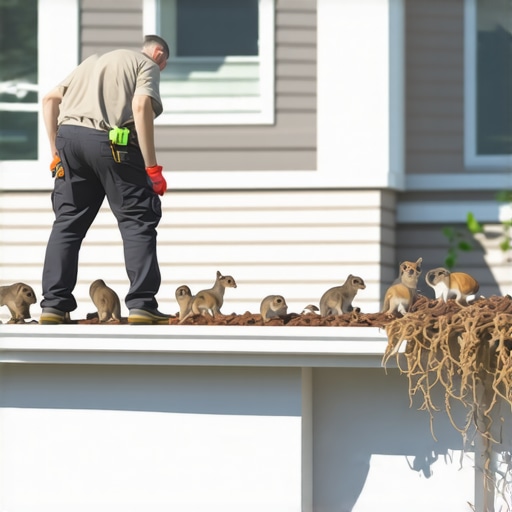
The War Against Water and Wildlife
I’ve spent over two decades staring at the edge of a roofline, and if there is one thing I have learned, it is that nature never sleeps. Most homeowners view their gutters as a simple aluminum trough meant to catch rain. I see a complex hydraulic system that is constantly under siege. When we talk about Removing Pests? Gutter Animal Removal Tips for 2026 Homes, we aren’t just talking about shooing away a few squirrels. We are talking about preventing the total structural failure of your home’s envelope. I once walked a property in a heavily wooded suburb where the entire corner of the foundation had shifted nearly three inches. The culprit? A single family of starlings had built a dense, straw-heavy nest inside a roof scupper drain. During a particularly nasty spring deluge, that nest acted like a high-pressure plug. Water backed up, surged over the miter, and sat against the fascia until the wood rotted through, eventually dumping five years of concentrated runoff directly into the footer. That is how a $50 bird problem becomes a $30,000 foundation repair.
“The capacity of a gutter is dependent on its size, shape, and slope. If the flow is restricted by debris or foreign objects, the hydrostatic pressure can lead to structural leakage.” – SMACNA (Sheet Metal and Air Conditioning Contractors’ National Association)
The Physics of Pest Infiltration
Why do birds and rodents love your gutters? It’s not just the height; it’s the micro-climate. In 2026, as we see more extreme weather shifts, animals are seeking the stability of a managed roofline. But here is the Hydro-Zoom technical reality: when a bird builds a nest in your elbow or leader, they are fundamentally altering the flow velocity of the water. Water is heavy—roughly 8.34 pounds per gallon. During a heavy downpour, a standard 50-foot run of gutter can be carrying hundreds of pounds of moving liquid. When that water hits a pest-related obstruction, the kinetic energy has to go somewhere. It creates a ‘back-surge’ that forces water under your shingles or into the soffit. This is why two-story gutter services are critical; the higher the drop, the more pressure builds up if there is a clog at the bottom.
Integrated Defense Systems: Bird Spikes and Beyond
To truly protect a home, you need to think like an engineer, not a gardener. Bird spike gutter protection is often misunderstood. It isn’t about hurting the birds; it is about breaking the landing pattern. If a bird cannot land on the edge of the end cap, they cannot scout for a nesting site inside the trough. We integrate these spikes with hurricane-rated installations to ensure that high-velocity winds don’t turn your pest protection into flying shrapnel. For the 2026 home, we are also seeing a massive shift toward EPDM gutter seals. Unlike the cheap caulking of the past that squirrels can gnaw through like a piece of cedar, EPDM provides a synthetic rubber barrier that maintains its integrity under thermal expansion and animal interference.
The Drainage Hierarchy: Moving Water (and Pests) Away
If you have pests in your gutters, you likely have a moisture problem on the ground. Landscape integration services are now a core part of the drainage conversation. If your splash block is sitting in a pool of stagnant water, you are inviting every mosquito and rodent in the county to set up shop. This is why I always advocate for underground downspout drainage. By piping the water ten to twenty feet away from the foundation and using a pop-up emitter, you remove the ‘watering hole’ effect that attracts pests to the base of your home. This system should be coupled with gutter maintenance plans that include seasonal inspections of the pitch and slope. A gutter that holds even a quarter-inch of water due to a saggy hanger is a breeding ground for problems.
“Secondary (emergency) roof drains or scuppers shall be provided where the roof perimeter construction extends above the roof in such a manner that water will be entrapped.” – International Plumbing Code, Section 1106
2026 Technology: Automated and App-Controlled Systems
We have moved beyond the ladder and bucket. Modern high-end homes are now utilizing automated cleaning systems that use high-pressure air or water bursts to clear light debris before it can form a pest-attracting dam. In colder climates where ice dams provide the perfect shelter for wintering rodents, app-controlled gutter heaters are a necessity. These aren’t just heat tapes thrown into the trough; they are calibrated thermal sensors that you can monitor from your phone. If you see a temperature drop that suggests ice formation—which expands and pulls your fascia away from the rafters—you can activate the system to maintain a clear path for runoff. This prevents the ‘cave’ effect that squirrels love during a freeze.
The Verdict: Professional Engineering vs. DIY
You can buy cheap plastic guards at a big-box store, but they are often just a ‘Gutter Guard Garden’ waiting to happen. Pests love the cover these cheap guards provide. Real protection comes from a system-wide approach: heavy-duty hangers spaced every 12 inches, oversized 3×4 leaders to allow debris to pass, and professional-grade spikes to deter avian nesting. Water is the most destructive force your home will ever face. Don’t let a three-ounce bird be the reason your foundation fails. Maintenance is a requirement of homeownership, but with the right engineering, you can reduce the frequency and the stress of the job.