The Cost of Underestimating the Sky
I remember a call I took three years ago in a neighborhood where every house looked like a million bucks but smelled like a wet basement. The homeowner was frantic because his finished basement, complete with a high-end theater system, had four inches of standing water. I walked outside, and the culprit wasn’t a broken pipe or a sump pump failure. It was a single kickout diverter that had never been installed where the roofline met the siding, combined with a 5-inch gutter system trying to handle a 40-square roof. That lack of a ten-dollar part and an extra inch of aluminum cost that man $45,000 in remediation. Water doesn’t just fall; it attacks. If your drainage system isn’t engineered for the specific hydraulics of your roof, you aren’t protected—you’re just waiting for the next ‘hundred-year storm’ that now seems to happen every third Tuesday.
The Physics of the Waterfall: Why Standard Sizing Fails
Most contractors still use the ‘rule of thumb’ method: five-inch gutters for houses, six-inch for commercial. That logic is as outdated as using spikes and ferrules to hang your troughs. In 2026, we are seeing rainfall intensities that laugh at standard 5-inch systems. When a heavy cell moves through, the flow velocity off a steep 10/12 or 12/12 pitch roof is so high that the water actually develops enough kinetic energy to leap right over the outer rim of the gutter. This isn’t just a nuisance; it’s a structural threat. When water overshoots, it lands directly against your foundation, saturating the soil and increasing hydrostatic pressure until your basement walls start to bow.
“Design of drainage systems shall be based on the 100-year hourly rainfall rate… or other data provided by the local authority.” – International Plumbing Code, Section 1106
To stop the overflow, we have to look at the Roof Square Footage and the Pitch Factor. A flat roof of 1,000 square feet is one thing, but tilt that same roof to a 45-degree angle, and you’ve significantly increased the speed at which that water reaches the eave. We calculate the Adjusted Square Footage by multiplying the actual area by the pitch factor (ranging from 1.0 for flat to 1.3 for steep slopes). If your adjusted square footage exceeds the capacity of a standard 2×3 leader, you’re going to have a backup, regardless of how clean your gutters are.
The Gutter Management Audit: Analyzing the Components
A true water management system is a chain, and it’s only as strong as its weakest miter. When I perform a gutter repair service, I’m not just looking for holes; I’m looking at the system’s architecture. Vinyl gutter repair is often a fool’s errand because the material expands and contracts so violently that the seams inevitably fail. For 2026, we recommend seamless aluminum or, for heritage properties, copper patina finishes that offer longevity measured in centuries, not seasons.
The Crucial Role of the Kickout Diverter
If you have a roofline that ends against a vertical wall—common in many modern suburban designs—you must have a kickout diverter installation. Without it, water follows the roof edge and is sucked behind the siding through capillary action. It rots the fascia, the soffit, and eventually the wall studs. I’ve seen barn gutter repair jobs where the entire side of a structure had to be rebuilt because a simple diverter was missing. It is the most ignored piece of flashing in the industry, and its absence is the #1 cause of hidden water damage.
Leaders and Downspouts: The Exhaust System
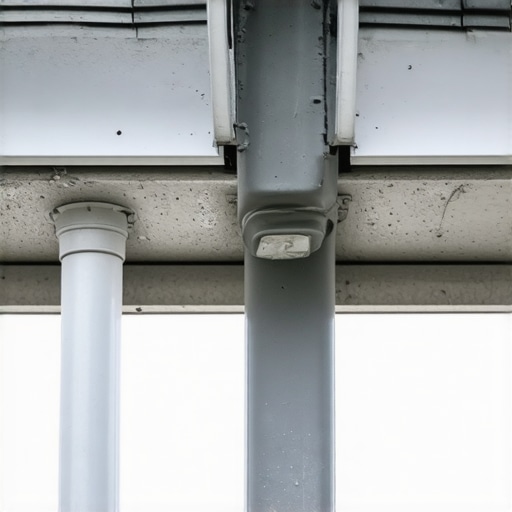
Think of your leaders (downspouts) as the exhaust system of your roof. If you have a massive engine but a tiny tailpipe, the system chokes. Moving from a 2×3 downspout to a 3×4 increases drainage capacity by over 50%. This is often the simplest gutter profile customization a homeowner can make to solve overflow issues without replacing the entire run. We also look at landscape integration services. Dumping all that water at the corner of your house is a recipe for disaster. You need splash blocks at a minimum, but ideally, the leaders should tie into a 4-inch PVC underground line that carries the water at least ten feet away from the foundation.
Climate Context: Ice, Snow, and Heavy Volume
In northern climates, the enemy changes from volume to weight. Heated gutter cables are no longer a luxury; they are a necessity to prevent ice dams. When snow melts on the upper roof and refreezes in the gutter, it creates a dam that forces water back up under the shingles. This weight can also rip hangers right out of the wood. This is why we space our hangers every 12 inches in snow zones, rather than the industry-standard 24 or 36 inches. For those looking at gutter removal services, the goal should be to upgrade the structural integrity, not just the appearance.
“Gutter hangers shall be of a type and spacing compatible with the expected snow and ice loads of the region.” – SMACNA Architectural Sheet Metal Manual
The Maintenance Reality
Even the most perfectly engineered system needs a check-up. Gutter leak repair usually starts at the end caps or the seams. If you’re tired of the ladder, consider gutter repair services that specialize in high-flow systems. Avoid the cheap plastic guards from big-box stores; they often act as a shelf for debris to sit on, effectively turning your gutter into a planter box. Instead, focus on landscape integration that allows for natural drainage and minimizes the organic load entering the system. Whether you are dealing with a barn gutter repair or a copper patina finish on a custom estate, the math remains the same: Water must be captured, contained, and conveyed away from the structure with zero exceptions.
Reading this post really opened my eyes about the importance of proper gutter sizing and installation. I’ve seen firsthand how neglecting details like kickout diverters and insufficient downspouts can lead to costly water intrusion issues, especially during heavy rainfalls. I agree with the emphasis on customizing gutter size based on roof pitch and potential rainfall intensity rather than relying on outdated ‘rules of thumb.’ The mention of seamless aluminum and copper finishes is interesting; I’ve worked on some heritage properties where durability is crucial, and those materials make a big difference over time. One thing I’ve struggled with is convincing homeowners to invest in upgrades like larger leaders or landscape drainage, especially when they see it as extra expense. Has anyone found effective ways to demonstrate the long-term savings and prevention of structural damage? I’d love to hear strategies for encouraging proactive improvements rather than reactive repairs after damage occurs.