The Invisible Enemy: Hydrostatic Pressure and Your Home
I’ve spent the last quarter-century crawling through muddy crawlspaces and balancing on ladders in thunderstorms, and if there is one thing I have learned, it is that water is a patient killer. Most homeowners look at a downspout and see a pipe; I see a localized fire hose that is actively trying to excavate a hole under your footer. When we talk about foundation erosion, we aren’t just talking about a little dirt moving around. We are talking about the structural integrity of your biggest investment. In 2026, the trend has finally shifted back to physics-based solutions over cheap plastic gimmicks. This is why rock splash blocks—specifically engineered heavy aggregate systems—are winning the war against the wet basement.
I remember a job back in 2019 on a hillside property in the suburbs. The homeowner called me out because their basement was smelling like a locker room, and they had a crack in the drywall that was wide enough to fit a nickel. I walked the perimeter and found the culprit: a $5 plastic splash block that had been tossed aside by a lawnmower three years prior. For three seasons, the leader (the downspout) had been dumping 800 gallons of water per hour of heavy rain directly against the fascia and then into a concentrated point at the corner of the foundation. The soil was so saturated it had liquified, causing the corner of the house to settle two inches. It was a $15,000 repair that could have been avoided with a $50 rock splash block and a proper French drain connection.
“Downspouts shall be sized based on the rainfall intensity of the region and the roof surface area.” – International Plumbing Code, Section 1106
The Physics of the Plunge: Why Plastic Fails
When water exits your gutter system, it has velocity. If you have a two-story home, that water has fallen 20 feet. By the time it hits the ground, it is carrying significant kinetic energy. Standard gutter repair services often overlook the discharge point, but that is where the most damage occurs. A lightweight plastic splash block is a joke. During a “gully washer,” the volume of water is so high that it creates surface tension issues, causing the water to skip right over the plastic and scour the earth beneath it. Furthermore, plastic degrades under UV rays. Within two seasons, it becomes brittle, cracks, and starts leaking water through the middle, defeating the entire purpose.
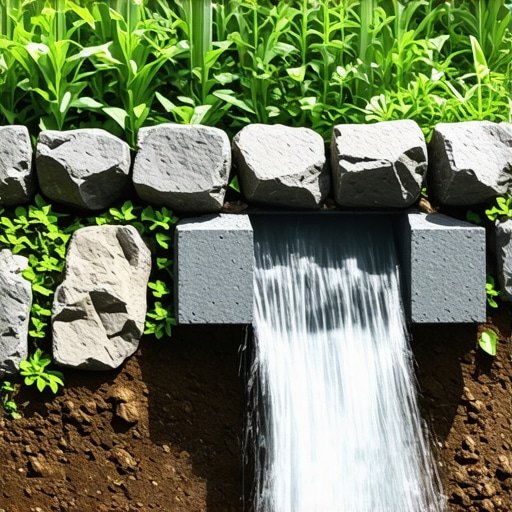
Rock splash blocks, or heavy-duty stone basins, work on the principle of energy dissipation. When that high-velocity stream hits a bed of river rock or a textured stone surface, the water is forced to break its path and spread out. This reduces the velocity and allows the water to seep into the ground slowly or enter a French drain connection without creating a massive borehole. We are seeing more metal roof gutter transitions where the water speed is even higher than asphalt shingles; in these cases, a rock bed is the only thing standing between you and a collapsed soffit or eroded landscaping.
Engineering the Flow: From Scuppers to Leaders
Many modern homes, especially those with flat sections or parapet walls, utilize roof scupper drains. These are high-volume exit points that can dump a staggering amount of water in a short window. If you are relying on spike and ferrule repair to keep your gutters attached under this kind of weight, you are asking for a disaster. Spikes pull out of the wood over time as the fascia swells and shrinks. In my shop, we only use heavy-duty screw-in hangers spaced every 12 inches for high-flow areas. This ensures that the pitch—that crucial 1/4 inch of slope for every 10 feet of run—remains consistent even when the system is under a full hydraulic load.
If you are managing a larger structure, such as a barn gutter repair, the scale of water management increases exponentially. A barn roof can catch enough water to fill a swimming pool in a single afternoon. This is where financing for gutter installs becomes a smart move rather than a luxury. You need 6-inch or 7-inch oversized seamless gutters and 3×4 leaders to handle the sheer volume. Without a rock-stabilized discharge area, that volume of water will turn your barnyard into a swamp, rotting the posts and compromising the building.
“Gutters and downspouts shall be maintained in a manner to prevent the accumulation of moisture against the foundation of a building.” – SMACNA Architectural Sheet Metal Manual
Protection Beyond the Water: Birds and Leaves
It isn’t just the water you have to worry about; it’s the debris that turns your gutters into a garden. I’ve seen leaf guard systems that work wonders and others that are nothing more than a shelf for moss to grow on. The key is matching the guard to your trees. If you have pine needles, you need a micro-mesh. If you have oak leaves, a perforated guard might suffice. And don’t forget the wildlife. I’ve had to perform bird spike gutter protection installs on more houses than I can count because pigeons love the warmth of a gutter against a soffit. When birds nest, they block the end cap, the water backs up, and suddenly your miter corners are leaking and rotting your fascia boards.
The ultimate goal is a closed-loop system. The water hits the roof, enters the gutter, flows down the leader, and hits a rock splash block that directs it into a French drain connection. This keeps the water at least 10 feet away from your foundation. It’s not magic; it’s fluid dynamics. If you ignore the exit point of your drainage system, you are essentially building a moat around your house, and the foundation is the only thing holding the water back. Don’t wait for the crack in the basement wall to realize that a $50 stone is more valuable than a $5,000 foundation piering job. Invest in the heavy stuff, check your slope, and keep your miters sealed. Your house will thank you when the next 50-year storm hits your neighborhood.