The Invisible Threat in Your Drainage System
As we move into 2026, the intersection of historic preservation and environmental safety has reached a boiling point. If your home was built before 1978, those old gutters aren’t just collectors for leaves; they are likely coated in multiple layers of lead-based paint. When I walk a property in a high-humidity coastal zone like Charleston or New Orleans, I don’t just look for clogs. I look for the chalking residue of lead that has been washed off the fascia and into the soil for fifty years. Water is a universal solvent, and it doesn’t just carry debris; it carries heavy metals. Proper underground downspout drainage is useless if you are piping toxic lead runoff directly into the water table. Most contractors want to just rip and flip, but the new 2026 EPA mandates have turned gutter replacement into a surgical operation. If you don’t respect the chemistry of the old paint and the physics of the new installation, you’re not just failing as a tradesman—you’re poisoning the job site.
The Charleston Foundation Sink: A Cautionary Tale
I recall a project on a 1910 Greek Revival where the northwest corner of the porch had settled nearly three inches. The owner thought it was a sinkhole. It wasn’t. For decades, the built-in box gutters had been leaking. Because they were coated in lead-based paint, the owner had been afraid to touch them. The constant drip of water—combined with the weight of lead-saturated sediment—had effectively liquefied the soil beneath the pier. By the time I arrived, the soffit was rotting from the inside out, and the miter joints had completely separated. We had to perform a full lead abatement before we could even think about gutter machine forming for the new system. It was a stark reminder: water management is the foundation of structural integrity, but safety is the foundation of the work itself.
“Downspouts shall be sized based on the rainfall intensity of the region and the roof surface area.” – International Plumbing Code, Section 1106
Rule 1: Strict HEPA Containment and the 10-Foot Drip Zone
In 2026, the ‘drip zone’ is legally defined as the area extending 10 feet horizontally from the asphalt shingle gutter edge. Before a single hanger is unscrewed, the entire perimeter must be draped in 6-mil reinforced poly sheeting. This isn’t just about catching old end caps; it’s about capturing the micro-dust that vibrates loose when you start hammering on old wood. When water hits an old lead-painted gutter, the surface tension pulls microscopic flakes toward the elbow. If that dust hits the grass, it stays there forever. We utilize weighted perimeter tubes to ensure the plastic doesn’t shift in high-wind scenarios. In hurricane-prone areas, this containment is even more critical because a sudden gust can turn a pile of lead chips into an airborne hazard in seconds.
Rule 2: The Mandate for Wet-Scraping and Misting
Dry sanding is a relic of the past—and a fast track to a massive fine. The 2026 protocols require constant misting during the removal of the leader and the fascia-mounted brackets. By keeping the substrate damp, you increase the mass of the dust particles, ensuring they fall straight down onto the containment plastic rather than floating into the neighbor’s yard. We use a low-pressure atomized mist that doesn’t cause runoff but keeps the lead stabilized. This is particularly vital when dealing with high-wind gutter anchors that have been rusted into place. The friction of extracting a seized screw can generate enough heat to vaporize lead if the site isn’t properly lubricated and cooled.
Rule 3: Component Segregation and Hazardous Waste Disposal
You cannot simply throw old lead-lined gutters into a standard dumpster. The 2026 rules require the segregation of materials. Old seamless aluminum that has been overpainted with lead must be treated as hazardous waste unless it can be stripped in a controlled environment. Every splash block and downspout section must be wrapped in plastic and taped before leaving the roofline. This prevents the ‘shaker effect’ where debris falls out of the pipes during transport to the disposal vehicle. I’ve seen guys lose their license because a single miter corner fell out of their truck on the highway. We calculate the gutter cost estimation with these disposal fees baked in—if a contractor’s quote seems too low, they are probably dumping lead in the woods.
Rule 4: Substrate Stabilization and the ‘Clean Face’ Protocol
Once the old system is off, you’re left with the fascia. You can’t just slap a new 6-inch K-style gutter over old lead-paint remnants. The 2026 safety rules require the ‘Clean Face’ protocol: the wood must be encapsulated with an EPA-approved lead-lock primer before the new gutter profile customization begins. This ensures that any remaining lead is sealed behind a polymer barrier. We then install a heavy-duty drip edge that extends further under the asphalt shingle gutter edge to ensure that future water flow never touches the old wood substrate. This is where the physics of flood prevention gutters comes in; if the water can’t touch the lead, it can’t carry it.
“The design and installation of roof drainage systems shall be in accordance with the provisions of this chapter and SMACNA Roof Drainage System Design.” – International Building Code, Section 1503.4
Rule 5: Respirator Rigor and Blood-Lead Level Monitoring
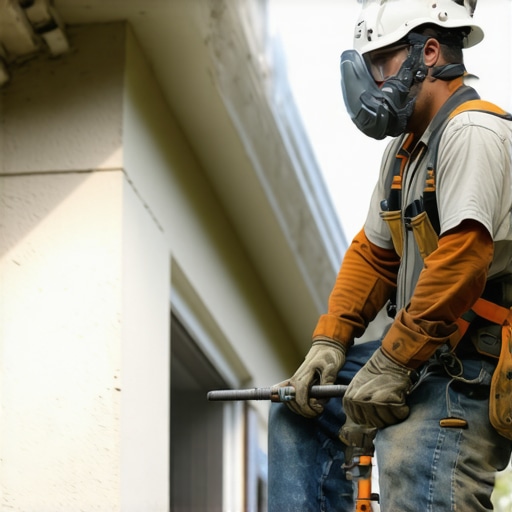
The final rule is the most personal: PPE is not optional. In 2026, any technician working within the 10-foot drip zone must wear a P100-rated respirator. But it goes beyond the mask. We now implement ‘Sticky Mat’ stations at the edge of the poly sheeting to pull dust off the bottom of work boots. This prevents ‘tracking’ lead into the client’s home or into the work truck. I’ve seen 25-year veterans laugh at masks until their first blood-lead level test comes back high. In the high-heat environments of the South, we use powered air-purifying respirators (PAPRs) to keep the crew cool while maintaining a 100% seal against toxic particulates.
The Engineering of Modern Storm Resistance
Once the lead is gone, we don’t just put back what was there. We engineer for the climate. In the South, we deal with ‘gully washers’ that drop three inches of rain in an hour. A standard 5-inch gutter is a joke in those conditions; the water moves with such flow velocity that it simply jumps over the pitch and erodes the soil. We move to 6-inch or 7-inch seamless aluminum formed on-site with a heavy-duty gutter machine. We use high-wind gutter anchors spaced every 12 inches—not the standard 24—to ensure the system stays on the house during a tropical storm. We also integrate self-cleaning gutter tech like micro-mesh guards that use surface tension to pull water in while ejecting pine needles. This isn’t just a gutter; it’s a hurricane-rated installation designed to move thousands of gallons of water away from the foundation through underground downspout drainage systems that terminate in pop-up emitters 20 feet from the house. That is how you protect a home from both the toxins of the past and the storms of the future.