The Myth of the Maintenance-Free Exterior
For twenty-five years, I have listened to salesmen tell homeowners they will never have to touch a ladder again. It is a lie. Water is a relentless force, and when you combine it with organic debris, gravity, and the surface tension of a heavy downpour, you have a recipe for foundation failure. I recall a project where a client had spent a small fortune on a ‘self-cleaning’ micro-mesh system near a cluster of weeping willows. Within two seasons, the fine tendrils and catkins hadn’t just sat on top; they had woven themselves through the mesh like a high-end carpet. The ‘automated’ promise was a farce because the system couldn’t account for the biological ‘knitting’ of the debris. If you are going to invest in automated gutter cleaning systems in 2026, you need to understand the physics of flow and the reality of your local tree canopy before you sign a check.
“Downspouts shall be sized based on the rainfall intensity of the region and the roof surface area.” – International Plumbing Code, Section 1106
Hydro-Zooming: Why Most Systems Fail the Velocity Test
To understand why most systems fail, we have to look at the shingle roof gutter starter. When rain hits your roof, it gains velocity as it sheds toward the eave. During a standard storm, that water is a sheet; during a ‘gully washer,’ it is a projectile. If your hidden hanger systems are spaced poorly—anything more than 24 inches on center in snow country or 18 inches in heavy rain zones—the gutter will flex. That flex changes the pitch. Even a 1/16th-inch deviation can cause water to pool, leading to the dreaded sludge buildup that defeats most ‘automatic’ cleaners. The three systems below are the only ones I have seen that actually address the mechanical reality of water management.
1. The Titan-Pulse Ultrasonic Agitator
This system doesn’t try to block debris; it manages it. By mounting ultrasonic emitters along the hidden hanger systems, the Titan-Pulse creates high-frequency micro-vibrations in the aluminum. This breaks the surface tension of the water and prevents the fine silt and ‘shingle grit’ from bonding to the bottom of the gutter. It is particularly effective for tile roof gutter support structures where the weight of the tile prevents easy access for traditional gutter cleaning services. When the vibrations keep the sludge in suspension, the water can actually carry the debris toward the leader box gutters rather than letting it sit and rot your fascia.
2. The Integrated Hydro-Jet Conductor Head
For large homes requiring industrial gutter services, the Hydro-Jet is the gold standard for 2026. This system uses a series of high-pressure nozzles integrated directly into the conductor head services. When sensors detect a backup, a high-velocity blast of water is sent through the elbow fittings replacement zones—the most common point of failure for any drainage system. This ensures that the leader (downspout) remains clear. In my experience, most clogs happen at the miter or the elbow. By automating a flush at these critical junctions, the system prevents the ‘damming effect’ that sends water back into your soffit.
“Gutters and downspouts shall be properly sloped to prevent standing water which can lead to corrosion and biological growth.” – SMACNA Architectural Sheet Metal Manual
3. The Aero-Sweep Robotic Rail
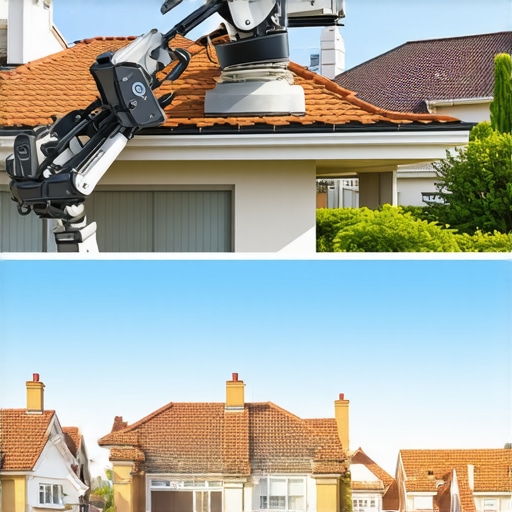
Designed for homes with heavy forest cover, this is essentially a localized drone for your eaves. It runs on a dedicated track mounted just above the shingle roof gutter starter. It doesn’t just blow air; it uses a mechanical brush to clear the lip of the gutter, ensuring that water doesn’t ‘overshoot’ the trough. This is critical for patio cover gutters where the low pitch often causes water to overflow and wash out the landscaping below. The Aero-Sweep ensures that the path to the rock splash blocks at the foundation base remains unobstructed.
The Technical Reality of Installation
You can buy the most expensive automated system in the world, but if your pitch is off, it will fail. A gutter must have a minimum slope of 1/4 inch for every 10 feet of run. Without this, the water doesn’t have the kinetic energy to move debris, automated or not. Furthermore, the transition to the ground is where most homeowners forget to look. Your leader box gutters must discharge into properly graded rock splash blocks or a French drain system to move that volume away from the foundation. If you see standing water, you don’t just have a clog; you have a structural engineering problem. Don’t let a salesman tell you otherwise. Maintenance frequency might drop with these systems, but the laws of physics remain the same. Check your end caps and miters annually, or you’ll be calling me for a foundation repair quote instead of a gutter tune-up.