The $40,000 Drip: A Lesson in Foundation Physics
I recently walked a perimeter in a coastal neighborhood where the owner was dealing with a two-inch sink in the northeast corner of their slab. The culprit wasn’t a tectonic shift or a broken water main; it was a single, weeping miter joint on a sectional gutter system installed just four years prior. For forty-eight months, every rainfall sent a concentrated stream of water directly into the soil adjacent to the footing, effectively ‘liquefying’ the bearing capacity of the earth. This is the reality of water management. When we talk about how on-site gutter rolling prevents 2026 leak callbacks, we aren’t just talking about aesthetics—we are talking about structural preservation. Water is a patient destroyer. It uses surface tension to ‘crawl’ behind fascia boards and gravity to find the microscopic gaps in your elbows and end caps.
“Downspouts shall be sized based on the rainfall intensity of the region and the roof surface area.” – International Plumbing Code, Section 1106
The Engineering of the Continuous Run
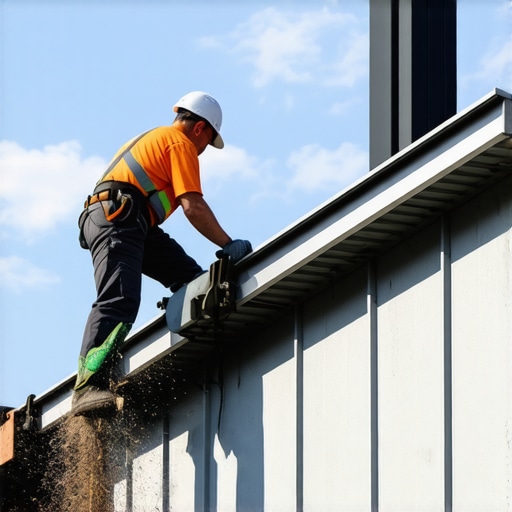
The primary weakness of any drainage system is the seam. In the old days, and unfortunately in the ‘big box’ retail world today, gutters come in ten-foot sections. Every ten feet, you have a potential failure point held together by nothing but sealant and a few zip screws. Over time, the thermal expansion and contraction of the metal—especially if you are dealing with steel gutter services—will stress those seals until they fail. On-site gutter rolling, or extrusion, eliminates this entire category of failure. We bring a portable roll-forming machine to the job site, feed in a continuous coil of heavy-gauge aluminum or copper, and ‘spit out’ a single, unbroken trough that spans the entire length of your roofline. No seams mean no leaks. When we integrate whole-house gutter systems this way, the only points of connection are at the corners, and even those are reinforced with high-grade miter boxes and solar-resistant polymers.
Hydro-Zooming: The Physics of the Overhang
To understand why on-site rolling is superior, you have to look at the ‘meniscus’ of water during a heavy downpour. In a ‘gully washer’ or a heavy storm, water doesn’t just fall into the gutter; it moves with horizontal velocity off the roof shingles. If your pitch is off by even an eighth of an inch, or if a seam has created a small ‘speed bump’ in the flow, the water will backup. This creates a ‘wicking’ effect where water travels backward via capillary action, soaking into the soffit and eventually rotting the fascia board. This often leads to the need for fascia board repair before a new system can even be hung. By rolling the metal on-site, we ensure a perfectly straight profile that maintains constant slope, ensuring that velocity is maintained until the water hits the leader (downspout).
The Drainage Hierarchy and Advanced Integration
Modern water management goes beyond just the eaves. For homes with complex architecture, we have to consider awning gutter integration. These smaller runs are often neglected but can dump massive amounts of water onto lower roof sections, overwhelmed the primary system. We also look at kickout diverter installation. A kickout diverter is a critical piece of flashing that directs water away from the wall-roof intersection and into the gutter. Without it, water gets behind the siding, leading to mold that you won’t smell for years until it’s too late. For those in colder climates, we integrate gutter de-icing services directly into the roll-formed profile. Heat cables are laid into the trough to prevent ice dams, which can weigh hundreds of pounds and rip a hanger right out of the wood if the spacing isn’t precisely 12 inches on center.
“The gutter drainage system shall be designed to withstand the expected snow load and thermal movement of the materials used.” – SMACNA Architectural Sheet Metal Manual
Material Matters: From Steel to Copper Patina
While aluminum is the standard, steel gutter services are making a comeback for their rigidity in high-wind zones. However, for the ultimate in longevity and ‘shelf appeal,’ nothing beats copper patina finishes. Copper is a living material; it heals itself from minor scratches and develops a protective oxide layer over time. For the eco-conscious homeowner, these systems are often the precursor to rainwater harvesting gutters. When you are collecting water for irrigation, you cannot afford the contaminants found in old-style coatings. Speaking of contaminants, we also specialize in asbestos gutter handling for older Victorian or mid-century homes that utilized cement-fiber troughs. These require specialized removal protocols to ensure no friable fibers enter the local atmosphere during the upgrade to a modern flood prevention gutters setup.
Conclusion: The Zero-Callback Standard
The goal of a master installer is to never see the client again—at least not for the same house. By utilizing on-site rolling, we ensure that the system installed today is the same system protecting the foundation in 2026 and beyond. We calculate the roof square footage, determine if you need the high-capacity 3×4 inch leaders over the standard 2x3s, and we set the pitch with laser precision. Water is the #1 enemy of your home’s structural integrity. Don’t fight it with ten-foot pieces of plastic and a prayer. Fight it with an engineered, seamless, and mathematically sound drainage solution.