The Cost of a Single Bad Connection
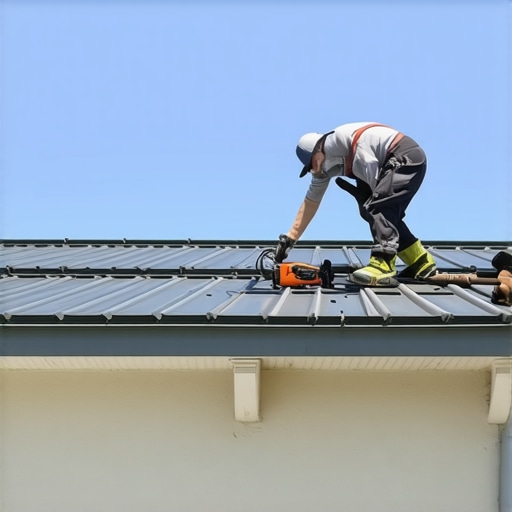
I was out on a job in a coastal town last November where the homeowner was convinced they needed a new foundation. The southwest corner of the house had settled nearly three inches, and the drywall in the master bedroom was cracking like a spiderweb. When I got up on the ladder, I didn’t see a foundation problem; I saw a physics problem. A high-rib metal roof was dumping hundreds of gallons of water directly behind the fascia board because the transition to the gutter was missing a simple three-dollar flashing. For five years, that water had been a slow-motion wrecking ball, liquefying the soil under the footing. This is what happens when you treat guttering as an afterthought instead of a hydraulic engineering project. Metal roofs present a unique challenge because their surface friction is significantly lower than asphalt shingles. Water doesn’t just flow; it accelerates. By the time it reaches the eave, it has the kinetic energy to jump standard five-inch gutters or, worse, use surface tension to wrap around the edge and rot your soffit. To prevent this, we have to look at whole-house gutter systems as a unified defense against gravity and fluid dynamics.
The Physics of Metal Roof Overshoot
When rain hits a metal panel, it forms a high-velocity sheet. Unlike shingles, which have granules to break up the flow, metal allows the water to maintain a laminar flow pattern. During a heavy downpour, this sheet of water can reach speeds that cause it to shoot straight over the front lip of a standard gutter. This is why fascia gutter mounting must be precise. If the gutter is hung too high, the metal roofing panels will hit the back of the hanger; if it is too low, the water overshoots. In 2026, the industry standard is moving toward larger volumes to handle the increasing intensity of storm cycles.
“Downspouts shall be sized based on the rainfall intensity of the region and the roof surface area.” – International Plumbing Code, Section 1106
This regulation is critical when dealing with metal roofs. We are no longer just installing 2×3 inch leaders. For a whole-house system on a metal-roofed structure, 3×4 inch or even 4×5 inch corrugated leaders are the only way to ensure the system doesn’t back up during a peak flow event.
Pro Fix 1: The High-Back Gutter and Drip Edge Integration
The most common failure point I see is the gap between the metal roof deck and the gutter itself. Water has a nasty habit called capillary action. It wants to cling to the underside of the metal panel and crawl backward. If your fascia gutter mounting doesn’t include a custom-bent drip edge that extends at least two inches into the gutter trough, you are begging for rot. For 2026, we are recommending high-back seamless gutters. These are custom-extruded so the back wall of the gutter sits tucked up behind the metal roofing’s hem. This creates a mechanical seal that water cannot bridge. It forces every drop into the trough, regardless of wind direction or volume. If you are dealing with a parapet drain system, this transition is even more vital, as the scupper must be flashed with a liquid-applied membrane to ensure no moisture penetrates the wall cavity. [image_placeholder_1]
Pro Fix 2: Half-Round Gutter Installation for Hydraulic Efficiency
If you are struggling with debris and high-flow leaks, a half-round gutter installation is often the superior choice for metal roofs. The circular profile of a half-round gutter creates a natural vortex that helps move sediment and small debris toward the leader more effectively than a standard K-style gutter. Furthermore, when paired with heavy-duty external hangers, the half-round system can be pitched more aggressively. Pitch is the lifeblood of drainage. I demand a minimum slope of 1/4 inch for every 10 feet of run. Without this, water sits. Standing water is heavy, it attracts mosquitoes, and in metal systems, it leads to premature oxidation at the miters and end caps. When we install these on metal roofs, we use heavy-gauge aluminum or copper to withstand the sliding snow loads that are common in northern climates, or the high-wind pressures in hurricane-prone regions.
Pro Fix 3: Hurricane-Rated Installations and Structural Hangers
Forget the old spikes and ferrules. Those are 1980s technology that has no place on a modern home. As wood fascia gets wet and dries, it expands and contracts, eventually spitting those spikes out like a bad habit. For a hurricane-rated installation, we use heavy-duty hidden hangers with two-inch stainless steel screws driven directly into the rafter tails, not just the fascia board. We space these hangers every 12 to 16 inches. This is double the industry standard, but when you have a metal roof shedding a foot of wet snow or facing 100-mph winds, you need that structural integrity.
“Gutters and downspouts shall be securely fastened to the structure to resist wind and snow loads as required by local building codes.” – SMACNA Architectural Sheet Metal Manual
This isn’t just a suggestion; it is a requirement for a lifetime gutter guarantee. If a contractor tells you they can do it with spikes, show them the door.
Maintenance and Long-Term Performance
Even the best-engineered system requires maintenance. For metal roofs, leaf blower gutter cleaning is the preferred method because it avoids the abrasive damage caused by metal scoops. However, if you have allowed organic sludge to build up, pressure washing gutters at a low-PSI setting might be necessary to clear the leaders. If you are seeing leaks at the corners, a vinyl gutter repair kit won’t cut it for a metal system. You need high-grade tri-polymer sealants that can handle the thermal expansion of the metal. Metal moves. It grows in the sun and shrinks in the cold. Your miters must be joined with internal and external boxes and sealed with a flexible industrial sealant to prevent the joints from snapping. Finally, always check your splash block or pop-up emitter. If the water exits the leader but pools within five feet of the house, your gutters have failed their primary mission: protecting the foundation. Engineering a dry home starts at the roof, but it only ends when the water is twenty feet away from the basement walls.
This post really highlights the importance of detailed planning when it comes to gutter systems on metal roofs. I recently encountered a similar situation where a homeowner’s oversight in applying a proper drip edge led to significant water damage over time. It’s fascinating to see how small components like a three-dollar flashing or the choice of gutter profile can make such a difference in long-term durability. Personally, I’ve found that half-round gutters, paired with a solid slope, not only improve water flow but also drastically reduce debris buildup, which minimizes maintenance over the years. I’m curious about anyone’s experience with the longevity of high-back seamless gutters in coastal environments—do they hold up well against salt air and wind? It seems like thoughtful, thorough installation practices like these are essential, especially with the increasing intensity of storms predicted in 2026 and beyond. Proper attachment and ongoing maintenance, including leaf blower cleaning, are key to avoiding those costly foundation issues caused by overlooked water management.