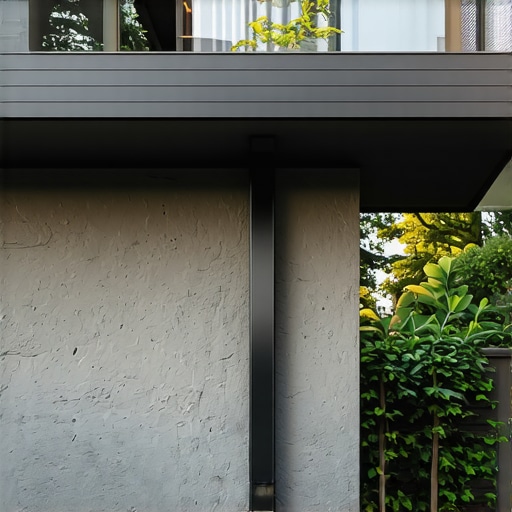
The Foundation of Water Management: Why Downspout Geometry Matters
I remember a project in the suburbs of Charlotte where a stunning 2020-built modern home was facing a catastrophic structural failure. The homeowner noticed a hairline fracture in the basement slab that had widened to nearly half an inch in just two seasons. When I walked the perimeter during a standard afternoon thunderstorm, the culprit was obvious: the sleek, aesthetic-first circular leaders were choking. Water was backing up into the gutters, overtopping the back wall, and saturating the soil directly against the foundation wall. The hydraulic pressure was literally pushing the house apart. This is the reality of poor drainage design, and it is why we are seeing a massive shift toward rectangular downspout systems for 2026 home standards.
As a specialist with over two decades in the field, I have seen every shortcut in the book. From the flimsy spikes and ferrules of the eighties to the ‘maintenance-free’ plastic traps of the early 2000s, nothing beats a properly engineered metal system. Modern architecture, especially with the rise of steep-pitch roofs and solar arrays, requires a volume of water management that old-school corrugated pipes simply cannot handle. When we talk about storm-resistant gutters, we are talking about a system where every component, from the gutter apron installation to the EPDM gutter seals, works in concert to move thousands of gallons of water away from your investment.
“Downspouts shall be sized based on the rainfall intensity of the region and the roof surface area.” – International Plumbing Code, Section 1106
Perk 1: Superior Hydraulic Flow and Debris Management
The physics of water movement inside a rectangular downspout (or leader) are fundamentally different from those of a standard 2×3 corrugated pipe. In a corrugated pipe, the internal ridges create turbulence. As water hits those ridges, it slows down, losing the velocity needed to flush out small granules from composite shingle services or organic grit. A rectangular downspout, particularly a 3×4 or 4×5 inch smooth-wall aluminum or copper variant, allows for laminar flow. This means the water moves in smooth, parallel layers, maintaining maximum velocity even during a heavy downpour.
When you have solar panel gutter avoidance strategies in place, the water often hits the gutter with much higher kinetic energy because it is sliding off glass rather than being slowed by shingle grit. A rectangular system handles this surge better because of its cross-sectional area. If you are dealing with an old system, corrugated downspout repair is often a band-aid. Upgrading to a rectangular profile increases the volume capacity by nearly 30 percent without looking bulkier on the fascia. This prevents the ‘waterfall effect’ where water bridges the gap between the gutter and the soffit, leading to wood rot that you won’t see until the hanger literally pulls out of the soft wood.
Perk 2: Structural Integrity and Longevity in Extreme Climates
In the southern regions where ‘gully washers’ are common, the weight of the water is the enemy. A standard gutter filled to the brim weighs approximately 8 pounds per linear foot. If your hanger spacing is too wide, the system will sag, ruining the pitch or slope. A rectangular downspout system is typically paired with heavy-duty box gutters and EPDM gutter seals. These seals are critical because they accommodate the thermal expansion and contraction of the metal without cracking, unlike cheap caulking.
“The drainage system must be designed to withstand the maximum expected load of water and debris without failure of the supporting members.” – SMACNA Architectural Sheet Metal Manual
We also have to consider the ‘splash’ factor. On 2026 modern homes with minimal overhangs, a gutter apron installation is mandatory to ensure water transitions from the starter strip services into the gutter trough. Without this apron, surface tension causes water to wrap around the edge of the shingle and run down the fascia. This leads to the ‘black stripe’ staining and eventual structural failure. By using rectangular leaders, we can use wider elbow joints that are less prone to clogging at the miter (the corner where two gutters meet), ensuring that even during a tropical storm, the water stays inside the metal and exits at the splash block or underground drain.
Perk 3: Integration with Advanced Protection Systems
Modern homes in 2026 are increasingly being fitted with bird spike gutter protection and solid hood guards. Rectangular downspouts are the ‘engine’ that makes these protection systems viable. A solid hood guard relies on the principle of liquid adhesion: water follows the curve of the hood into the gutter while leaves fall off. However, if the downspout cannot evacuate that water fast enough, the gutter fills, the adhesion breaks, and the system fails. A 3×4 rectangular leader ensures the ‘exit’ is never the bottleneck.
Furthermore, when we process free gutter quotes processing for clients, we look at the specific debris profile. If you have heavy needle-bearing trees, a rectangular downspout is easier to clear because it lacks the internal ridges that trap needles. When combined with a starter strip that is properly aligned, you create a path of least resistance for water. This is essential for maintaining the health of your composite shingle services, as standing water in a gutter can wick back up into the roof deck, causing mold and rot that standard warranties won’t cover.
The Math of Drainage: Why Capacity is King
Let’s talk numbers. A 1,000-square-foot roof area will produce 625 gallons of water during a 1-inch rainstorm. If that rain falls in 15 minutes, you are trying to move 41 gallons per minute through your leaders. A standard 2×3 corrugated downspout maxes out at about 25 to 30 gallons per minute before it starts to back up due to friction and turbulence. A 3×4 rectangular downspout can easily handle 45 to 50 gallons per minute. By choosing the rectangular profile, you are building in a 50 percent safety margin for those ‘once-in-a-decade’ storms that now seem to happen every three years. This is why we insist on storm-resistant gutters for any new construction or major renovation.
The installation of these systems is a craft. You have to ensure the end cap is crimped and sealed correctly, that the pitch is exactly 1/16 of an inch per foot toward the leader, and that the hanger is driven into a solid rafter tail, not just the fascia board. This is the difference between a system that lasts 30 years and one that fails in five. Water is the most destructive force your home faces; don’t invite it into your foundation by using undersized, outdated drainage hardware.