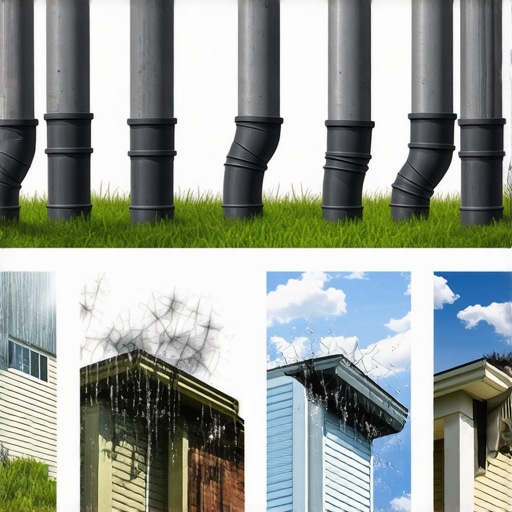
The Big Box Store Illusion: Why Most Flexible Downspout Extensions Fail
I have spent over two decades climbing ladders and inspecting the damage caused by ‘quick-fix’ drainage solutions. If you walk into any home improvement warehouse, you are greeted by rows of those accordion-style, flexible black plastic tubes. They look convenient. They look simple. They are, quite frankly, a disaster waiting to happen to your foundation. As a veteran in this trade, I view every rainstorm as a relentless siege on a home’s structural integrity. Your roof is a massive collection deck, and when the clouds open up, it funnels thousands of gallons of water toward your fascia and soffit. If that water is not managed with precision engineering, it wins. The flexible extension is the weakest link in that defense.
The Narrative Failure: The Case of the Crushed Accordion
I recall a job three summers ago in a heavily wooded suburb. The homeowner was baffled as to why their basement smelled like a damp cave despite having brand new storm-resistant gutters. I walked the perimeter and found the culprit: a forty-foot run of flexible black extension snaking through the mulch bed. Not only had the mower deck clipped the thin plastic, creating a jagged entry point for rodents, but the internal ridges of the pipe were packed solid with a mixture of decomposing oak tassels and fine silt. It had become a 20-foot long plug. The water, having nowhere to go, was backing up into the leader, overflowing at the miter, and dumping directly into the window well. This ‘convenient’ five-dollar part was causing ten thousand dollars in foundation settling. Here is why those flexible extensions are a professional’s nightmare.
The Physics of Flow: Laminar vs. Turbulent
When we talk about drainage, we have to discuss fluid dynamics. A professional-grade, smooth-wall PVC or aluminum extension allows for laminar flow. The water moves in a smooth, predictable path with minimal friction. However, those flexible extensions are corrugated. Every single one of those hundreds of ridges creates internal turbulence. As water hits these ridges, it slows down. This loss of velocity means that heavy sediment, which would normally be flushed out by a strong current, instead settles in the valleys of the corrugations. Over one season, this sediment builds up into a thick sludge. This is why micro-mesh gutter guards are often blamed for failures when the real issue is the stagnant water sitting in the extension because it cannot overcome the friction of the pipe itself.
“Leaders and conductors shall be sized to provide a capacity to drain the roof area based on the maximum recorded rainfall intensity.” – International Plumbing Code, Section 1106.1
The Climate Context: Volume and Overshoot
In regions prone to heavy downpours, the sheer volume of water is staggering. During a ‘gully washer,’ a standard roof can shed 600 gallons of water per hour for every inch of rain. If you are using a cheap flexible extension, the restricted diameter and internal friction mean the pipe reaches capacity almost instantly. Once the pipe is full, the water backs up. It doesn’t just sit there; it creates hydrostatic pressure at the end cap and the elbow. This is often when homeowners notice a vinyl gutter repair is needed because the weight of the backed-up water has pulled the hanger out of the fascia. We see this often with church steeple gutters where the height of the drop generates immense pressure; using anything other than a rigid, high-flow system is asking for a structural collapse of the drainage run.
The Material Science of Failure
The plastic used in most flexible extensions is not UV-stabilized to the same degree as professional-grade recycled plastic gutters or high-grade vinyl. After one summer of baking in the sun, the plastic becomes brittle. When the first freeze of winter hits, the water trapped in those corrugated ridges expands. Because the plastic has lost its elasticity, it hairline fractures. You won’t see these cracks until the next spring thaw, when you realize your extension is leaking water directly next to your foundation walls. This is a primary reason why insurance claim assistance is so frequently sought for ‘unexplained’ basement flooding; the source is a hidden fracture in a cheap plastic pipe hidden under three inches of mulch.
The Importance of Pitch and Slope
In the world of professional water management, pitch is everything. We aim for a minimum of 1/4 inch of drop for every 10 feet of run. Flexible extensions are notoriously difficult to pitch correctly. Because they are soft, they tend to ‘belly’ or sag between the points where they are pinned to the ground. These sags become standing water pools. Standing water is not just a weight issue; it is a biological one. These pools become breeding grounds for mosquitoes and can lead to the growth of heavy algae that eventually works its way back up the leader. If you aren’t practicing professional ladder safety to check these runs frequently, you’re likely living on top of a swamp.
“Roof drainage systems shall be designed and installed to prevent water from entering the building or causing damage to the structure or the foundation.” – SMACNA Architectural Sheet Metal Manual
Beyond the Extension: The Professional Solution
If you are serious about protecting your home, you move toward rigid solutions. This includes scupper installation for flat roofs or 3×4 inch oversized aluminum leaders for residential homes. We are even seeing the rise of smart gutter monitoring systems that can alert a homeowner when the flow rate at the discharge point drops, indicating a clog is forming. But no amount of technology can fix a fundamentally flawed pipe choice. When we perform an end cap replacement or a full system overhaul, we always advocate for smooth-wall underground piping that exits through a pop-up emitter at least ten feet from the foundation. This ensures that the water is not just moved away from the roof, but is successfully deposited where it can do no harm.
Maintenance and the Human Element
There is no such thing as a maintenance-free house. Even with the best micro-mesh gutter guards, you must inspect your discharge points. A common failure point we see is the connection between the metal leader and the plastic extension. Often, these are just shoved together and held with a single zip tie or, worse, duct tape. A professional installation uses a specific adapter that ensures a water-tight seal, preventing the ‘back-splash’ effect that rots out the bottom of the fascia board over time. If you have experienced storm damage, don’t just replace like-for-like. Consult with a specialist who understands the hydro-geographic needs of your specific lot. A properly engineered system is the difference between a dry, stable home and a sinking, moldy nightmare.