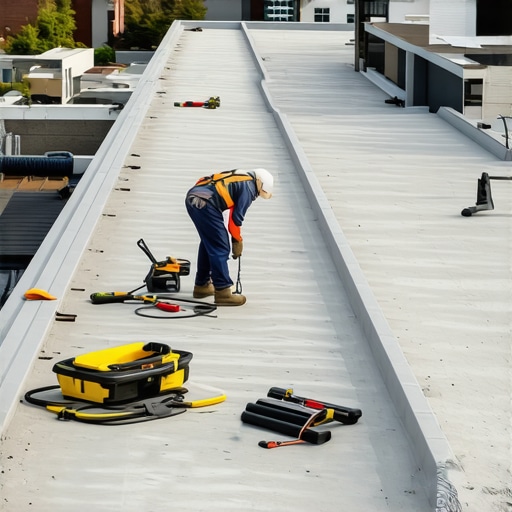
The High Stakes of Commercial Drainage Management
I was standing on the edge of a 150,000-square-foot distribution center in Florida last July during a tropical depression when I saw it: a 40-foot section of box style seamless gutters literally peeling away from the parapet wall like a piece of wet cardboard. Why? The original installer used standard fasteners into a rotting substrate, and the sheer weight of the 7-inch volume of water—moving at nearly 80 gallons per minute—created a leverage force that no simple screw could withstand. This wasn’t just a leak; it was a structural failure that eventually led to a two-inch sinkhole near the main loading dock because a single internal leader had backed up, forcing water into the building’s footer. When we talk about commercial flat roofs, we aren’t just talking about keeping a building dry; we are talking about engineering a system that survives the brutal physics of hydraulic pressure and volume.
“Internal gutters and box gutters shall be provided with expansion joints at intervals not exceeding 50 feet to allow for thermal expansion and contraction of the metal.” – SMACNA Architectural Sheet Metal Manual
1. The Geometry of the Sagging Gutter Fix
Most sagging gutter fix requests come too late. On a commercial flat roof, a sag of just half an inch can create a stagnant pool that weighs several hundred pounds. This weight further stretches the hanger, creating a vicious cycle. In 2026, we are moving away from the standard 24-inch spacing. If you want a system that lasts, you need heavy-duty industrial hangers every 12 to 16 inches, secured into the structural steel or masonry, not just the fascia board. We analyze the pitch—the slope must be a minimum of 1/4 inch per 10 feet of run. Anything less and you’re just building a linear mosquito pond. When water sits, it creates acidic sludge that eats through aluminum and galvanized steel, leading to the eventual need for vinyl gutter repair or total replacement.
2. Gutter Overflow Prevention and the Physics of Velocity
In storm-heavy regions like the South, gutter overflow prevention is about more than just cleaning out leaves. It’s about surface tension and overshoot. When a flat roof sheds water, it doesn’t just drip; it surges. During a heavy downpour, water velocity can cause the stream to overshoot the box style seamless gutters entirely. We mitigate this by installing high-back splash guards and oversized leaders. If you are still using 3×4 downspouts for a 20,000-square-foot roof section, you are asking for a flood.
“The size of leaders shall be based on the maximum projected roof area and the rainfall intensity for the specific location as determined by the local weather bureau.” – International Plumbing Code, Section 1106.2
In 2026, we advocate for 4×5 or even 5×6 corrugated leaders to handle the increased rainfall intensities we’ve seen in recent years.
3. The Evolution of Gutter Debris Removal and Automated Systems
The old way of sending a guy up a 40-foot ladder with a bucket for gutter debris removal is becoming a liability nightmare. We are seeing a massive shift toward automated cleaning systems—specifically high-pressure internal flush lines that can be triggered remotely. However, these systems only work if the initial gutter screen installation was done correctly. For commercial sites near heavy canopy, a micro-mesh system is essential. It’s not just about the leaves; it’s the silt and organic granules from the flat roof’s torch-down or EPDM surface. This sludge settles in the bottom of the gutter, creating a heavy mat that blocks the elbow and end cap. Proper gutter screen installation should involve a stainless steel mesh that can withstand the high-velocity runoff of a large commercial surface without collapsing.
4. Solar Panel Gutter Avoidance and Structural Integrity
As more commercial roofs adopt green energy, solar panel gutter avoidance has become a critical engineering step. Solar arrays change the way water sheds; they create concentrated ‘valleys’ of runoff that can overwhelm specific points in your drainage system. When we install or repair these systems, we must ensure the soffit ventilation during install is not obstructed. Proper airflow under the roof deck prevents the temperature differentials that lead to condensation inside the fascia. If the soffit is blocked, the wood backing for your gutter system will rot from the inside out, regardless of how many hangers you use.
5. Landscape Integration Services: The Final Exit
The job doesn’t end at the splash block. For commercial properties, landscape integration services are mandatory to protect the foundation. You cannot dump 5,000 gallons of water at the base of a tilt-wall building. We engineer landscape integration services that include buried 4-inch PVC lines (not the cheap corrugated stuff) leading to pop-up emitters or designated detention ponds. This ensures that the water your gutters worked so hard to collect is actually moved far enough away from the building to prevent soil saturation and foundation settling. A dry foundation is a stable foundation, and it all starts with the miter at the corner of your roof.