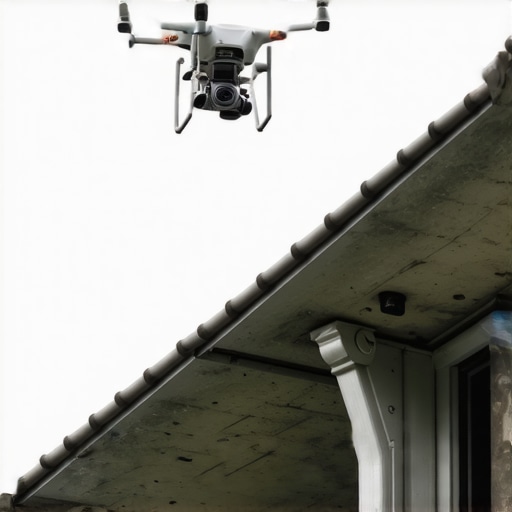
The Invisible Failure: Why Your Ladder Isn’t Tall Enough
I remember a job on a three-story Victorian in the humid corridor of the South where the owner was baffled by a persistent damp smell in the library. Three different inspectors had climbed their ladders, poked at the fascia, and declared the gutters clear. When I flew my thermal-equipped drone over the roofline, the truth was startling. Hidden behind a massive chimney stack was a dead-end miter where a literal forest of hackberry saplings had taken root in a thick mat of decomposed oak leaves. The gutters looked perfect from the ground, but up there, the water was backing up, capillary action was drawing it under the shingles, and it was rotting the roof deck from the inside out. This is the reality of modern water management. If you are not looking at the system from the air, you are guessing.
The Physics of Water Management and Surface Tension
To understand why gutters fail, you have to understand the Coanda effect. This is the tendency of a fluid jet to stay attached to a convex surface. In a perfect world, rain follows the curve of your drip edge into the trough. But when you have commercial flat roof gutters or even a standard residential setup, dirt and pollen change the surface tension. Water starts to ‘bridge’ the gap, running behind the gutter and directly onto your fascia board. A drone can see the staining patterns that indicate this overshoot long before a human on a ladder notices the wood is soft. We are talking about flow velocity. During a heavy downpour, a 5-inch gutter on a steep-pitch roof is often insufficient. The water moves with such force that it leaps over the front lip. Drones allow us to capture high-speed video of this overshoot in real-time during a storm, something no sane inspector would do from a ladder.
“Downspouts shall be sized based on the rainfall intensity of the region and the roof surface area.” – International Plumbing Code, Section 1106
The Death of the Spike and Ferrule
For decades, the industry standard was the spike and ferrule repair. It is a cheap, lazy way to hang metal. You drive a long spike through the gutter, through a hollow tube, and into the fascia. Here is the problem: wood expands and contracts. Metal expands and contracts. Over time, that spike works its way out like a loose tooth. Once it wiggles just a fraction of an inch, water enters the hole. Now you have rot inside the rafter tail. I have seen entire whole-house gutter systems sagging because the spikes were pulling out one by one. Modern engineering demands heavy-duty internal hangers clipped into the front lip and screwed with a 3-inch zinc-coated screw into the sub-fascia. Drones can zoom in on these fasteners to see if they are backing out, identifying the ‘shadow’ of a loose hanger that indicates a pending system failure.
Commercial Flat Roof Gutters: A Different Beast
Commercial systems involve massive surface areas. A flat roof isn’t actually flat; it is a series of low-slope planes designed to move water toward scuppers or internal drains. When these are integrated with commercial flat roof gutters, the volume of water is staggering. I’ve seen systems where the French drain connection at the base of the building was restricted by a single crushed corrugated pipe. The drone allows us to see the ‘ponding’ on the roof, which tells me the gutter isn’t just clogged; it is undersized or the pitch is dead wrong. If the water isn’t moving at a minimum of 1/4 inch per 10 feet of slope, it is sitting, and sitting water is the precursor to structural collapse.
“Gutters and downspouts shall be designed and installed to resist the weight of water, ice, and debris without permanent deformation or failure of the support system.” – SMACNA Architectural Sheet Metal Manual
The Truth About Gutter Guard Installation
Everyone wants a maintenance-free life. The marketing for gutter guard installation is full of promises that are frankly dangerous. Whether it is a micro-mesh, a perforated plate, or a surface-tension helmet, every guard has a failure point. In forested areas, pine needles act like needles on a sewing machine, stitching themselves into the mesh and creating a waterproof mat. Drones help us identify exactly which type of debris is causing the issue. If you have broad-leaf maples, a perforated plate might work. If you have fine-needle pines, you need a different strategy. We also look for the ‘shingle grit’ buildup. New roofs shed granules that settle in the bottom of the trough, turning into a heavy sludge that automated cleaning systems often cannot touch. A drone can spot the heavy ‘belly’ in a gutter run that indicates five gallons of wet mud are sitting there, weighing down the fascia.
Advanced Integration: French Drains and Rain Barrels
A gutter is only as good as its exit strategy. If the water drops at the corner of your foundation, you are just delayed the inevitable basement flood. We look for a clean French drain connection. This involves transitioning from the corrugated downspout repair or the smooth-wall leader into a 4-inch PVC underground pipe that carries water at least 10 feet away from the foundation to a pop-up emitter. Additionally, rain barrel integration is becoming a standard for green building. However, most people forget the overflow. A drone can see if the rain barrel overflow is dumping water right back against the foundation wall, which defeats the entire purpose of the system. We also check the soffit ventilation during install. If the gutter is hung too high, it blocks the intake air for your attic, leading to ice dams in the winter and a baked roof in the summer.
The Aesthetic of the Half-Round Gutter Installation
For historic homes, half-round gutter installation is the gold standard for looks, but it is a nightmare for performance if not handled by a pro. These systems require external brackets that must be perfectly aligned. Because they have a lower carrying capacity than a K-style gutter of the same width, the math has to be perfect. Drones allow us to check the alignment of these brackets across a long run without the distortion of looking up from the ground. We look for the ‘miter’ integrity. Every corner is a potential leak point. If the sealant has cracked, the drone’s high-resolution camera picks up the salt-staining on the brickwork below, a tell-tale sign of a slow, constant drip.
Conclusion: Water Always Wins
You can ignore your gutters, but you cannot ignore the laws of physics. Water is a solvent; it wants to dissolve your home. Whether it is through automated cleaning systems that fail to reach the corners or a simple spike and ferrule repair that has reached its expiration date, the signs of failure are there if you have the right perspective. Drone technology has changed the way we protect foundations. It allows us to see the system as a whole, from the peak of the roof to the French drain connection in the yard. Don’t wait for the basement to smell like a swamp. Get an eye in the sky and fix the pitch before the fascia rots out.
About the Author
Joan Babasa
HomeCraft Gutter Protection - LinkedIn Philippines
Joan Babasa is a dedicated professional in the home improvement and gutter protection industry, bringing specialized expertise to elitegutterworks.com. With a professional background at HomeCraft Gutter Protection, Joan has developed a comprehensive understanding of the technical requirements and long-term benefits of high-quality gutter guard systems. Her experience in the field has equipped her with the knowledge necessary to help homeowners safeguard their properties against water damage and structural issues caused by clogged or inefficient drainage. Educated at Sorsogon State College, Joan combines her academic foundation with practical industry insights to provide authoritative advice on exterior home maintenance. At elitegutterworks.com, she focuses on delivering clear, actionable information that empowers readers to make informed decisions about their home's protection. Her writing reflects a deep familiarity with the latest trends in gutter technology and debris management, ensuring that homeowners receive the most relevant and reliable guidance available. Joan is passionate about helping others achieve peace of mind through effective and sustainable home maintenance solutions.
LinkedIn Profile