The Fatal Flaw of the Spike and Ferrule
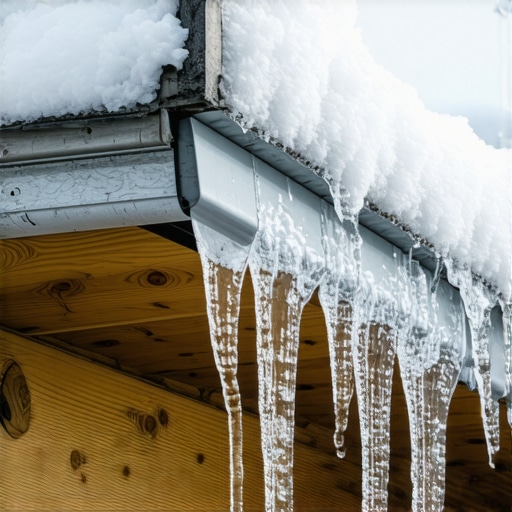
For decades, the industry standard for hanging gutters was the spike and ferrule. It was fast, cheap, and required little more than a heavy hammer. But as a specialist who has spent twenty-five years crawling on ladders, I can tell you that this system is a ticking time bomb for your fascia board and your foundation. When you look at a spike and ferrule setup, you are looking at a giant nail driven through the outer face of the gutter, through a metal tube (the ferrule), and into the wood of your home. It looks solid until the first heavy snow hits. I remember a job back in the winter of 2003 during a particularly brutal Nor’easter. I stood in a driveway in the freezing rain, looking at a beautiful colonial home where forty feet of aluminum gutter was dangling like a broken limb. The spikes had not just pulled out; they had acted as levers, prying the fascia board away from the rafter tails. The weight of the frozen slush was more than those three-inch spikes could handle. This is the reality of outdated drainage technology in northern climates.
“Support systems for gutters shall be designed to resist the weight of the gutter when full of water or ice.” – SMACNA (Sheet Metal and Air Conditioning Contractors’ National Association)
The physics of failure is simple yet devastating. When snow accumulates on your roof, it eventually slides down into the gutter. This is not light, fluffy snow; it is dense, water-saturated weight. As the temperature fluctuates, this mass freezes into a solid block of ice. In a spike and ferrule system, that weight pushes outward on the front lip of the gutter. Because the spike is only held in by the friction of the wood grain in your fascia, the constant expansion and contraction of the metal causes the hole to widen. Once that hole is wallowed out, the spike loses its grip. Water then follows the spike back into the fascia, leading to rot and eventually a sagging gutter fix that involves much more than just hammer work. If your home still has lead paint, a lead paint gutter abatement process is necessary before you even think about replacing these systems, as the friction of removing old spikes can release hazardous dust into your soil.
The Science of Gutter Sizing and Water Velocity
Engineering a proper water management system requires more than just eyeballing the length of the roof. We use specific gutter sizing calculations to ensure the system can handle peak rainfall intensity. The volume of water a roof sheds is staggering. During a heavy downpour, a 2,000 square foot roof can move over 1,200 gallons of water per hour. If your gutters are undersized or the pitch is off, that water backs up. We calculate the roof’s square footage, the pitch factor, and the local rainfall intensity to determine if you need a standard five-inch or an oversized six-inch seamless gutter installation.
“Downspouts shall be sized based on the rainfall intensity of the region and the roof surface area.” – International Plumbing Code, Section 1106
The slope, or pitch, must be exactly one-quarter inch for every ten feet of run. If the pitch is too shallow, water pools, leading to mosquito breeding and rust. If the pitch is too steep, the water moves with such velocity that it overshoots the miter at the corner, causing erosion at the foundation. We also have to consider the asphalt shingle gutter edge. If the shingles do not overhang the drip edge by the correct margin, water will use surface tension to crawl back under the shingle and rot the roof deck before it ever hits the gutter.
The Heavy-Duty Solution: Internal Hangers and Seamless Runs
The only way to combat the weight of ice and snow in the North is to move away from spikes and toward internal hidden hangers. These hangers are not just nails; they are heavy-duty brackets that clip into the front and back of the gutter and are screwed into the fascia with long, coarse-thread ceramic screws. By spacing these hangers every twelve inches rather than the standard thirty-two, we create a system that can support the weight of a grown man. This structural integrity is vital when you are dealing with snow loads. A seamless gutter installation eliminates the weak points found in sectional systems. Every miter, every end cap, and every leader outlet is a potential leak point if not sealed with high-grade tri-polymer sealant. For those looking for high-end aesthetics or historical accuracy, copper gutter installation offers a lifetime solution, as copper naturally resists corrosion and develops a protective patina. On the other end of the spectrum, for eco-conscious builds, bamboo gutter alternatives are emerging, though they require significant maintenance and are rarely suitable for heavy snow regions.
Managing the Exit: Downspouts and Erosion Control
Getting the water into the gutter is only half the battle. You have to get it away from the house. A standard 2×3 inch leader is often insufficient for modern storms; we prefer 3×4 inch oversized downspouts to prevent debris from bridging and causing a clog. When water exits the downspout, it has immense kinetic energy. Without proper erosion control downspouts, you will find a trench being dug into your landscaping within a single season. We often integrate rain barrel integration systems for gardeners, but during the winter, these must be bypassed to avoid freezing. The ultimate solution for yard drainage is a combination of splash blocks and underground pipes leading to pop-up emitters or a French drain. This ensures that the water that fell on your roof ends up fifty feet away from your foundation rather than in your basement. If you are struggling with debris, reverse curve guards can help by using surface tension to pull water into the gutter while shedding leaves, though they must be matched to the specific debris profile of your local trees. In a forested area, a micro-mesh guard might be more effective to keep out fine pine needles that would otherwise turn into a thick organic sludge inside your gutters. Protecting your home is about managing the hydro-geographic reality of your specific lot. Water is patient, and it is persistent, but with the right engineering, you can keep your foundation dry for a century.