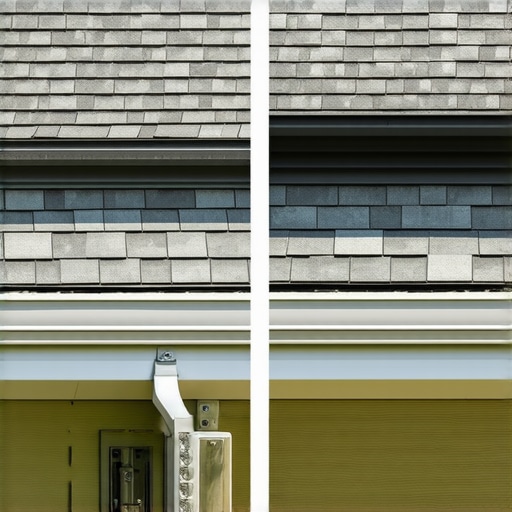
The Invisible War Against Your Foundation
In twenty-five years of ladder climbing, I have seen more foundations destroyed by ‘simple’ water than by earthquakes or fires. Most homeowners treat their gutters like a crown molding for the exterior, but in reality, they are the primary defense system for your home’s structural integrity. When we talk about spike and ferrule repair versus hidden hangers, we are not just talking about aesthetics. We are talking about the mechanical failure points of your roofline. If your gutters are sagging, pulling away, or leaking at the end cap, you are watching a slow-motion catastrophe. Water is a heavy, relentless force. One gallon of water weighs roughly 8.34 pounds. During a heavy New England downpour, a single fifty-foot run of gutter can be asked to carry hundreds of pounds of moving liquid. If that weight is supported by outdated technology, the system will fail. Period.
The Case of the Two-Inch Sinking Corner
I recall a job in a quiet suburb where the homeowner was frantic because his basement door wouldn’t close. I walked around the perimeter and saw a classic failure. A single thirty-foot section of seamless gutter had been installed using the old spike and ferrule method. Over a decade of freezing winters, the ice load had pulled those spikes just half an inch out of the fascia. This created a gap. Instead of the water flowing to the leader, it began to ‘bridge’ the gap, tracking behind the gutter and saturating the fascia and the soffit. More importantly, it dumped a concentrated stream of water directly onto the corner of the foundation for years. The soil became hydrostatic soup, and the corner of the house sank two inches. All of this because of a seven-inch nail. This is why gutter replacement services are often a structural necessity rather than a cosmetic choice.
“Gutter and downspout systems shall be maintained so that water does not accumulate on the roof or cause damage to the structure or the foundation.” – International Property Maintenance Code (IPMC), Section 304.7
The Physics of Failure: Spike and Ferrule Systems
The spike and ferrule method was the industry standard for decades. It consists of a large spike driven through a sleeve (the ferrule) and into the fascia board. On paper, it works. In the reality of a northern climate, it is a disaster. Wood is hygroscopic; it expands and contracts with moisture and temperature. As the spike—a smooth-shanked nail—sits in the fascia, the wood fibers around it eventually loosen. When an ice dam forms in the winter, the weight of the ice pushes outward. Because the spike has no threading, it slowly ‘creeps’ out. Once that spike moves, the pitch of the gutter is ruined. Standing water then accumulates, attracting mosquitoes and leading to built-in gutter systems rotting from the inside out. If you see silver nail heads popping out from the front of your gutters, your system is already compromised.
The Engineering of Hidden Hangers
Modern seamless gutter installation almost exclusively uses hidden hangers, and for good reason. A hidden hanger is a heavy-duty bracket that clips into the front bead of the gutter and screws directly into the fascia with a coarse-thread screw. Unlike a spike, which relies on friction, a screw creates a mechanical bond with the wood fibers. Furthermore, hidden hangers are ‘hidden’ inside the trough, providing a clean, architectural look without visible nail heads. In regions with heavy snow, we space these hangers every twelve inches. This distributed load capacity prevents the gutter from ‘rolling’ forward under the weight of slush. This is the gold standard for maintenance-free gutter systems because it eliminates the most common point of structural failure.
“Downspouts and gutters shall be sized according to the rainfall intensity and the drainage area… and shall be securely supported to withstand the expected loads.” – SMACNA Architectural Sheet Metal Manual
Hydro-Zooming: Why Volume and Velocity Matter
When analyzing your drainage, you have to consider flow velocity. During a storm, water doesn’t just fall; it gains momentum as it slides down the shingles. If the gutter is not tilted—or pitched—at exactly 1/4 inch per 10 feet toward the leader, the water loses velocity. This leads to the accumulation of silt and organic debris. When we perform a commercial gutter installation or a high-end residential job, we often upgrade the downspouts from the standard 2×3 to a 3×4 ‘oversized’ leader. This prevents the ‘glugging’ effect where air gets trapped in the downspout, slowing the exit of water. Without proper exit velocity, even the best hidden hangers can’t save a system from overflowing. For those with complex rooflines, tile roof gutter support requires specialized heavy-gauge hangers to handle the extreme weight of both the tile and the water volume.
Managing the Discharge: Beyond the Gutter
Capturing the water is only half the battle. If you let that water dump at the base of your house, you’ve gained nothing. We often recommend underground downspout drainage to move that volume at least ten feet away from the foundation. Using rock splash blocks is a temporary fix, but a dedicated PVC line buried and sloped toward a pop-up emitter is the only way to ensure a dry basement. If you are worried about the cost of a full overhaul, many companies now offer financing for gutter installs, making it easier to protect your home before a foundation crack becomes a five-figure repair. Additionally, gutter guard installation can be a life-saver, but only if the guard is matched to your specific tree cover. A micro-mesh is great for pine needles, but a perforated screen might be better for large oak leaves.