The Hidden Cost of Outdated Gutter Fasteners
In my twenty-five years of inspecting water management systems, I have seen houses succumb to the slow, steady pressure of water in ways that most homeowners never notice until it is too late. I remember a particular Victorian property in Pennsylvania where the owner complained about a damp smell in the library. After a quick ladder climb, the culprit was obvious: a forty-foot run of aluminum gutter was held up by nothing but hope and a few rusted spikes. The ice from the previous winter had formed a massive four-hundred-pound log inside the trough, and because the spikes were spaced three feet apart, the weight had sheared the fasteners right through the soft pine fascia. This is the fundamental flaw of the spike and ferrule system, and it is why spike and ferrule repair remains the most common maintenance task in the industry.
“Downspouts shall be sized based on the rainfall intensity of the region and the roof surface area.” – International Plumbing Code, Section 1106
The Physics of Fastener Failure
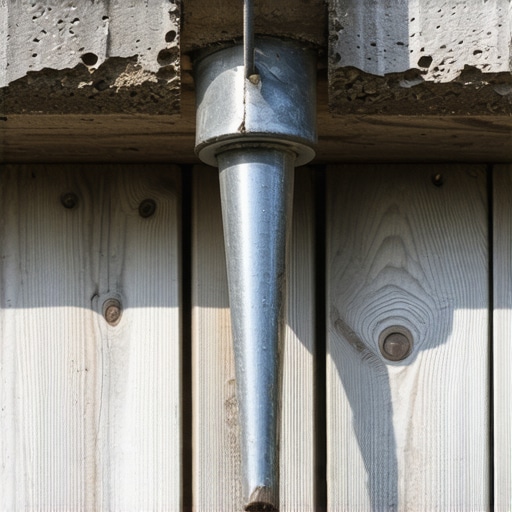
To understand why these systems fail, we have to look at the mechanics of how they are installed. A spike and ferrule system involves a large nail (the spike) driven through the front of the gutter, through a hollow tube (the ferrule), and into the fascia board. In a climate where water freezes and expands, this design is a liability. During the cycle of gutter winterization, we see how thermal expansion causes the metal to move. Aluminum expands and contracts at a different rate than the wood fascia. This constant tugging slowly enlarges the hole in the wood. Once that hole is loose, the spike loses its grip. When a heavy rain hits, the weight of the water pulls the gutter away from the house. This creates a gap where water can bridge the distance between the metal and the wood, leading to rot that necessitates comprehensive gutter removal services.
Hydro-Zooming: Why Water Destroys Foundations
Let us look closer at what happens during a heavy downpour. When a gutter is properly sloped at a pitch of one-quarter inch per ten feet, the flow velocity is sufficient to sweep debris toward the leader or downspout. However, when spikes begin to pull out, the gutter sags. This creates stagnant pools. Water has a property called surface tension, which allows it to cling to surfaces. In a sagging gutter, the water overflows and ‘hugs’ the underside of the trough, curling back toward the fascia and soffit. This moisture doesn’t just disappear; it saturates the wood and eventually travels down the interior of the wall. This is the primary cause of foundation failure. A single disconnected downspout can dump hundreds of gallons of water directly at the base of your home, saturating the soil and causing the foundation to settle unevenly.
“Gutters and downspouts shall be constructed of materials that are resistant to corrosion and shall be securely fastened to the structure.” – SMACNA Architectural Sheet Metal Manual
The Solution: Internal Hangers and Proper Drainage
The modern specialist knows that spikes and ferrules belong in a museum, not on your home. We now use heavy-duty internal hangers with a threaded screw design. These hangers clip into the front and back of the gutter, providing structural integrity without piercing the front face of the metal. For those in snow-prone areas, ice dam prevention starts with these hangers being spaced every twelve inches to support the weight of frozen slush. Furthermore, we must address where that water goes. Standard splash blocks are often insufficient. We recommend downspout extension services or, better yet, underground downspout drainage systems that carry the water at least ten feet away from the building envelope. This prevents the swampy yard syndrome and protects the structural integrity of the slab.
Advanced Water Management Systems
For more complex properties, we often look at greenhouse gutter collection or specialized coping cap alignment for flat-roofed sections. Every miter and end cap must be sealed with high-grade tri-polymer sealant to prevent leaks. During a professional install, we also evaluate soffit ventilation during install to ensure that the attic remains cool, which is the best defense against the heat transfer that causes ice dams in the first place. If you are dealing with pests, gutter animal removal is often necessary because sagging gutters provide the perfect entry point for squirrels and birds to get behind the fascia. Finally, always verify your gutter warranty services to ensure that your new screw-fastened system is covered for the long haul. Properly engineered drainage is not just an upgrade; it is the only thing standing between your home and the destructive power of the next storm.