The Frozen Truth About Flat Roofs
I remember a job back in the winter of 2021 when a modern flat roof in Michigan literally buckled under the weight of a four-foot ice ledge. The homeowner called me because they heard a sound like a shotgun blast in the middle of the night. It was the sound of the Hanger brackets snapping one by one as ten thousand pounds of ice decided it was time to obey gravity. The Fascia board was ripped clean off the rafters, exposing the Soffit and the interior wall insulation to the elements. This was not a failure of the roof material itself; it was a failure of the water management system. Flat roofs are never truly flat. They are engineered with a specific Pitch or Slope, usually a quarter-inch per foot, to guide water toward collection points. When that engineering fails during a freeze-thaw cycle, you don’t just get a leak; you get a structural catastrophe. Many contractors just slap on some flashing and call it a day, but I have spent 25 years watching how water moves, and I can tell you that winter drainage on a flat roof is a game of physics and thermal bridging.
Hydro-Zooming: The Physics of the Ice Dam
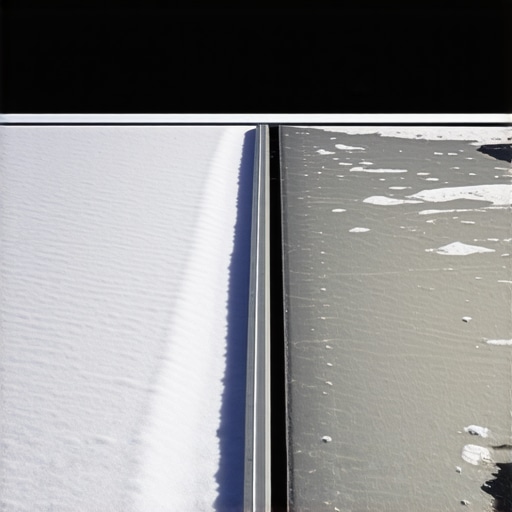
Ice dams on flat roofs are more insidious than those on pitched roofs. On a steep slope, gravity is your friend. On a flat roof, the Parapet Drain Systems are your only hope. The process begins with the latent heat of fusion. Even when it is twenty degrees outside, the heat escaping through your roof deck melts the bottom layer of snow. This liquid water, trapped under a thick blanket of white insulation, flows toward the roof edge. As it reaches the uninsulated parapet or the cold metal Miter at the corner, the temperature drops below freezing. The water transitions back to solid ice. This creates a tiny ridge. The next wave of meltwater hits that ridge and freezes. Now you have a dam. This is where surface tension and hydrostatic pressure become your worst enemies. The water backs up behind the dam, finding every Gutter Leak Repair point or microscopic hole in the membrane. It doesn’t just sit there; it uses capillary action to climb up and over the waterproof layers, saturating the wood structure. This is why Gutter Warranty Services are useless if the initial design did not account for thermal bridging at the roof edge.
“Roof drainage systems shall be leaded to an approved location. The capacity of the drainage system shall be based on the roof area and the 100-year, 1-hour rainfall intensity.” – International Plumbing Code, Section 1106
The Parapet Strategy and Scupper Logic
In northern climates, the Parapet Drain Systems must be the primary line of defense. A parapet is essentially a low wall around the edge of the roof. If the drains in this wall clog, your roof becomes a swimming pool. I have seen Bird Spike Gutter Protection used effectively here to keep pigeons from nesting inside the scuppers, which is a common cause of blockage. When water cannot exit through the Leader (the vertical pipe), it accumulates. During winter, that accumulation freezes solid, expanding as it does so. This expansion can crack a cast-iron drain body or tear a TPO membrane. To prevent this, we use a combination of tapered insulation to increase the Slope toward the drains and heated End Cap assemblies. For homeowners with exterior gutters, Micro-Mesh Gutter Guards can help, but they must be installed with a heated cable system to keep the mesh clear of ice. Without heat, the mesh becomes a frozen sheet, causing water to overshoot the gutter entirely and erode the foundation below.
Integrating Landscape and Downspouts
Once the water leaves the roof through the Leader, the battle is only half-won. In sub-zero temperatures, the exit point is where the system usually fails. If you have Flexible Downspout Extensions, they must be pitched aggressively. If they have a