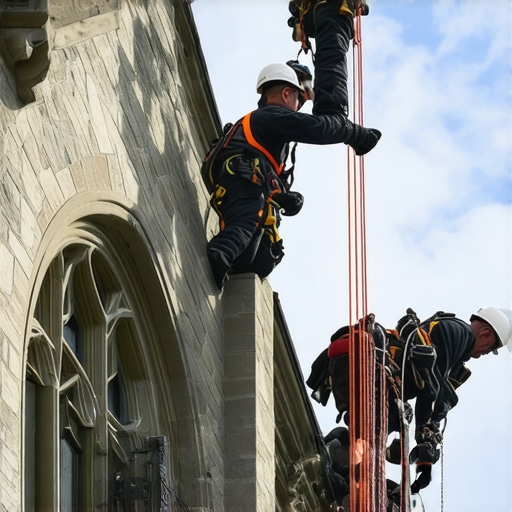
The Vertical Challenge of Preservation: Engineering Water Management Above the Sanctuary
For twenty-five years, I have walked around structural foundations, hunting down the invisible paths of water. When water leaves a roofline, it is a localized force of erosion, searching for any weakness in the building envelope. This struggle becomes exponentially more dangerous when dealing with historic architecture. Historic churches are not typical residential structures; they are massive vertical watersheds. When you are dealing with heights that exceed forty, sixty, or even eighty feet, a failing gutter system ceases to be a simple maintenance issue. It becomes a structural emergency that can rot out century-old timbers, ruin irreplaceable plaster ceilings, and undermine massive stone foundations.
During a massive storm front in Ohio, I stood inside a historic 1890s chapel with a building committee. The church steeple gutters had been neglected for years. Water was overflowing the lead-coated copper troughs, running backward over the wooden cornice, and pooling inside the sanctuary walls. By the time they called me, a five-foot section of lath and plaster had collapsed onto the altar. The root cause? A series of rusted-out hangers at the seventy-foot mark that had dropped the trough below its critical pitch. The entire run had back-sloped, turning a high-capacity drainage system into a stagnant, heavy reservoir that eventually tore away from the structural fascia.
Historic buildings require specialized engineering, particularly when addressing the high-wind environments and extreme heights of steeple architecture. The average residential installer who shows up with a twenty-four-foot extension ladder is completely out of their depth. Managing water at these heights requires heavy-duty equipment, specialized knowledge of historical materials, and structural rigging that respects the integrity of the building.
“Where historic buildings are concerned, the preservation of original fabric is paramount. Water must be directed away from the building envelope using materials and systems that are both historically sympathetic and structurally secure.” – National Park Service Preservation Briefs, Section 4
The Physics of High-Elevation Water Management
To understand why a church steeple gutter or high-level cornice system fails, you must understand the physics of high-velocity water and wind. At eighty feet in the air, wind currents do not hit a building horizontally; they swirl, create updrafts, and push falling rain upward and under the eaves. Standard gutter installations are utterly useless here. When water falls from a slate roof pitched at a steep 12:12 angle, it gains immense velocity. By the time it reaches the eave, it has enough kinetic energy to overshoot any standard five-inch trough.
This is why high-volume aluminum gutter installation is so critical for these retrofits, often requiring custom six-inch or seven-inch commercial profiles. If the system is not pitched perfectly, even a minor debris clog will cause water to pool. A single gallon of water weighs 8.34 pounds. If a sixty-foot run of gutter is holding three inches of standing water because of poor pitch, you have hundreds of pounds of dead weight hanging from a wooden fascia board that may already be softened by moisture. Under this stress, standard spikes or cheap hanger brackets will simply pull out, leading to a catastrophic structural failure.
“Gutters and downspouts shall be securely fastened to prevent failure under wind, snow, and ice loads characteristic of the local climate.” – International Building Code, Section 1503
To combat this, we utilize heavy-duty hidden hanger systems coupled with high-wind gutter anchors. Unlike external brackets that catch wind and debris, hidden hangers screw directly through the back of the trough and deep into the rafter tails. This creates a continuous structural bridge that can withstand both heavy snow loads and high-velocity wind updrafts without backing out or warping the metal.
Let us look at how these elements compare when engineered for high-wind and historic applications:
| System Component | Standard Residential Grade | Historic Commercial Grade |
|---|---|---|
| Fasteners | Spikes & Ferrules (Prone to pulling) | Hidden Hangers with High-Wind Anchors |
| Material Thickness | 0.027 Gauge Aluminum | 0.032 Gauge Aluminum or 16 oz. Copper |
| Hanger Spacing | 32 inches to 36 inches | 12 inches to 18 inches (Max) |
| Sizing | 5-inch K-Style | 6-inch or 7-inch Box/Half-Round |
Specialty Access Equipment: The Only Way Up
You cannot repair a corrugated downspout or install custom miter joints at sixty feet using basic tools. Church steeple gutters require heavy machinery. We utilize specialized articulating boom lifts (often called spider lifts) that can crawl through narrow churchyard gates, spread their outriggers to protect historic landscaping, and reach high over slate roofs without touching the fragile tiles. Attempting to rest a ladder against a historic slate roof will instantly crack the slate, leading to thousands of dollars in secondary roof leaks.
Using these lifts, technicians can safely perform comprehensive gutter replacement services, ensuring the new gutter sits exactly at the correct pitch (one-quarter inch of fall for every ten feet of run). It also allows us to properly address the transition points where the vertical leaders meet the horizontal run. The elbow at the top of a downspout is a notorious bottleneck. If this elbow is not secured with heavy-duty brackets, the weight of descending water during a heavy downpour can literally tear the downspout assembly apart from the wall, leaving water to cascade down the masonry and saturate the foundation.
Because accessing these heights is a major logistical undertaking, building managers must plan for seasonal gutter cleaning and proactive inspections. It is highly recommended to inspect these high-elevation systems twice a year. Ignoring small clogs leads to frozen ice dams in northern climates, or massive water backflow into the wooden soffit in southern, storm-prone regions. When damage does occur due to severe storms, navigating the paperwork is another hurdle. Seeking professional insurance claim assistance ensures that the full cost of specialty access equipment, historical materials, and structural stabilization is covered by your policy, rather than leaving the parish with an unexpected financial burden.
While modern materials like recycled plastic gutters are finding a niche in low-level residential builds, they lack the structural rigidity, thermal stability, and historic accuracy required for church steeples. Heavy-gauge aluminum and traditional copper remain the gold standard. They resist the extreme thermal expansion and contraction cycles that tear apart lesser materials at high elevations, ensuring that the congregation’s investment protects the sanctuary for decades to come.