The Myth of the ‘Set It and Forget It’ Drainage System
I stood on a ladder in a high-end development last spring, looking at a ‘lifetime’ micro-mesh system that had been completely overtaken by an organic sludge of decomposed oak tassels and shingle grit. The homeowner was baffled why water was cascading over the gutter like a curtain. The truth was the mesh had become a structural foundation for a new ecosystem, rendering the entire gutter installation useless. This is the reality of the ‘maintenance-free’ promise in 2026. As a veteran with 25 years in this trade, I’ve seen every gimmick, and while technology has improved, the physics of water and gravity remain undefeated. Water is the single most destructive force your home faces, and thinking you can ignore your drainage is a recipe for a rotted fascia and a cracked foundation.
“Downspouts shall be sized based on the rainfall intensity of the region and the roof surface area.” – International Plumbing Code, Section 1106
The Hydro-Physics of Gutter Failure: Why Surfaces Matter
To understand if a system is ‘worth it,’ you have to understand surface tension and laminar flow. When rain hits your roof, it doesn’t just fall; it gathers velocity and volume. On a standard 2,000-square-foot roof, a one-inch rainstorm generates approximately 1,250 gallons of water. That water needs to be captured and moved away from the structure immediately. This is where gutter apron aluminum and gutter apron flashing become critical. Without a proper gutter apron, water utilizes surface tension to curl backward, bridging the gap between the gutter and the fascia board. Once that water reaches the wood, you have a countdown to rot. No ‘maintenance-free’ guard can save a system that wasn’t flashed correctly at the start.
Gravel Stops and Flat Roof Integration
In modern architectural designs, we often see gravel stop integration. A gravel stop is essentially a metal edge designed to keep the roof’s stone ballast in place while allowing water to flow over the edge into the gutter. If the integration between the gravel stop and the gutter is misaligned by even an eighth of an inch, water will back up under the roofing membrane. This is particularly dangerous in 2026’s heavier ‘micro-burst’ storm patterns, where the volume of water temporarily exceeds the capacity of standard drainage. We also see this with roof scupper drains on parapet walls. A scupper is a hole in a wall that lets water exit a flat roof, but if the leader (the pipe carrying water down) is too small or the miter is poorly sealed, the wall itself becomes a sponge.
The Battle of the Guards: Brush, Mesh, and Helmets
When clients ask about brush gutter guards, I tell them the truth: they are a temporary solution at best. While they keep large leaves out, they act as a comb for smaller debris. Pine needles and seeds get trapped in the bristles, creating a ‘bird’s nest’ that eventually sprouts. In 2026, the high-end market is dominated by micro-mesh and surface tension ‘helmets.’ Helmets work on the principle that water will follow the curve of the metal into the gutter while debris falls off the edge. However, this fails when the metal gets a coating of pollen or ‘roof scum.’ The water loses its grip on the metal and shoots right over the top. This is why a proper gutter installation focuses on the pitch—the 1/4 inch of drop for every 10 feet of run—ensuring that even if a guard fails, the water that does make it in moves fast enough to self-scour the trough.
“The success of a gutter system is dependent upon the proper integration of flashing and the structural integrity of the fascia attachment.” – SMACNA (Sheet Metal and Air Conditioning Contractors’ National Association)
Managing Heavy Materials: Slate and Tile
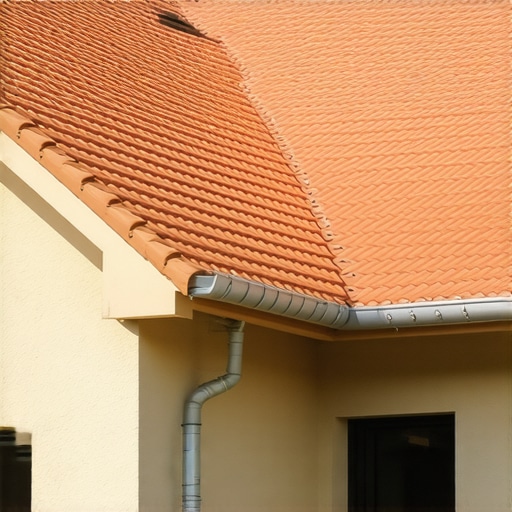
Slate roof gutter care and tile roof gutter support are in a category of their own. You cannot simply screw a standard hanger into the soffit and expect it to hold. Slate and tile roofs are incredibly heavy, and the water runoff from these surfaces is more aggressive because the materials are non-porous. For these homes, we use heavy-duty copper or thick-gauge aluminum with specialized brackets that provide tile roof gutter support without putting pressure on the tiles themselves, which would cause cracking. We often recommend round downspout services for these high-end installs. A round downspout (or leader) has a higher flow velocity than a rectangular one of the same width because it lacks the internal corners where debris can snag and water can swirl into turbulence.
The Weak Links: End Caps and Sealants
Even the most expensive ‘maintenance-free’ system is only as good as its weakest joint. End cap replacement is one of the most common service calls I get. Most installers use cheap silicone that dries out and shrinks in the sun. Once an end cap leaks, the water drips directly onto the corner of the foundation. In 2026, we are seeing more use of high-polymer sealants that remain flexible for decades, but these must be applied to a bone-dry, clean surface—something ‘blow-and-go’ crews never do. A proper miter (the corner joint) should be strip-mitered and pop-riveted, not just slapped together with a box miter and a prayer.
The Verdict: Is It Worth It?
Are these systems worth it? Yes, but only if you view them as ‘low maintenance’ rather than ‘no maintenance.’ A high-quality gutter installation with a professional-grade micro-mesh and proper gutter apron flashing will reduce your cleaning frequency from twice a year to once every three or four years. But you still have to check the splash block at the bottom of the leader. You still have to ensure the end cap isn’t weeping. And most importantly, you have to ensure the system is actually moving water away from the house. If you see a green patch of moss on your soffit, the system has already failed, regardless of what the marketing brochure promised.