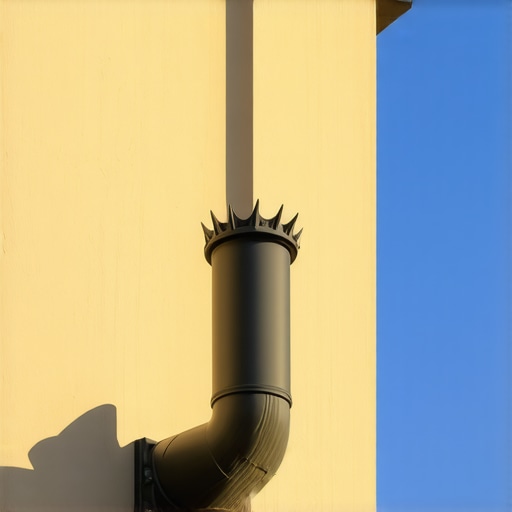
The Invisible Saboteurs of Your Drainage System
In my twenty-five years of engineering water management systems, I have seen every manner of debris attempt to compromise a home. Most homeowners obsess over leaves and pine needles, but they overlook the tactical engineers of the animal kingdom: birds. When a bird decides that your gutter miter or the mouth of your leader pipe is the perfect foundation for a multi-generational housing complex, your entire drainage strategy is at risk. Rain is a persistent, destructive force. It is not a gentle visitor; it is a fluid weight that seeks out every weakness in your fascia and soffit. When birds build nests, they aren’t just creating a home; they are creating a hydro-blockage that can lead to thousands of dollars in foundation damage. I have walked onto job sites where the entire built-in gutter system was backed up for thirty feet because a single sparrow family decided the downspout was a cozy alcove. This is why we need to discuss the engineering behind bird spike installations as a primary defense mechanism.
The Narrative of the Avian Dam
I recall a specific project for a client who had recently invested in high-end steel gutter services. Within six months, they called me back, complaining that water was cascading over the front porch like a localized monsoon despite the lack of trees nearby. I climbed the ladder and found what I now call the Avian Fortress. A pair of starlings had moved into the elbow of the downspout. They hadn’t just used twigs; they had scavenged bits of plastic, mud, and even aluminum foil. This composite material had effectively sealed the three-by-four inch leader. Because the water had nowhere to go, it sat stagnant, increasing the weight on the hangers by nearly eight pounds per linear foot. The hydrostatic pressure eventually forced water behind the drip edge and into the wooden fascia board, causing early-stage rot on a brand-new installation. This is the reality of avian interference; it is a structural threat that begins with a simple nest.
[IMAGE_PLACEHOLDER]
Hydro-Zooming: The Physics of the Downspout Obstruction
To understand why bird spikes are necessary, you must understand the physics of water flow within a gutter. Water has surface tension and momentum. In a clean system, gravity pulls water toward the downspout, and as it enters the drop outlet, it accelerates. This velocity is crucial for carrying away small granules from asphalt shingles. However, when a nest is present, it creates a turbulent flow. Water hits the organic mass and loses its kinetic energy. This causes the water to pool, which is the beginning of the end for your gutters. When water pools, it increases the risk of rust in older systems and creates a breeding ground for mosquitoes. More importantly, it creates a weight load that most spike and ferrule systems cannot handle. I hate spikes and ferrules because they pull out of the wood over time as the gutter expands and contracts. We only use heavy-duty hidden hangers spaced every twelve inches to ensure that even if a temporary blockage occurs, the system doesn’t rip off the house. But the goal is to prevent the blockage entirely.
“Downspouts shall be sized based on the rainfall intensity of the region and the roof surface area.” – International Plumbing Code, Section 1106
The Engineering of Bird Spikes
Bird spikes are not about harming the animals; they are about changing the structural geometry of the gutter edge. By installing stainless steel or polycarbonate spikes along the rim and specifically around the downspout openings, you eliminate the landing and nesting platform. This is a critical component of any comprehensive landscape integration services plan. If a bird cannot land, it cannot build. We often integrate these spikes during a box gutter installation or when we are performing gutter sizing calculations for a new build. You have to account for the local environment. If you are in a heavily forested area, the birds are more aggressive in their search for sheltered spots. The spikes act as a physical deterrent that keeps the entrance to the leader pipe clear, ensuring that your downspout extension services actually have water to move away from the foundation.
The Drainage Hierarchy: Beyond the Gutter
A gutter system is only as good as its exit point. Once we have secured the top of the system with bird spikes and high-quality steel gutters, we have to look at where that water goes. This is where downspout extension services and French drains come into play. If you are collecting water for a greenhouse gutter collection system, the last thing you want is avian waste and nesting materials contaminating your water supply. Pure rainwater is a resource, but bird-contaminated water is a hazard. We often recommend telescopic gutter tools for homeowners who want to keep an eye on their spikes without climbing a ladder every week. These tools allow for a quick visual check to ensure that no stray twigs have been dropped between the spikes, which can occasionally happen during the spring nesting season.
“Gutters and downspouts shall be constructed of materials that are resistant to corrosion and shall be securely fastened to the structure.” – SMACNA Architectural Sheet Metal Manual
Materials and Longevity
When considering the cost, many homeowners look for financing for gutter installs to ensure they get the best materials. I always steer people away from cheap plastic guards or bamboo gutter alternatives if they have a real bird problem. Bamboo might look aesthetic for a garden feature, but it lacks the structural integrity to withstand the pecking and nesting habits of larger birds like pigeons or crows. Steel and heavy-duty aluminum are the only ways to go. We focus on seamless transitions and mitered corners that are sealed with high-grade solar-sealant. The bird spikes should be riveted or screwed into the top lip of the gutter, not glued. Glue fails under the intense UV radiation and the thermal expansion of the metal. If you want a system that lasts thirty years, you build it with mechanical fasteners and high-grade alloys.
Climate Context: Managing Volume and Debris
In regions with heavy rainfall, the volume of water can be staggering. A one-inch rain on a 2,000 square foot roof produces over 1,200 gallons of water. If your downspout is even partially blocked by a nest, that water will back up in seconds. This is why oversized six-inch gutters and four-inch downspouts are becoming the standard. The larger the opening, the harder it is for a bird to completely block it, but the bird spikes are still the primary line of defense. By maintaining a clear path for the water, you ensure that the flow velocity remains high enough to self-clean the bottom of the gutter. It is all about managing the fluid dynamics of the roof run-off and ensuring that the water is moved at least ten feet away from the foundation to prevent soil saturation and hydrostatic pressure against your basement walls.