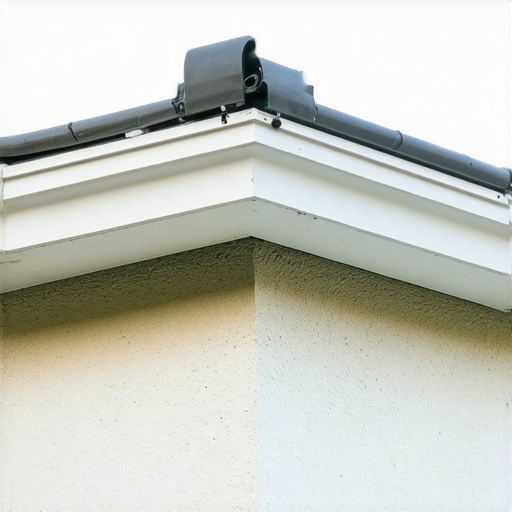
The Invisible Killer of Your Home’s Structural Integrity
I’ve spent over two and a half decades on ladders, and if there is one thing I have learned, it is that water is a patient predator. It doesn’t need a flood to ruin your home; it just needs a tiny gap and the laws of physics. In 2026, as we see more extreme weather patterns, the old ways of simply ‘hanging a trough’ are resulting in catastrophic failures. I recently inspected a home where the owner was baffled. They had a premium roof and brand-new gutters, yet the paint on their fascia was bubbling and the wood underneath felt like wet cardboard. Upon closer inspection, the installer had skipped the gutter apron. That missing three-inch piece of metal resulted in a $12,000 repair bill for rot that had traveled all the way into the rafter tails. This is the reality of modern water management: if you don’t control the flow, the flow controls your bank account.
“Flashings shall be installed in a manner that prevents moisture from entering the wall or the structural components of the building.” – International Residential Code (IRC), Section R903.2
When we talk about gutter apron flashing, we aren’t talking about a luxury add-on. We are talking about the critical bridge between your roof deck and your water evacuation system. Without it, you are relying on luck. Most people assume that water just rolls off a shingle and falls into the gutter. Physics tells a different story. Due to surface tension—the same force that allows some insects to walk on water—rainwater often curls back under the edge of the shingle. It ‘wicks’ upward and backward, finding the narrowest gap between the roof deck and the fascia board. This is where fascia rot begins. It starts as a microscopic dampness, then turns into a fungal colony, and eventually, your hidden hanger systems lose their grip because the wood they are screwed into has the structural integrity of a sponge.
The Physics of the Drip: Why Standard Drip Edges Fail
Many contractors will tell you that a standard ‘D-style’ drip edge is enough. They are wrong. A drip edge is designed to push water away from the roof, but in high-wind events or heavy downpours, water is easily blown back against the fascia. A true gutter apron has a longer leading edge that extends deep into the gutter trough. This ensures that even when water is moving at high velocity or being pushed by 40-mph winds, it has no choice but to enter the gutter. This is especially vital for homes with composite shingle services or those requiring shake roof gutter protection, where the thickness of the roofing material can create larger gaps that water loves to exploit. If your coping cap alignment is off even by a fraction of an inch, you are essentially inviting a slow-motion flood into your attic space.
The 2026 Climate Reality: Ice Dams and Weight Loads
For those of you in northern climates, the gutter apron is your primary defense against the ‘Ice Dam Explosion.’ When snow melts on your roof and refreezes at the eaves, it creates a pool of standing water. If you don’t have a properly installed apron tucked behind the gutter and over the fascia, that water will find its way behind the gutter. I’ve seen 40-foot runs of seamless gutters ripped clean off a house because water leaked behind the trough, froze, and expanded, prying the hidden hanger systems out of the rotted wood. We aren’t just dealing with rain anymore; we are dealing with massive weight loads. A gutter filled with ice can weigh hundreds of pounds. If that weight is supported by a rotting fascia board, the entire system is a ticking time bomb. This is why lifetime gutter guarantees are often worthless; read the fine print, and you’ll find they don’t cover damage caused by ‘improper flashing’ or ‘structural failure of the fascia.’
“The collector’s flange shall extend at least 2 inches onto the roof and be stripped in with a layer of felt or membrane.” – SMACNA Architectural Sheet Metal Manual
The Fallacy of ‘Maintenance-Free’ Solutions
I get calls every week from homeowners who fell for the ‘never clean your gutters again’ sales pitch. They’ve installed foam gutter inserts or snap-in gutter screens, thinking their problems are over. Here is the grumpy truth: there is no such thing as a maintenance-free system. Foam gutter inserts act like a giant petri dish, trapping organic silt and becoming a heavy, water-logged mess that promotes fascia rot by keeping moisture in constant contact with the roof edge. Snap-in gutter screens often collapse under heavy debris, and worse, they can interfere with the gutter apron if not installed by a pro. I’ve seen homeowners try to save a few bucks with leaf blower gutter cleaning, only to blow their joint sealant repair right out of the miter joints because they didn’t understand the pressure limits of the sealant.
Engineering the Perfect Evacuation: Beyond the Trough
Managing water doesn’t stop at the end cap. Once the water is in the leader (downspout), you need to get it away from the foundation. I’ve walked around houses where the erosion control downspouts were dumping thousands of gallons of water directly into the corner of the foundation. Within five years, that house had a two-inch sink in the foundation. You need a holistic approach: hidden hanger systems spaced every 12 to 16 inches for strength, a perfectly calculated pitch/slope of 1/4 inch per 10 feet, and erosion control downspouts that terminate at least 10 feet from the crawlspace or basement. If you are dealing with a miter that constantly leaks, don’t just slap more caulk on it. A joint sealant repair is a temporary fix; often, the leak is a symptom of a ‘clog-induced backup’ that has pressurized the joint.
The Specialist’s Checklist for 2026
When you are auditing your home’s exterior, look for these red flags. First, look at the soffit. Is there staining? If so, water is getting behind your gutters. Second, check the splash block. Is it displaced? This indicates your leader is discharging too much volume for the current setup, possibly requiring an upgrade to 6-inch gutters. Third, inspect the coping cap alignment on any parapet walls. Water should never be allowed to sit. In 2026, we are recommending ‘over-engineered’ solutions. This means heavy-gauge aluminum, hidden hanger systems with stainless steel screws, and always, without exception, a heavy-duty gutter apron. Don’t let a ‘cheap’ install ruin your most valuable asset. Water is coming for your house; make sure you’ve given it a clear, armored path to the ground.