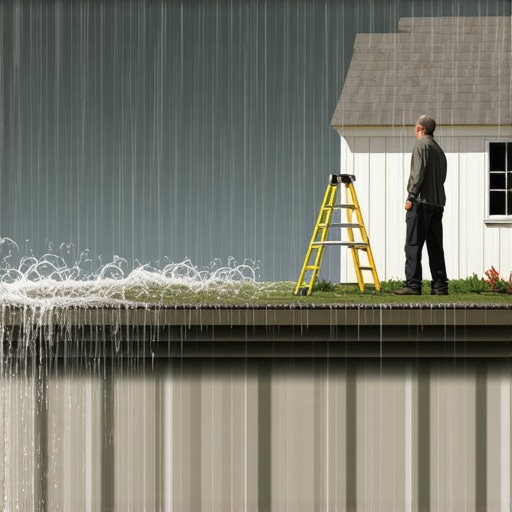
The Physics of the Drip: Why Your Gutters Are Actually Failing Your Home
I have spent nearly three decades on a ladder, and if there is one thing I have learned, it is that most homeowners treat their gutters like an afterthought until the basement smells like a swamp or the fascia board starts to crumble like a wet cracker. We are talking about water management, not just hanging some aluminum troughs. When we look at the title of this discussion, we are addressing the literal peak of ladder stress. Every time the clouds turn grey, the anxiety kicks in. Will the miters hold? Will the leaders clog? After twenty-five years as a specialist, I can tell you that the solution is not just about keeping leaves out; it is about mastering the physics of surface tension. I remember a job in a heavily wooded suburb where a homeowner had installed some cheap, hardware-store snap-in gutter screens. He thought he was safe. I arrived to find a massive oak limb had dropped enough organic silt to turn those screens into a solid shelf. Rainwater was hitting that shelf and launching straight over the edge, landing right against his foundation. Over five years, that concentrated stream eroded the soil so badly that the corner of his porch settled three inches. This is the reality of poor water management. It is a slow-motion wrecking ball.
“Downspouts shall be sized based on the rainfall intensity of the region and the roof surface area.” – International Plumbing Code, Section 1106
The Hydro-Physics of Surface Tension and the Coanda Effect
To understand why surface tension screens are the answer to ladder stress, you have to understand the Coanda effect. This is the tendency of a fluid jet to stay attached to a convex surface. In high-end gutter installation, we use this principle to our advantage. A surface tension screen is designed with a rounded nose. As water flows off your roof and hits the guard, surface tension causes the liquid to wrap around that curved edge and drop into the trough, while leaves, twigs, and pine needles, which lack that fluid property, are shot off the edge and onto the ground. This is hydro-zooming in action. During a heavy downpour, water velocity is high. If you use a standard mesh, the water often bridges the small holes through sheer speed, skipping over the gutter entirely. A properly engineered surface tension system manages that velocity, forcing the water to follow the curve. This is why we focus so much on the pitch. If the gutter is not sloped at exactly one-quarter inch per ten feet toward the leader, even the best guard will fail because the water will back up and break that tension bond.
The Critical Role of Wood Shake Gutter Flashing and Aprons
Many failures start before the water even reaches the gutter. If you have a wood shake roof or even standard shingles, the interface between the roof deck and the gutter is a primary failure point. This is where gutter apron installation becomes non-negotiable. Without a proper metal apron tucked under the first course of roofing and over the back of the gutter, water will inevitably wick backward. This is capillary action, the enemy of your home. It pulls water behind the gutter, where it saturates the fascia board. I have seen countless fascia board repair jobs that could have been avoided with a ten-dollar piece of flashing. When water rots that wood, the hangers lose their grip. Once the hangers pull out, the pitch is ruined, and you have a hundred-pound aluminum snake hanging off your house. We often see this in older homes where end cap replacement was done poorly, leaving a gap where water can seep into the rafter tails. Every component, from the miter to the end cap, must be a watertight seal to prevent the slow rot that eventually demands expensive gutter repair services.
Why Half-Round Gutter Installation Requires More Than Just Good Looks
While most modern homes use K-style gutters, many of my clients prefer the aesthetic of half-round gutter installation. They look classic, especially on historic renovations, but they are a different beast entirely when it comes to drainage. Half-round gutters have less volume capacity than a K-style of the same width. This means your drainage math has to be perfect. You cannot just slap on any guard. You need a system that accounts for the lower carrying capacity. If you are adding a pergola gutter addition, for instance, you are dealing with a smaller footprint where water needs to be diverted rapidly to avoid splashing onto the deck or patio. In these cases, we often install gutter flow sensors. These are not toys; they are early warning systems that tell you if a blockage is forming before you see the overflow. For a homeowner tired of the ladder, these sensors provide peace of mind that the system is functioning at peak efficiency.
“Gutters and downspouts shall be maintained in good repair and free from obstructions.” – International Property Maintenance Code, Section 304.7
The Solution for Forested Environments: Beyond the Snap-In Screen
If you live under a heavy canopy of oak or maple, those basic snap-in gutter screens are a recipe for frustration. They act as a filter, and filters eventually clog. The surface tension helmet design is the only way to significantly reduce maintenance. When we perform a full gutter installation, we look at the tree type. Pine needles are the worst; they find their way into every crack. A surface tension system with a minimal opening is the only thing that keeps those needles out of the trough. This prevents the heavy sludge that builds up and weight-stresses the hangers. When we talk about ladder stress, we are talking about the frequency of cleaning. No system is zero-maintenance, but moving from four cleanings a year to one inspection every two years is a massive win for any homeowner. We also ensure that we use heavy-duty hangers spaced every twelve to eighteen inches, rather than the old-fashioned spikes and ferrules which eventually pull out of the wood. This structural integrity ensures the system can handle the weight of water during a tropical deluge or a heavy spring rain.