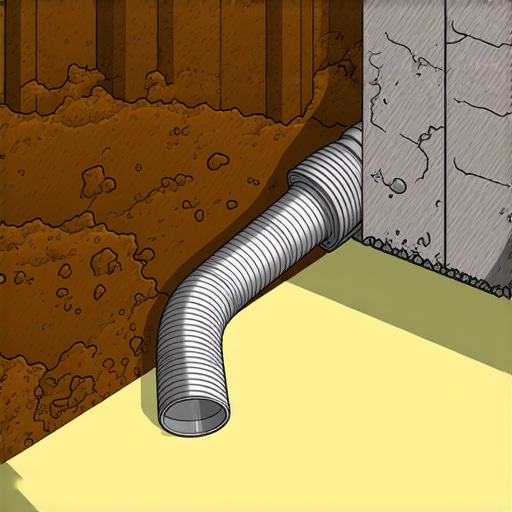
The Deceptive Simplicity of the Flexible Extension
I have spent over a quarter-century looking at water damage, and if there is one thing that makes my blood boil, it is the sight of a $15 plastic ‘accordion’ tube dangling off the end of a high-quality drainage system. Homeowners see a cheap solution to move water away from the house. I see a ticking time bomb. I remember a property in the rolling hills of the Pacific Northwest where a client had recently invested in box style seamless gutters. The installation was beautiful, but to ‘save money’ on the final run, the general contractor slapped on those flexible brown plastic extensions. The house sat on a 30-degree incline. Within two rainy seasons, the foundation near the master suite had settled nearly an inch. Why? Because those corrugated ridges inside the flexible pipe don’t just hold water; they trap every bit of asphalt grit coming off the roof. The extension became a heavy, silt-filled anchor that eventually snapped the leader right off the fascia, dumping five hundred gallons of water directly into the footer every time it poured. This is the reality of choosing convenience over engineering.
Hydro-Physics: Why Corrugation Kills Flow Velocity
When we talk about water management, we are talking about velocity and friction. In a smooth-wall rigid pipe, water maintains a laminar flow, sliding over the surface with minimal resistance. However, when you introduce a flexible extension on a steep slope, the internal corrugation creates massive turbulence. Think of it as a series of tiny speed bumps. As water hits these ridges at high speed due to the steep grade, it creates micro-vortices. These vortices don’t just slow the water down; they act as catchment basins for debris. If you have recently had composite shingle services, those tiny granules shed by the new shingles will settle into these ridges. On a steep slope, the gravity should be your friend, but the friction of the plastic pipe turns that advantage into a liability. The water begins to back up, increasing the weight of the extension until the hanger system fails or the elbow connection shears off.
“Roof drainage systems shall be designed to withstand the maximum calculated load of water.” International Plumbing Code, Section 1106
This standard is impossible to meet when your discharge point is a piece of flimsy plastic prone to internal clogging.
The Structural Integrity of the Box Style Seamless Gutter
To understand why flexible extensions are such a mismatch, we have to look at the source. Modern gutter machine forming allows us to create box style seamless gutters that can handle immense volumes of water. These systems are rigid, engineered for specific weight loads, and designed to move water to the leader (downspout) with clinical precision. When this rigid system meets a flexible extension, you are creating a weak link in the chain. During a heavy downpour, the volume of water exiting a 6-inch box gutter is significant. If that water hits a bottleneck caused by a kinked or debris-filled flexible extension, the hydrostatic pressure builds up backward. I have seen this pressure force water behind the TPO roof gutter flashing, rotting out the soffit and the rafter tails from the inside out. This is why soffit ventilation during install is so critical; it allows the wood to breathe, but it cannot save a system that is fundamentally blocked at the exit point.
The Dangers of Steep Slope Transitions
Steep slopes present a unique challenge for metal roof gutter transition points. On a metal roof, water moves significantly faster than on asphalt. When that water reaches the gutter and is funneled into a downspout, it has a high kinetic energy. If you use a flexible extension on a hill, that energy is wasted on internal friction. Worse, the ‘stretch-to-fit’ nature of these products means they are often thinner than rigid PVC or aluminum. Over time, UV exposure and the physical stress of the water’s weight cause the plastic to crack. A drone gutter inspection often reveals these cracks on the underside of the pipe where the homeowner can’t see them. By the time you notice the splash block is dry during a storm, the water has already found a path under your foundation. This is where camera scoping for gutters becomes invaluable. We can run a line through the drainage path and show the homeowner the literal pounds of sludge sitting in the ‘flexible’ part of their system.
Professional Alternatives: Downspout Relocation and Rigid Drainage
If your property has a steep grade, the only real solution is downspout relocation combined with rigid, smooth-bore piping. We use gutter machine forming to create custom lengths of aluminum or copper that can be securely anchored to the structure. This ensures that the miter joints and end cap seals aren’t under unnecessary stress.
“The capacity of a gutter is dependent upon its shape, size, and the slope of the gutter.” SMACNA Residential Sheet Metal Guidelines
When we engineer these systems, we calculate the exact square footage of the roof to determine if a 2×3 or 3×4 leader is required. If the slope is extreme, we might even install a metal roof gutter transition that includes a high-flow collector box. This isn’t just about ‘cleaning’ the system; roof gutter sweeping and maintenance are easier when you have a rigid system that doesn’t sag or trap needles in plastic ribs. Using drone gutter inspection technology allows us to verify that the pitch is correct throughout the entire run, ensuring that water never sits still long enough to breed mosquitoes or cause rust. In the end, your home is likely your largest investment. Don’t protect its foundation with a plastic toy. Invest in a rigid, engineered drainage path that respects the destructive power of moving water.