The Invisible Weight: Why Your Gutters Are Failing
Gravity is the silent predator of the American home. Most homeowners look at their roofline and see a simple metal channel, but as someone who has spent two and a half decades on a ladder, I see a hydraulic management system under constant stress. When that system begins to bow, it is not just an aesthetic flaw; it is a structural emergency in the making. Water is heavy. A single gallon of water weighs approximately 8.34 pounds. During a typical storm in a northern climate, a 40-foot run of gutter can easily be asked to manage hundreds of gallons per minute. If the pitch is off by even a fraction of an inch, that water pools. You are no longer looking at a drainage tool; you are looking at a 300-pound horizontal pendulum tearing at your fascia board.
The Case of the Sinking Porch: A Cautionary Tale
I recall a call out to a colonial-style home in a suburb prone to heavy lake-effect snow. The homeowner complained about a damp smell in the mudroom. I walked the perimeter and found the culprit immediately. A 30-foot section of seamless aluminum had sagged in the middle, creating a valley. Because the hidden hanger systems had been spaced thirty inches apart instead of the recommended eighteen for heavy snow zones, the weight of the previous winter’s ice had bent the metal. This sag caused water to overtop the back of the gutter, running down the soffit and directly into the foundation. Over three years, this constant saturation caused the front porch footer to settle by nearly three inches, cracking the masonry. This entire disaster started because a screw moved half an inch. It is a perfect example of why precision in hanger adjustment is the difference between a dry basement and a five-figure repair bill.
“Downspouts shall be sized based on the rainfall intensity of the region and the roof surface area.” – International Plumbing Code, Section 1106
The Physics of the Sag: Why Spikes Fail and Hangers Rule
To understand the fix, you have to understand the failure. Old-school gutter installations relied on spikes and ferrules. These are essentially giant nails driven through the gutter, through a spacer, and into the fascia. Over time, the expansion and contraction of the wood, combined with the freeze-thaw cycles of winter, cause the wood fibers to lose their grip. The spike backs out, the gutter tilts forward, and the sag begins. Modern hidden hanger systems are a massive improvement, using a heavy-duty screw that bites deep into the sub-fascia or rafter tail. However, even these are subject to the laws of physics. If the installer didn’t hit the rafter or used too few hangers, the leverage of the water’s weight will eventually pull the front lip of the gutter down. This creates a ‘belly’ in the line where organic sludge, pine needles, and stagnant water collect, further increasing the weight load and accelerating the failure.
Hydro-Zooming: The Mechanics of the 1/4 Inch Slope
Flow velocity is the key to a self-cleaning gutter. We aim for a pitch of 1/4 inch for every 10 feet of run. This may seem negligible, but it is scientifically calculated to ensure that water moves fast enough to carry small debris toward the leader without moving so fast that it overshoots the mitered corners. When a gutter sags, you lose this velocity. The water stalls. Surface tension then takes over, allowing the water to ‘wick’ back under the shingles or overflow the front edge. This is why automated cleaning systems and micro-mesh gutter guards are so popular; they attempt to keep the debris out, but if the underlying pitch is wrong, even the most expensive guard will fail as the water simply sits atop the mesh and spills over.
The Instant Fix: Adjusting Your Hidden Hanger Systems
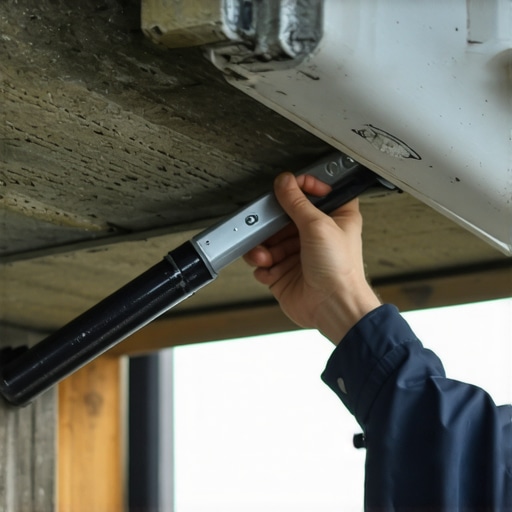
The solution to a sagging gutter is rarely a full replacement. Most of the time, it is a matter of re-establishing the structural integrity of the line. First, identify the high point of the run, usually the end furthest from the downspout. Using a string line and a level, mark the desired low point at the downspout opening. If you have a belly in the middle, you must back out the screws on the hidden hangers in that section. By using a specialized gutter tool or a simple pry bar, you can lift the channel back into alignment with your string line. The secret is to install additional hangers between the existing ones. In regions where gutter winterization is a priority due to ice dams, I recommend spacing hangers every 12 inches. This distributes the weight load across more points of contact on the fascia, preventing the metal from bowing under the weight of frozen slush.
“Gutter systems must be securely fastened to the building structure to withstand the anticipated weight of water and debris, as well as wind and snow loads.” – SMACNA Architectural Sheet Metal Manual
Advanced Considerations: From Wood Shakes to Patio Covers
Not every house is a simple gable. For those with luxury finishes, such as wood shake gutter flashing, the margin for error is zero. Wood shakes are porous and prone to rot if they are constantly wicked by standing water. Similarly, patio cover gutters often have limited mounting surfaces, making the choice of hanger even more critical. In these scenarios, downspout extension services are vital to ensure that once the water is successfully channeled through the gutter, it is moved at least six to ten feet away from the structure. We often use pop-up emitters or underground PVC lines to achieve this. If you are dealing with a built-in gutter system, also known as a box gutter, the repair is more complex, often involving soldering and custom copper work to ensure the internal lining hasn’t been breached by years of standing water caused by poor original slope.
The Final Word on Water Management
Protecting a home is an exercise in vigilance. Color-matched gutters might make the house look beautiful, but their primary job is utilitarian. If you see water dripping from the middle of a run during a rainstorm, or if you notice tiger-striping on the face of the aluminum, you have a pitch problem. Don’t wait for the foundation to crack or the fascia to rot. Grab a drill, a box of high-quality hidden hangers, and a string line. Re-establish that 1/4 inch slope and ensure your home stays dry. Water is a force of nature, but with the right engineering, it is a force you can control.
Comments are closed.