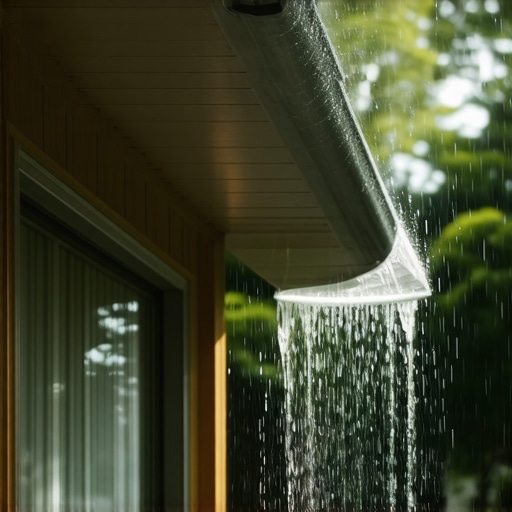
The Invisible Force Threatening Your Home’s Foundation
As a specialist who has spent over two and a half decades on ladders, I have seen more ‘flood-proof’ basements than I can count that were destroyed not by a rising river, but by a simple 5-inch gutter system that failed to do its job. Water is the universal solvent; it is patient, heavy, and relentless. When spring storms arrive, they don’t just bring rain; they bring a volume of water that most standard residential systems are ill-equipped to handle. Most homeowners think of their gutters as passive troughs, but in reality, they are the primary defense in a complex hydraulic management system. If that system fails, the damage starts at the fascia and ends at the footer of your foundation.
The $15,000 Downspout Lesson
I remember walking around a property in the suburbs where the homeowner was convinced he had a major plumbing leak under his concrete patio. The slab had settled nearly three inches, causing a massive crack that ran right toward the basement wall. After a quick inspection, I didn’t look at the pipes; I looked up. A single end cap replacement had been ignored for years, and a poorly aimed leader was dumping the runoff from an entire 800-square-foot roof section directly into the corner where the patio met the house. Over five seasons, that concentrated flow of water had scoured the soil beneath the slab, creating a void. It wasn’t a plumbing failure; it was a management failure. A simple upgrade to a 3×4 rectangular downspout install and proper water diversion could have saved him a fifteen-thousand-dollar masonry bill. This is why I obsess over the details that most ‘chuck-in-a-truck’ installers ignore.
“Storm drainage systems shall be provided for the conveyance of all storm water from the roof to an approved point of disposal.” – International Plumbing Code, Section 1106.1
The Physics of the Spring Deluge: Hydro-Zooming into Failure
To understand why your current setup might be failing, we have to look at the physics of water movement. During a heavy spring downpour, water doesn’t just fall off your roof; it gains velocity. On a steep-pitch roof, that water reaches a speed that can actually cause it to ‘jump’ over a standard 5-inch K-style gutter. This is known as overshoot. When water moves this fast, surface tension allows it to cling to the underside of the shingles and curl back behind the gutter if you lack a proper gutter apron aluminum flashing. This leads to rot in the fascia and soffit, which is often hidden until the wood is soft enough to poke a finger through.
Furthermore, we have to consider the weight. One gallon of water weighs approximately 8.34 pounds. In a heavy storm, a 50-foot run of gutter can be carrying hundreds of pounds of water at any given second. If your system relies on old spike and ferrule repair jobs, you are asking for trouble. Spikes are just large nails driven through the gutter and into the fascia. Over time, the constant expansion and contraction of the metal, combined with the weight of the water, pulls those spikes out. Once they loosen, the pitch of the gutter is lost. A gutter without a 1/4-inch slope per 10 feet of run is just a long, heavy mosquito pond. This is why modern systems require hidden hangers with heavy-duty screws spaced every 12 to 18 inches, especially in regions prone to snow melt gutter solutions where ice weight is a factor.
The Hierarchy of Drainage: Beyond the Gutter
True water management doesn’t end at the end cap. A common mistake I see is a perfect gutter installation that dumps water two feet from the foundation. This is where the sump pump linkage becomes critical. If your gutters are discharging water that eventually seeps into your foundation, your sump pump has to work twice as hard to push it back out. It is a closed-loop of failure. Upgrading to a professional drainage system involves moving that water at least 10 feet away from the structure. This often requires a half-round gutter installation for higher flow capacity or the use of 6-inch oversized seamless aluminum to handle the sheer volume of a spring ‘gully washer’.
“Gutters and downspouts should be designed to handle the anticipated water volume based on local rainfall intensity records.” – SMACNA Architectural Sheet Metal Manual
Identifying the Need for Old Gutter Demolition
How do you know it is time to move on? Look for the ‘tiger stripes’ on the front of your gutters. These are streaks caused by water constantly overflowing and taking debris with it. Look at your miters. Are they leaking at the corners? If you see daylight through a corner joint, no amount of sealant will fix it permanently. The metal has likely fatigued. This is the time for old gutter demolition. Modern color-matched gutters not only improve curb appeal but utilize factory-mitered corners and high-grade sealants that withstand the UV breakdown that ruins older systems. We also now have the technology for smart gutter monitoring, which uses sensors to alert you to clogs before the water starts backing up into your attic.
The Truth About Gutter Protection
Everyone wants ‘maintenance-free’ living, but the reality is that water needs a clear path. While guards can help, they must be matched to your specific environment. If you have oak trees, a standard perforated screen will clog with tassels in one afternoon. If you have pine needles, you need a micro-mesh that prevents those needles from ‘weaving’ into the holes. The goal of a guard is to reduce the frequency of cleaning, not to eliminate the need for inspection. A failed guard is worse than no guard because it gives the homeowner a false sense of security while water is secretly rotting the roof deck above them. Proper installation of these systems is an engineering task, requiring a deep understanding of slope, volume, and the structural integrity of the home’s exterior.
Conclusion: Respect the Water
In 25 years, I’ve learned that you cannot fight water; you can only guide it. If your gutters are sagging, leaking, or undersized, you aren’t just looking at a minor repair; you are looking at a ticking clock for your home’s foundation. Upgrading to high-capacity leaders and ensuring your fascia is protected by a proper apron is the only way to sleep soundly during a spring storm. Don’t wait for the basement to smell like a swamp. Address the roof-line drainage now, and keep the water where it belongs: away from your home.