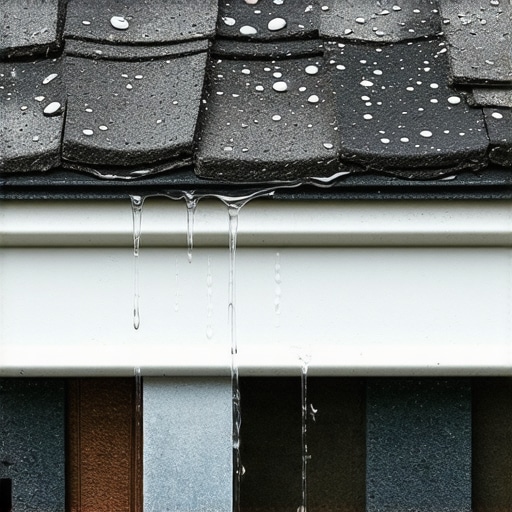
The Hidden Engineering of the Roof Edge
I once walked a property where the homeowner was convinced his foundation was haunted by rising groundwater. In the northwest corner, the concrete had settled so severely that a hairline fracture had opened up wide enough to swallow a butter knife. He had spent thousands on interior waterproofing, yet the basement still smelled like an old shipwreck. I didn’t look at his sump pump. I grabbed my ladder and looked at his roof edge. What I found was a classic rookie mistake: the shingle starter strip was installed flush with the drip edge, or in some spots, recessed by a quarter inch. For five years, every storm didn’t just fill the gutters; it sent a silent, steady stream of water behind the fascia board, down the wall cavity, and directly into the soil surrounding the footer. That is why the shingle starter position dictates your gutter success: it is the first point of contact where gravity and surface tension decide the fate of your home. If the shingle does not extend at least three quarters of an inch past the drip edge, you are not managing water; you are inviting it into your framing.
“Gutters shall be placed below the extended roof line so that snow and ice can slide over them.” – SMACNA Architectural Sheet Metal Manual, Section 1.3
The Physics of Surface Tension and Overhang
Water has a frustrating property called capillary action. When rain hits a roof, it gathers speed as it moves down the slope. As it reaches the edge, if the shingle starter is too short, the water doesn’t simply drop into the trough. Instead, it wraps around the edge of the shingle and follows the undersurface back toward the fascia. This is where the rot begins. Over time, the constant moisture destroys the wood grain, making traditional spike and ferrule repair impossible because there is no solid wood left for the spike to bite into. We call this the drip-back effect. To combat this, your shingle starter must be the “launchpad.” It provides the necessary extension to ensure that the water’s velocity carries it safely into the center of the gutter, avoiding the back edge where it could infiltrate the soffit. When dealing with a metal roof gutter transition, the stakes are even higher. Metal roofs have much lower friction than asphalt, meaning the water moves significantly faster. Without a correctly positioned starter and a high-back gutter design, that water will overshoot the 5-inch standard gutter entirely during a heavy downpour.
Solving the Spike and Ferrule Failure
If you live in an older home, look at your gutter line. Do you see silver nail heads popping out from the front of the gutter? That is the old spike and ferrule system. It was the industry standard for decades, but it is fundamentally flawed. These spikes react to the expansion and contraction of the metal. In cold climates, as water freezes and expands inside the gutter, it puts immense outward pressure on the spike. Eventually, the hole in the fascia wallows out, and the gutter begins to sag. Once the pitch is lost, you get standing water. Standing water is heavy: a standard 10-foot section of gutter filled with water can weigh over 50 pounds. This weight pulls the spike further out, creating a gap between the gutter and the fascia. Our approach is to abandon spike and ferrule repair in favor of heavy duty internal hangers with 3-inch ceramic coated screws. These hangers clip into the front lip of the gutter and pull the back tight against the fascia, distributing the weight load more effectively and preventing the sagging that leads to mosquito breeding grounds and ice damming.
“Downspouts shall be sized based on the rainfall intensity of the region and the roof surface area.” – International Plumbing Code, Section 1106
Advanced Water Management: EPDM Seals and Automation
For more complex structures like patio cover gutters, we cannot rely on simple caulking. Patio covers often have lower pitches and different thermal expansion rates than the main house. This is where EPDM gutter seals come into play. EPDM is a synthetic rubber that maintains flexibility from forty below zero to three hundred degrees Fahrenheit. By using EPDM gaskets at the miters and end caps, we create a flexible joint that won’t crack when the sun beats down on the metal. In regions with heavy snow, we are also seeing a shift toward integrated home automation. Gone are the days of manually plugging in heat cables. Modern systems utilize app-controlled gutter heaters. These systems use moisture and temperature sensors to detect when an ice dam is likely to form. They only activate when needed, saving electricity while ensuring that the leader and the elbows remain clear of ice. This prevents the weight of a 200-pound icicle from ripping the entire system off the house.
The Drainage Hierarchy: Beyond the Gutter
A gutter system is useless if the water just dumps at the corner of the house. This is why downspout extension services are the final, critical step in the drainage hierarchy. We aim to move water at least ten feet away from the foundation. In high-traffic areas, we install underground lines leading to pop-up emitters in the lawn. This keeps the water from eroding your landscaping or flooding your walkways. During seasonal gutter cleaning, we don’t just scoop out the leaves; we flush these underground lines to ensure no silt has built up. If you are dealing with a multi-story gutter cleaning task, safety is paramount. Using ladder stabilizers is non-negotiable to avoid crushing the gutter walls. Furthermore, in some older properties, we encounter the hazard of asbestos gutter handling. Some vintage homes used Transite pipes for drainage. These are cement-asbestos composites. If these are cracked or need removal, they must be handled with specific wetting techniques and disposal protocols to prevent fiber release. It is a reminder that every component of your exterior drainage, from the shingle starter to the buried exit pipe, is a piece of a singular, protective machine.
Maintenance and the Myth of Zero Labor
Many homeowners ask about “maintenance-free” systems. Let me be clear: there is no such thing. Even with the best guards, you need seasonal gutter cleaning to remove the fine silt and shingle grit that settles in the bottom of the trough. This grit acts like sandpaper, wearing down the protective coating of the aluminum. A clean gutter is a fast-flowing gutter. By maintaining the correct pitch and ensuring your shingle starter provides that vital overhang, you extend the life of your home by decades. You aren’t just buying gutters; you are buying a dry basement and a stable foundation. Pay attention to the details, or the water will do the paying for you.