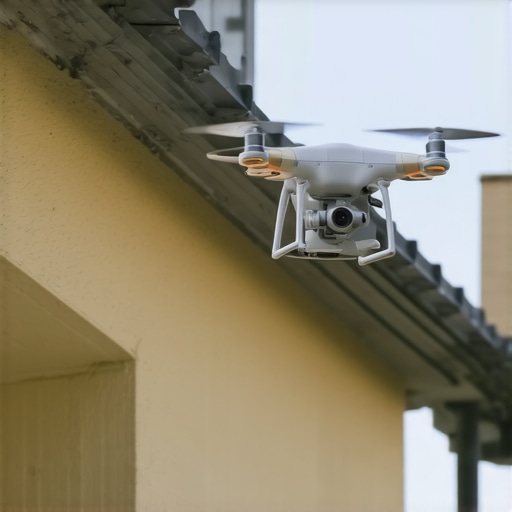
After twenty-five years on a ladder, I have learned one hard truth: water is a patient predator. It doesn’t just fall; it searches. It looks for the tiniest gap in your fascia, the slightest dip in your pitch, or the smallest crack in an end cap. Most homeowners think a gutter is just a metal trough, but it is actually a hydraulic management system that protects your single largest investment. For years, I did things the old way, hauling a forty-foot extension ladder around a property, sweating over every miter and elbow. But the introduction of drone technology has changed the math of maintenance. It is not about being fancy; it is about the physics of early detection and the reality of cost suppression. In a world where a wet basement can cost twenty thousand dollars to remediate, a drone is the ultimate scout.
The Phantom Blockage: A Coastal Warning
I remember a call out in a coastal neighborhood after a particularly nasty spring season. The homeowner was meticulous. He had high-end copper patina finishes that looked spectacular against his cedar siding. From the ground, everything looked perfect. He called me because he heard a strange ‘thumping’ sound during a heavy rain. We sent a drone up to look at the roofline of his third-story gables. What we found was a nightmare that no ladder could have easily spotted. A large sea bird had nested right inside the mouth of the leader, and the subsequent rain had packed silt and salt spray around it, creating a dam. Because the gutters were K-style gutter services with heavy-duty hangers, the weight hadn’t pulled them down yet, but the water was already bridging the gap behind the fascia board. This is where the damage happens. If we hadn’t used the drone, that water would have rotted the sub-fascia within two seasons. Instead, we identified the exact miter that needed clearing and followed up with a vacuum gutter extraction to pull the organic sludge out without making a mess of his expensive landscaping.
“Downspouts shall be sized based on the rainfall intensity of the region and the roof surface area.” – International Plumbing Code, Section 1106
Hydro-Zooming: The Physics of the Downpour
When we talk about maintenance costs, we have to talk about volume. In regions prone to heavy weather, you aren’t just fighting a drizzle; you are fighting a ‘gully washer.’ During a tropical storm, the velocity of water coming off a steep roof pitch is enough to overshoot a standard five-inch system. This is where a drone inspection provides invaluable data. By observing the ‘stain patterns’ on the roof and the wear on the gutter screen installation from a top-down perspective, we can see where the system is failing to keep up with the flow. We often find that a rectangular downspout install is necessary to replace smaller, circular leaders that simply cannot handle the cubic-feet-per-minute requirements of a modern storm. Drones allow us to see these flow patterns without the distortion of looking up from the ground. We look for the ‘splash-back’ effect on the soffit. If the soffit shows signs of moisture, it means the water is backing up at the hanger point. This is usually caused by an improper pitch. A proper system needs a slope of at least one-quarter inch per ten feet. If that slope is lost because a hanger has pulled out, the drone’s gimbal-stabilized camera will catch the standing water, which is a breeding ground for mosquitoes and a primary cause of rust in older systems.
The Spring Gutter Startup: Why Precision Matters
Every spring gutter startup should begin with a comprehensive view of the entire drainage hierarchy. We start at the highest point of the roof and work our way down to the splash block or the underground drain. Using drones, we can inspect the integrity of hurricane-rated installations. These systems use specialized brackets that are spaced more tightly, often every twelve inches, to ensure that the weight of water and wind doesn’t tear the metal away from the wood. If even one of those hangers is loose, the whole run is compromised. During a drone flight, we can also check the status of recycled plastic gutters on outbuildings. While these are cost-effective, they have a higher rate of thermal expansion than aluminum or copper. A drone can see if the sections have buckled or if the sealant at the joints has cracked. Once the inspection is complete, we move to vacuum gutter extraction. This is a far more efficient method than the old ‘hand-and-bucket’ style. It allows us to clear the entire run, including the hard-to-reach elbows, without the risk of damaging the color-matched gutters with ladder marks or heavy boots. It is a surgical approach to maintenance that extends the life of the system by years.
“Gutters and downspouts shall be properly sloped to prevent standing water and ensure the rapid discharge of storm water from the roof.” – SMACNA, Architectural Sheet Metal Manual
Matching Hardware to the Environment
One of the biggest mistakes I see is the ‘one size fits all’ approach to gutter screen installation. A homeowner in a pine forest needs a completely different solution than one in an area with broadleaf maples. Drone footage allows us to categorize the type of debris that is actually accumulating. If we see fine needles weaving into the mesh, we know a standard screen won’t work; we need a micro-mesh or a solid-surface helmet that utilizes surface tension to pull water into the trough while shedding the needles. We also look at the condition of the color-matched gutters. Over time, UV rays can degrade the finish, leading to chalking. A drone can spot this degradation early, allowing for a recoat or a targeted replacement before the metal itself begins to oxidize. For those with high-end architectural needs, we often discuss the transition to copper patina finishes. These systems are not just beautiful; they are incredibly durable. However, they require precise installation of the leader and miter joints to ensure that the natural oxidation doesn’t cause staining on the stone or brickwork below. A drone allows us to monitor that patina process across the entire roofline to ensure it is aging evenly.
The Financial Reality of Drone Inspections
The real reason drone inspections cut costs is the avoidance of ‘ladder-induced’ damage and the reduction of labor hours. Traditional inspections require two men and several hours to move equipment. A drone can map a four-thousand-square-foot roof in twenty minutes. This speed allows us to offer more frequent checks, which is the key to preventing major failures. We are looking for the ‘stress points’ where the gutter meets the fascia. If the fascia is starting to pull away, it is a sign that the drainage system is overloaded. By catching this early, we can recommend a rectangular downspout install to increase the exit velocity of the water. This prevents the weight from bowing the gutters and saves the homeowner from a full system replacement. Ultimately, water management is a game of inches and angles. Whether it is K-style gutter services or a custom-fabricated setup, the goal is to get the water off the roof and at least ten feet away from the foundation. Drones give us the bird’s-eye view necessary to ensure that every elbow, hanger, and splash block is doing its job. In the long run, the small cost of a tech-based inspection is nothing compared to the security of a dry basement and a solid foundation.