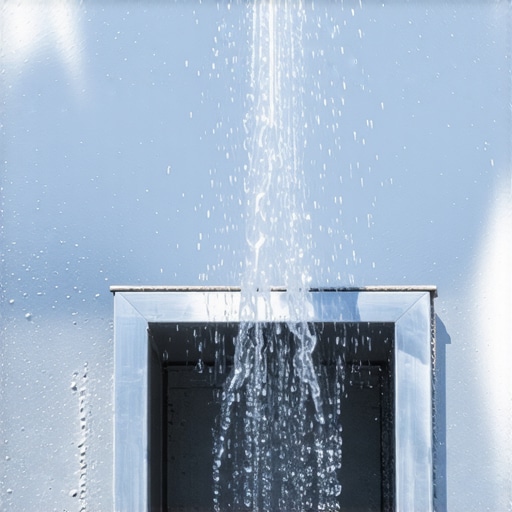
The Engineering Reality of Flat Roof Drainage
I walked around a commercial property last October where the owner complained of a small leak in the breakroom. When I climbed the ladder, I didn’t find a hole; I found a three-inch deep lake. The roof scupper drains were so severely undersized and choked with debris that the roof was holding approximately 15,000 pounds of unplanned water weight. The corner of the parapet wall was actually starting to hairline fracture under the lateral pressure. This is the reality of flat roof management: water is not your friend, and gravity is a fickle partner. When you are dealing with a flat or low-slope surface, you aren’t just installing a drain; you are managing a hydraulic system that must contend with surface tension, debris load, and the terrifying weight of standing water.
“Downspouts shall be sized based on the rainfall intensity of the region and the roof surface area.” – International Plumbing Code, Section 1106
Hydro-Zooming: The Physics of the Scupper Vortex
To understand why your flat roof is failing, you have to look at how water behaves at the point of exit. When rain hits a flat roof, it migrates toward the scupper through a combination of pitch and hydrostatic pressure. As the water approaches the scupper opening, it doesn’t just fall out. It creates a vortex. This swirling action introduces air into the center of the flow, which effectively reduces the diameter of your outlet pipe connection. If you have a 4-inch scupper, the air pocket in a heavy downpour might mean you are only getting the drainage capacity of a 2.5-inch pipe. This is why custom gutter fabrication is often necessary to create wide-mouth transitions that break the surface tension and allow for a smoother, faster exit velocity. Without proper sizing, the water backs up, the temperature drops, and suddenly you have an ice dam that can weigh more than a pickup truck sitting on your fascia.
The Hierarchy of Materials: Copper Gutter Installation and Longevity
In my 25 years in this trade, I have seen every material known to man. For flat roof transitions and high-end drainage, copper gutter installation remains the gold standard. Why? Because copper is the only material that handles the expansion and contraction of a flat roof’s edge without cracking its solder joints. When we perform custom gutter fabrication in copper, we are building a 100-year solution. Aluminum is great for your standard ranch home, but on a flat roof where the end cap replacement is a frequent necessity due to thermal movement, copper’s malleability and the ability to create 100% waterproof soldered seams make it the only logical choice for a serious building. We often see homeowners try to save money with sectional vinyl or thin-gauge aluminum, but those systems fail at the miter or the end cap within five seasons of heavy snow.
“The collector head shall be sized to provide a volume at least equal to the volume of the scupper and shall be located a minimum of 2 inches below the scupper flow line.” – SMACNA Architectural Sheet Metal Manual
Managing the Northern Threat: Gutter De-icing Services
In northern climates, the scupper is the first thing to freeze. Because the parapet wall stays colder than the heated interior of the building, water hits that cold masonry and turns to ice instantly. This is where gutter de-icing services become a mandatory part of the water management audit. We install self-regulating heat cables inside the scupper box and down the leader to ensure the path remains open. If that path freezes, the water has nowhere to go but backward, under the roofing membrane. This leads to the dreaded interior wall leak. A downspout relocation may even be required if the original architect placed the drain on the north-facing, shaded side of the building where sun-thaw cycles never reach. We move the leader to a warmer orientation or internalize the drain to prevent the catastrophic failure of a frozen system.
Safety and Compliance: Asbestos Gutter Handling
When dealing with older industrial flat roofs, we frequently encounter asbestos gutter handling requirements. You cannot simply rip out old transite or cementitious gutters. These materials are brittle and release hazardous fibers the moment they are disturbed. A professional specialist knows how to identify these legacy systems during the audit. We treat them with the respect the law demands, often involving encapsulation or specialized abatement before we can install a modern seamless gutter or scupper system. Ignoring this doesn’t just risk your health; it risks massive EPA fines that will cost more than the roof itself.
The Role of Protection: Gutter Screen Installation and Maintenance
Many people think gutter screen installation is a luxury, but on a flat roof, it is a structural necessity. Because flat roofs collect more organic debris that doesn’t just wash off, the scupper is a magnet for leaves and silt. However, you cannot use a standard mesh on a high-flow scupper. You need a specialized shake roof gutter protection style or a heavy-duty stainless steel cage. If the screen is too fine, the pollen and silt will create a biological mat that is actually more waterproof than the roof itself, causing an immediate backup. We look at the tree canopy surrounding the building. If you have oak or pine, we use a different gutter screen installation strategy than if you have broad-leaf maples. It is about matching the aperture of the screen to the specific debris of the micro-climate.
Calculating the Load: Why Sizing Matters
Most contractors just guess. They put a 3×4 leader on everything and call it a day. But if you have 5,000 square feet of roof and a 3-inch-per-hour rainfall rate, that 3×4 pipe is going to fail. We calculate the square footage and use regional rainfall charts to determine if you need a 4×5 or even a 6-inch round downspout relocation. We also look at the splash block or the underground tie-in. If the water leaves the roof but saturates the foundation because the outlet pipe connection isn’t directed five feet away from the wall, you’ve just traded a roof leak for a cracked foundation. End cap replacement and proper pitch are the final touches that ensure every drop of water is accounted for from the moment it hits the membrane to the moment it enters the storm drain. Water is the primary enemy of your home’s structural integrity. Treat your drainage system as the primary defense line it was meant to be. This involves checking every hanger, every soffit gap, and every miter for signs of fatigue before the next storm hits. High-velocity drainage is an engineering challenge, not a DIY weekend project.