The Unseen Enemy Above Your Herd
I have spent over a quarter century hanging metal on everything from suburban ranches to massive commercial warehouses, but nothing tests the limits of drainage engineering quite like a working barn. When you are responsible for a structure that houses living, breathing livestock, water management is no longer a matter of curb appeal; it is a matter of asset protection. A barn roof is essentially a massive, tilted plain designed to capture thousands of gallons of water and dump them directly at the base of your foundation. If that water is not controlled, it turns your dry lot into a swamp, rots your sill plates, and creates a breeding ground for hoof rot and respiratory issues in your animals. Many contractors try to slap up standard 5 inch residential systems on these buildings, and every time I see it, I know I will be back in three years to fix the wreckage.
The Collapse of the North Ridge Dairy Barn
I recall a call out to a farm in late March, just as the heavy slush of a tail-end winter storm was beginning to melt. The owner had a 120 foot long dairy barn with a metal roof. He had opted for the ‘budget’ installation two years prior: standard K-style gutters held up by spikes and ferrules spaced every three feet. During that storm, the weight of the saturated snow sliding off the metal roof hit that gutter with the force of a low-speed freight train. Because the spikes had no mechanical grip in the aged fascia, the entire 120 foot run didn’t just sag; it ripped away entirely, peeling back the gutter apron aluminum and exposing the raw wood to the elements. The livestock inside were subjected to a constant curtain of freezing water pouring through the gap, and the resulting erosion at the foundation line was deep enough to bury a man’s boot. This is why we don’t use ‘standard’ hardware on agricultural builds.
“Downspouts shall be sized based on the rainfall intensity of the region and the roof surface area.” – International Plumbing Code, Section 1106
The Physics of Surface Tension and High-Velocity Flow
When rain hits a metal barn roof, it doesn’t just trickle. Due to the lack of shingles to provide friction, the water achieves a high velocity, creating a sheet of liquid that can easily overshoot a standard gutter. This is where we look at the hydraulic head at the outlet. If your outlet pipe connection is too small, the water backs up instantly, creating a heavy standing pool in the trough. This weight is what kills systems. You need to understand the pitch. A standard 1/4 inch per 10 feet slope is the bare minimum, but on long barn runs, we often have to calculate a more aggressive slope to ensure that the water is moving toward the leader fast enough to prevent overflow. Without the correct pitch, you are just building a very long, very heavy elevated birdbath.
Heavy-Duty Brackets: The Backbone of the System
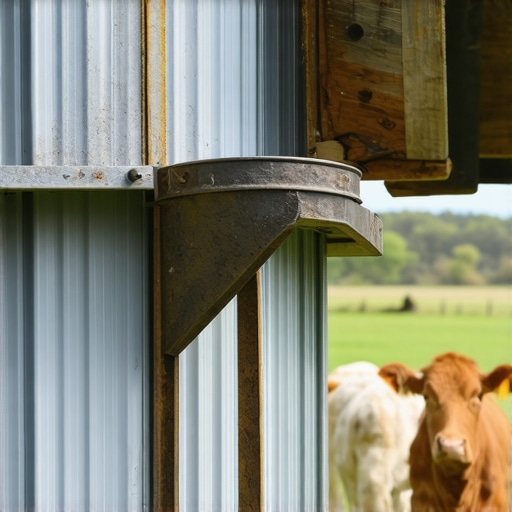
On a barn, we throw the spikes in the trash. We use heavy-duty internal screw hangers, and we space them every 12 inches, not the standard 24 or 36. In regions with heavy snow, we also utilize external wrap-around hangers that bolt directly into the rafters. This creates a mechanical bond that can withstand the vertical load of ice dams. Ice dam prevention is a critical part of barn health. When heat escapes from the livestock area below, it warms the roof, melting the bottom layer of snow. That water runs down to the cold gutter, freezes, and builds up. A heavy-duty bracket ensures that when that 500-pound block of ice forms, it stays attached to the building instead of becoming a lethal projectile. We also ensure the use of gutter apron aluminum to bridge the gap between the roof edge and the trough, preventing capillary action from pulling water back into the fascia and soffit, which leads to structural rot.
“The capacity of gutters shall be determined by the plan area of the roof that they serve.” – SMACNA Architectural Sheet Metal Manual
Managing the Outfall: Beyond the Downspout
Getting the water off the roof is only half the battle. On a farm, erosion control downspouts are mandatory. You cannot simply drop 2,000 gallons of water into a splash block and call it a day. That water needs to be directed away from the building via a dedicated outlet pipe connection and piped at least 20 feet from the foundation into a daylight exit or a French drain system. This prevents the soil saturation that leads to foundation settling. Furthermore, if you are working with an older barn, you must be aware of environmental hazards. Lead paint gutter abatement and asbestos gutter handling are serious concerns on heritage structures. You cannot simply scrape and dump; you need professional protocols to ensure that lead and asbestos do not contaminate the soil where your livestock grazes.
Leaf Guard Systems for Agricultural Use
Farmers often ask about leaf guard systems to reduce maintenance. However, on a barn, the debris isn’t just leaves; it is often dust from the hay mow, bird nesting material, and heavy grit. A micro-mesh system is often the only viable choice because it prevents the ‘organic sludge’ from forming in the trough. If you use a large-hole perforated guard, the hay dust will simply settle inside, mix with water, and create a heavy mud that will eventually sprout a garden in your gutters. We recommend color-matched gutters in a heavy-gauge aluminum or steel to match the barn’s aesthetic while providing the structural integrity needed to support the weight of the guards and the debris they catch.
The Reality of Professional Installation
When we talk about professional ladder safety on a barn, we are talking about heights that can reach 30 feet or more. This is not a weekend DIY project. The risk of a fall is magnified by the uneven terrain around most agricultural buildings. It is why getting free gutter quotes processing from specialists who understand the unique load requirements of a barn is essential. We don’t just look at the roof; we look at the soil, the animal traffic patterns, and the prevailing wind directions. We engineer a system that keeps the interior of that barn bone dry, protecting your livestock from the damp-induced illnesses that can decimate a herd’s productivity. Water is the most destructive force on your farm; treat it with the respect it deserves by installing a drainage system built for the long haul. [{“@context”: “https://schema.org”, “@type”: “HowTo”, “name”: “How to Install Heavy-Duty Barn Gutter Brackets”, “step”: [{“@type”: “HowToStep”, “text”: “Measure the roofline and mark the rafters every 12 inches for bracket placement.”}, {“@type”: “HowToStep”, “text”: “Install the gutter apron aluminum under the first course of roofing to ensure water enters the trough.”}, {“@type”: “HowToStep”, “text”: “Secure heavy-duty screw hangers through the gutter and into the fascia or rafter tails using high-torque drivers.”}, {“@type”: “HowToStep”, “text”: “Verify the pitch toward the downspout is at least 1/16 inch per foot to prevent standing water.”}]}]