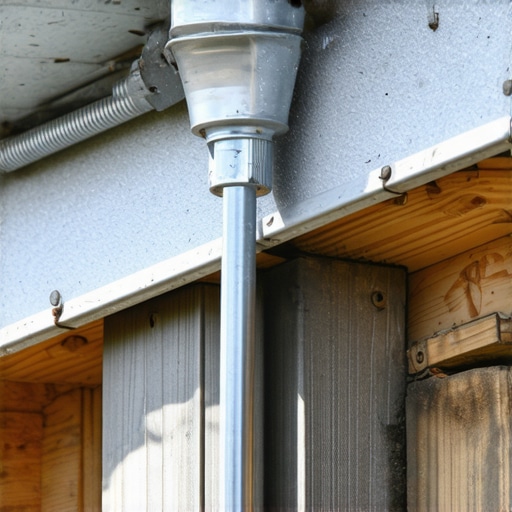
I remember a job in a high-altitude area during the late autumn of ’99. The homeowner complained about a persistent thudding sound every time the sun hit the roof. I climbed up and found that three-quarters of the spikes and ferrules on a forty-foot run had backed out of the fascia by two inches. The weight of heavy slush from an early freeze had acted like a lever, prying the metal away from the house. When the wood warmed up, it expanded; when it cooled, it contracted. This cycle, repeated over decades, turns a tight spike into a loose needle. You are looking at a system on the verge of catastrophic failure, and simply hammering those spikes back in is like putting a band-aid on a broken leg. This is the reality of traditional metal gutter maintenance.
The Physics of the Fail: Why Spikes and Ferrules Sag
To understand why your gutters are pulling away, you have to look at the mechanics of the spike and ferrule system. The spike is a long, heavy-duty nail. The ferrule is a cylindrical sleeve that sits inside the gutter. The spike goes through the front of the gutter, through the ferrule, through the back of the gutter, and finally into the wooden fascia board. The ferrule’s only job is to act as a spacer so you do not crush the gutter when you hammer the spike home. It is a primitive system. Over time, moisture travels down the shaft of the spike via capillary action. This water hits the wooden fascia, causing the grain to swell and then rot. Once the wood loses its grip, the weight of the water, debris, and snow pulls the spike out. This is not just an aesthetic issue. A sagging gutter loses its pitch. If the slope is not at least one-quarter inch for every ten feet of run, water sits. Standing water is heavy, weighing about eight pounds per gallon. This added mass accelerates the pull, creating a feedback loop of destruction that eventually rots your soffit and fascia.
“Gutter and downspout systems must be designed to accommodate the maximum expected rainfall intensity for the specific geographic location.” – SMACNA Architectural Sheet Metal Manual
Hydro-Zooming: The Movement of Water and Thermal Expansion
When rain hits a roof, it gains velocity. On a wood shake roof, the texture of the shakes creates turbulence, but during a heavy downpour, that water becomes a sheet. If your gutters are sagging due to loose spikes, the water does not just sit; it overflows the back of the gutter. Surface tension causes the water to wrap around the bottom of the metal and move toward the house. This is where wood shake gutter flashing becomes critical. Without proper flashing, that water wicks directly into the roof deck. In northern climates, snow melt gutter solutions are required because the freeze-thaw cycle is the primary enemy. As snow on the roof melts, it runs down into the cold gutter and refreezes. This creates an ice dam. The weight of this ice is immense. Traditional spikes cannot handle this load. They pull out, leaving a hole in your fascia that invites hornets and wood rot. This is why many pros are moving toward high-wind gutter anchors and internal screw-style hangers that bite into the wood with threads rather than friction.
Repairing the Sag: The Professional Approach
If you are determined to fix your current spikes, do not just hammer them back into the same hole. That hole is stripped. You can try a larger diameter spike, but a better move is to replace the spike and ferrule entirely with a heavy-duty hidden hanger. These hangers clip into the front lip of the gutter and screw directly through the back into the fascia. They are invisible from the ground and provide much better structural integrity. For those dealing with massive water volume, box style seamless gutters offer a larger trough and a more rigid profile that resists twisting. If you are inspecting a high-reach area, a drone gutter inspection can help you identify which spikes have backed out without you having to climb a sixty-foot ladder. It is also worth looking at micro-mesh gutter guards during the repair process. By keeping out the organic sludge that traps moisture against the spikes, you extend the life of the wood. However, even the best shake roof gutter protection will fail if the underlying support system is compromised.
“Downspouts shall be sized based on the rainfall intensity of the region and the roof surface area.” – International Plumbing Code, Section 1106
Choosing the Right System for Your Climate
In regions where wind is the primary concern, storm-resistant gutters are a necessity. This involves not only the metal itself but the spacing of the hangers. While standard code might allow for thirty-two-inch spacing, a specialist will place high-wind gutter anchors every twelve to eighteen inches. This prevents the wind from getting behind the gutter and peeling it off like a sardine can lid. We also see interest in bamboo gutter alternatives in certain eco-conscious circles, but in high-moisture or snow-heavy areas, they lack the tensile strength of seamless gutter installation using 0.032-gauge aluminum. The ultimate goal of any water management system is to move the liquid away from the foundation. This means checking your elbow joints and ensuring the leader (downspout) is clear of obstructions. Every miter corner must be sealed with high-grade solar-sealant to prevent dripping, which leads to localized soil erosion. Remember, the gutter is just the collector; the entire system must work in harmony to keep your basement dry.