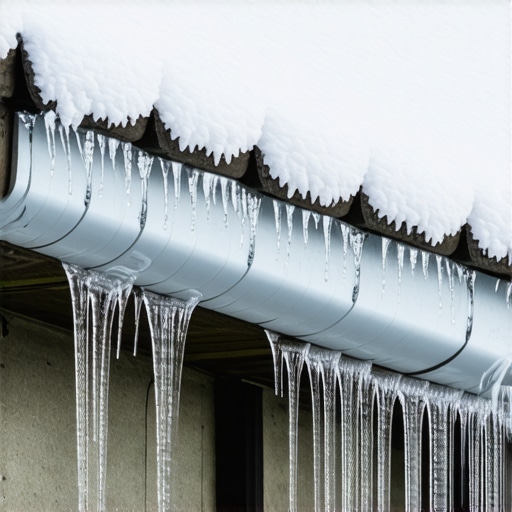
You spent hundreds of dollars on self-regulating heat tape, climbed a shaky ladder in freezing wind, and carefully snaked that cable along your roof line. Yet, the first major blizzard hits, and you are still staring at a massive, destructive ice dam hanging from your eaves like a row of frozen daggers. Why did your expensive setup fail? As an exterior drainage specialist with over 25 years on the roof, I see this exact scenario every single winter. The truth is painful: most gutter heating systems fail because they are treated as a magical cure rather than a small part of a highly engineered thermal and hydraulic system.
The Cold Reality: An Ice Dam Explosion in Action
During a brutal deep freeze a few winters back, I was called to a property where a massive 50-foot run of seamless aluminum gutter had literally sheared off the fascia board. It lay twisted in the snow, still anchored to the house by a few screaming screws, carrying with it chunks of ruined composite shingle services and torn fascia timber. The homeowner was baffled. They had run brand-new self-regulating heat cables the entire length of the run. What they did not realize is that those cables were resting on top of frozen leaves, and the bracket spacing was over three feet apart. When the meltwater from the upper roof hit that cold gutter, it froze instantly underneath the cable, building up thousands of pounds of dead weight that no cheap hanger could support. This is why engineered, custom gutter fabrication and structural integrity matter far more than just plugging in a wire.
The Thermal Trap: Why Cables Alone Fail
To understand why your heating cables are not stopping ice, you have to understand the thermal physics of a winter roof. When snow accumulates on your roof, heat escaping from your attic space warms the underside of the roof deck. This melts the bottom layer of snow. That liquid water then runs down the cold roof slope until it reaches the unheated overhang (the eave and the soffit area). Here, the temperature drops below freezing again, and the water solidifies.
If you lay a heating cable inside the gutter trough without addressing the broader water path, you create a microscopic tunnel of warmth through the ice, while the rest of the gutter remains a solid block of frozen tundra. The water running down from the warm roof hits this ice block, overflows the front lip, and forms those massive icicles. Even worse, it backs up under your shingles, rotting your roof deck and eventually dripping inside your walls.
“Ice dams form when water from melting snow runs down a roof until it reaches a cold surface, where it refreezes. Proper ventilation and attic insulation are the primary defenses against this phenomenon.” – International Residential Code, Section R806
The Mechanics of Failure: Hangers, Spacing, and Ice Weight
In northern climates, ice and snow weight are the absolute enemies of your drainage system. When water freezes, it expands by about nine percent. This expansion exerts incredible pressure inside your gutter troughs. If your system was installed using outdated spike and ferrule fasteners, or if the hangers are spaced too far apart, the system is doomed to fail under load.
For heavy snow areas, we never space hangers more than 12 inches apart. When we perform professional repairs or install whole-house gutter systems, we physically screw heavy-duty internal hangers directly through the back of the trough and deep into the rafter tails. If your gutters are sagging even a fraction of an inch, water will pool, freeze, and short out or render your heating cables completely useless by submerging them in frozen sludge.
The Essential Trio: Correct Cable Installation, Slope, and Flow Path
To make heating cables actually work, you must establish a continuous, unbroken path for melted water to escape. This means your cable cannot just sit in the bottom of the trough; it must run through the entire drainage route.
- The Roof Zig-Zag: The cable must extend up the roof deck in a pattern of wide loops, crossing the boundary where the warm roof meets the cold overhang. This prevents the initial dam from forming at the eave.
- The Trough Run: The cable must lie flat along the bottom of the gutter, resting beneath any potential water level.
- The Downspout Loop: Crucially, the cable must loop down inside the outlet pipe connection and run all the way through the leader to the ground level or the splash block. If the downspout remains frozen, the melted water from the roof has nowhere to go and will overflow immediately.
Without a clear outlet pipe connection, your heating system is simply producing warm puddles that refreeze the second they drift an inch away from the heat source.
Material Choice: Aluminum vs. Recycled Plastic Gutters
Your choice of materials significantly impacts how your system handles thermal stress. Some homeowners ask about recycled plastic gutters as a cheap alternative. While synthetic materials have their place, they suffer from extreme expansion and contraction cycles during rapid temperature swings. When exposed to severe cold and freezing water, plastic can become brittle and crack under the weight of trapped ice. Aluminum or heavy-gauge copper, especially in a traditional half-round gutter installation, provides the structural rigidity and heat conductivity needed to withstand brutal winters.
“Gutters and downspouts shall be securely fastened to prevent sagging and water ponding, which can lead to ice accumulation and structural failure under load.” – SMACNA Architectural Sheet Metal Manual
Furthermore, during heavy winter storms, you must ensure that your seams are perfectly sealed. Applying a high-grade gutter sealant application along miters and end caps is critical; ice will actively force open any microscopic gaps in your seams, leading to destructive leaks come spring thaw.
What to Do If Your System Has Suffered Winter Damage
If ice has already twisted your gutters out of shape, ripped downspouts away from the walls, or caused internal water damage, you may need to seek insurance claim assistance. Many homeowners do not realize that sudden ice dam damage is often covered under standard homeowners policies, provided the failure was not due to long-term neglect. Document the damage immediately, take photos of the failed hangers, and consult with a professional who can provide a comprehensive exterior water management plan that includes proper attic insulation, high-flow custom gutter fabrication, and correctly configured heating paths.
Ultimately, do not rely on heating cables as a primary fix. They are a secondary tool designed to keep a properly sloped, structurally sound gutter system clear of ice blockages. Get your slope right, space your hangers close, seal your miters, and ensure your downspouts are clear before you ever flip that switch in the winter.