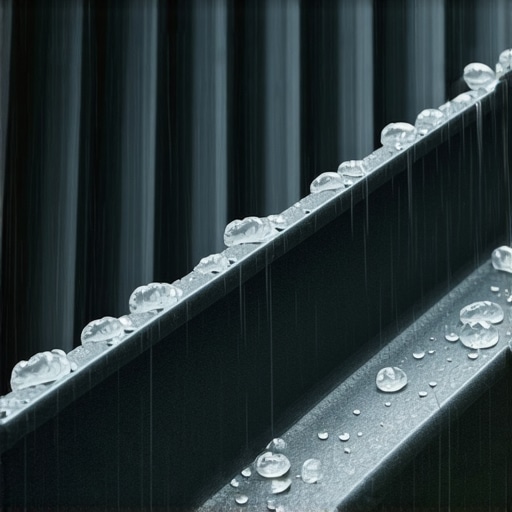
The Water Management Audit: Why Your Drainage System Is Failing the Impact Test
I stood on a ladder in Oklahoma last June, looking at a three-year-old home that already had a foundation crack wide enough to swallow a credit card. The homeowner was baffled. They had a beautiful roof and what looked like functional gutters. But upon closer inspection, those 0.027-gauge aluminum troughs were essentially useless. A single spring storm with golf-ball-sized hail had turned the gutter floor into a series of miniature mountain ranges. The water did not flow; it pooled in the craters, creating stagnant micro-swamps that bred mosquitoes and accelerated the corrosion of the aluminum’s protective coating. When the next heavy rain hit, the water could not achieve the necessary velocity to reach the downspout. Instead, it crested over the top, saturating the soil right next to the footer. This is the reality of living in a high-impact zone: if your drainage system cannot survive the sky throwing stones, it is not a drainage system; it is a liability. Throughout my 25 years in this trade, I have seen thousands of houses where the ‘standard’ install failed because the installer did not account for the kinetic energy of hail or the sheer weight of ice-slush. We are going to break down why 26-gauge galvanized steel, paired with modern hidden hanger systems, is the only engineered solution for these environments.
“Downspouts shall be sized based on the rainfall intensity of the region and the roof surface area.” – International Plumbing Code, Section 1106
The Physics of Impact: Why Aluminum Buckles and Steel Stands
When we talk about high-impact zones, we are discussing the survival of the trough. Most residential installers use aluminum because it is cheap and easy to run through a portable roll-forming machine. However, aluminum is a soft metal. When hail hits it, the metal deforms instantly. This deformation is not just an aesthetic issue; it is a hydraulic failure. In a properly pitched gutter, water moves at a specific flow velocity determined by the slope (usually 1/4 inch per 10 feet) and the smooth surface of the metal. When hail creates dents, it introduces turbulence. This turbulence slows the water down, allowing sediment and shingle grit to settle in the low spots. Over time, these low spots become heavy, further sagging the gutter and ruining the pitch. Steel, specifically 26-gauge galvanized or Galvalume, has a much higher tensile strength. It resists the ‘oil-canning’ effect and the deep pitting caused by hail. While it is heavier and harder to work with, it maintains its structural integrity and its pitch through decades of abuse. This is why industrial gutter services almost exclusively use heavy-gauge steel for large-scale projects: the risk of failure is simply too high with softer materials.
The Death of the Spike and Ferrule
If you are still seeing contractors offering spike and ferrule repair, you are looking at a relic of a failed era. The spike and ferrule system involves driving a large nail through the front of the gutter, through a tube (the ferrule), and into the fascia board. In hail-prone regions, the constant expansion and contraction of the metal, combined with the weight of frozen precipitation, causes these spikes to pull out. Once that spike moves even half an inch, the seal is broken. Water then travels down the spike and begins to rot the fascia from the inside out. This leads to expensive fascia board repair that could have been avoided with a hidden hanger system. A hidden hanger clips into the front lip of the gutter and screws directly into the rafter tail or the fascia board. It is internal, meaning it is protected from the elements, and it provides significantly more torque and holding power. In a high-impact zone, I recommend spacing these hangers every 12 inches rather than the standard 24 or 36 inches. This creates a rigid ‘skeleton’ for the steel trough, ensuring it does not pull away from the house when it is loaded with several hundred pounds of hail and water.
“The selection of gutter materials should consider local weather extremes, including snow loads and potential impact from debris or hail.” – SMACNA Architectural Sheet Metal Manual
Gutter Apron Installation: The Barrier Against Capillary Action
One of the most overlooked components in a drainage system is the gutter apron installation. During a heavy downpour in the Midwest or the South, water does not just fall into the gutter. Because of surface tension, water wants to ‘cling’ to the underside of the shingles. Without a proper metal apron tucked under the shingles and over the back edge of the gutter, water will wick backward. It will travel behind the gutter and run down the fascia board and the soffit. I have seen homes where the gutters were perfectly clear, yet the basement was flooding because the lack of an apron allowed water to bypass the drainage system entirely. The apron acts as a mandatory guide, breaking the surface tension and forcing every drop into the steel trough. This is especially critical during hail storms, as the accumulation of ice at the roof edge can create temporary dams that push water up and under the shingles.
Managing the Volume: Flood Prevention Gutters and Downspout Sizing
Capacity is the second half of the battle. In high-impact storm zones, we often see ‘gully washers’ that drop two inches of rain in twenty minutes. A standard 5-inch gutter is often overwhelmed, causing overshoot. This is why I advocate for 6-inch or even 7-inch oversized steel systems for residential properties in these areas. This is not just about the trough; it is about the leader (downspout). A 2×3 inch downspout is easily choked by a handful of hail or a few stray leaves. Moving to a 3×4 inch or a 4×5 inch industrial-sized leader increases the drainage capacity exponentially. Think of it like a highway: the wider the lanes, the less likely you are to have a traffic jam during peak flow. For homeowners, this means flood prevention gutters that can handle the sheer volume of a tropical depression or a massive Midwestern thunderstorm without overflowing and eroding the landscaping or the splash block area.
The Myth of Maintenance-Free: Screens and Cleaning
I hate to be the bearer of bad news, but there is no such thing as a ‘maintenance-free’ gutter. I have seen homeowners spend thousands on expensive ‘helmet’ style guards only to find a forest of seedlings growing in the silt that accumulated on top. In hail zones, snap-in gutter screens are particularly problematic because the hail can knock them loose or crush the mesh, creating a trap for debris. If you have heavy tree cover, you need a high-quality stainless steel micro-mesh that is securely fastened. Even then, you must have a gutter maintenance plan. This includes annual inspections and leaf blower gutter cleaning to remove the fine organic sludge that mesh cannot stop. This sludge, if left alone, will eventually find its way to the elbows and miters, causing clogs that lead to standing water and rust, even in galvanized systems. Regular maintenance ensures that the end cap seals remain tight and the pitch remains true.
Final Verdict: Protecting the Foundation
Your home is likely your largest investment, and the foundation is its most critical component. When you choose cheap, thin aluminum gutters and outdated spike-and-ferrule attachment methods in a high-impact hail zone, you are gambling with that foundation. The cost of steel is higher upfront, yes, but the cost of a foundation repair or a total fascia replacement is significantly higher. Invest in 26-gauge steel, use hidden hangers spaced tightly, ensure a proper gutter apron is in place, and size your leaders for maximum volume. Water is a destructive force that never sleeps; your drainage system is the only thing standing between your home and the slow, wet rot of the earth. Keep your feet dry, keep your foundation stable, and don’t let a twenty-minute storm dictate the lifespan of your house.