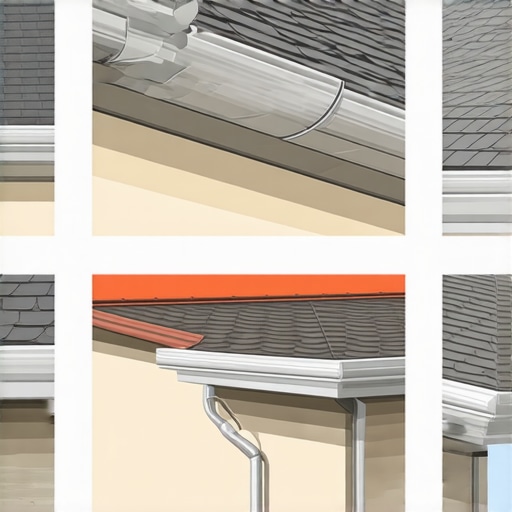
The 25-Year Gutter Specialist Perspective on Terminus Failure
After a quarter-century on a ladder, I have learned one immutable truth: water is a patient assassin. It does not just fall; it searches for the path of least resistance to your foundation. Most homeowners focus on the long runs of a garage gutter installation, but the real battle is won or lost at the end cap. If the end cap fails, your fascia board becomes a sponge, and your soffit begins the slow dance of rot. I remember a project back in the winter of 2021 in a high-elevation neighborhood. The homeowner complained of a ‘phantom drip’ that occurred even hours after the rain stopped. I climbed up and found a standard aluminum end cap that had been installed with nothing but a smear of cheap hardware store silicone. The thermal expansion of the long gutter run had pulled the cap away by a mere fraction of a millimeter. That tiny gap, combined with the wood shake gutter flashing that was improperly tucked, allowed water to syphon backward via capillary action, rotting out three feet of the rafter tails. It was a five-thousand-dollar repair caused by a five-cent failure in seal integrity.
“Gutter joints and end caps must be joined to provide a watertight connection capable of withstanding thermal expansion and contraction without failure of the sealant or the mechanical fastener.” – SMACNA Architectural Sheet Metal Manual
The Physics of the Drip: Why Standard Seals Fail
To understand why your gutters are dripping in 2026, you have to understand the physics of water volume and surface tension. During a heavy downpour, the water in your gutter trough is not just sitting there; it is a moving mass with significant kinetic energy. As it hits the end cap, it creates a small surge of hydrostatic pressure. If you have a standard crimp-on end cap, that pressure is constantly testing the chemical bond of your sealant. Over time, UV rays and the constant expansion and contraction of the metal break that bond. This is especially true in regions where snow melt gutter solutions are necessary. When snow sits in the trough and melts during the day, then refreezes at night, that ice expands. It acts like a hydraulic jack, slowly prying the end cap away from the gutter profile. This is why we are seeing a massive shift toward more robust sealing technologies and mechanical reinforcements.
Fix 1: Transitioning to EPDM Gutter Seals and Pressure Testing
The first and most effective fix for a recurring end cap leak is the abandonment of traditional tri-polymer sealants in favor of EPDM gutter seals. EPDM, or ethylene propylene diene monomer, is a synthetic rubber that maintains its elasticity from minus 40 degrees to over 300 degrees Fahrenheit. Unlike liquid sealants that harden and crack, an EPDM gasket remains flexible. When performing a garage gutter installation, I now insist on using EPDM inserts that are mechanically compressed against the gutter wall. But the installation is only half the job. You must perform pressure testing gutter seals before you pack up your tools. This involves temporarily plugging the leader or the round downspout services outlet and filling the gutter with two inches of water. We look for ‘weeping’ at the seams. If it can hold standing water for ten minutes without a drop, it will survive a decade of storms. This method ensures that the hydrostatic head pressure at the end of the run does not force moisture through microscopic voids in the sealant bead.
“Leaders and downspouts shall be sized to accommodate the maximum projected roof area, with consideration given to the rainfall intensity of the specific geographic region.” – International Plumbing Code, Section 1106.1
Fix 2: Coping Cap Alignment and Wood Shake Flashing Integration
The second fix addresses the ‘behind the scenes’ leak. Often, what looks like an end cap leak is actually a failure of the coping cap alignment or the flashing above it. On homes with wood shake roofs, the wood shake gutter flashing must be precisely integrated with the gutter’s back flange. If the flashing is too short or lacks a proper drip edge, water will track behind the gutter and onto the fascia. When we replace an end cap, we must also inspect the coping cap alignment. The coping cap is the metal covering on top of a parapet or the end of a roofline. If it is not sloped back toward the roof or directly into a roof scupper drains system, water will cascade over the side, hitting the end cap from the outside. This external water pressure eventually finds its way into the seam. By ensuring the flashing overlaps the gutter back by at least two inches and that all coping is pitched correctly, we redirect the water into the trough where it belongs. This is critical for preventing the ‘back-flow rot’ that destroys soffit boards.
Fix 3: Structural Reinforcement and Snow Melt Management
In northern climates, the weight of ice is the primary killer of end caps. A standard hanger spaced every 24 inches is not enough to support the weight of a frozen trough. For a permanent 2026 fix, we move the last hanger to within three inches of the end cap. This provides structural rigidity that prevents the gutter from twisting under snow load. Furthermore, we integrate snow melt gutter solutions such as self-regulating heat cables directly at the terminus. By keeping the area around the end cap and the entry to the leader clear of ice, we prevent the ‘ice plug’ effect. When a round downspout services a gutter, the vortex created by the round shape moves water faster, but it is also more prone to flash-freezing at the throat. A heat cable ensures that the water remains in a liquid state until it reaches the splash block or the rain barrel integration point. This takes the physical stress off the end cap seams, extending the life of the EPDM seals indefinitely.
The Drainage Hierarchy: Beyond the Trough
Stopping the drip at the end cap is only the first step in a complete drainage strategy. You have to consider where that water goes once it leaves the trough. If you are using rain barrel integration, the overflow must be managed with a high-capacity leader. We often recommend round downspouts for modern or industrial-style homes because they handle high-velocity flow better than rectangular ones. The lack of corners in a round leader reduces the friction of the water, allowing it to clear the gutter faster during a ‘gully washer.’ This reduces the depth of the water in the trough, which in turn reduces the pressure on your end caps. If the ground near your foundation is swampy, the end cap fix won’t save your basement. You need to connect those leaders to a proper underground drainage system. We look at the entire ‘hydro-path’ from the peak of the roof down to the final discharge point. Whether it is a simple splash block or a complex network of roof scupper drains leading to a dry well, the goal remains the same: keep the water moving and keep it away from the foundation. Water that stands still is water that is doing damage. By obsessing over the slope (at least 1/4 inch per 10 feet) and the integrity of every miter and end cap, we ensure the home stays dry for another twenty-five years.