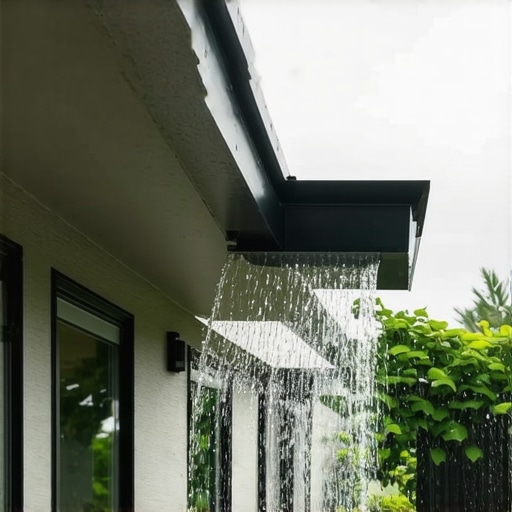
The High Cost of Cheap Metal: A Foundation’s Downfall
I once walked onto a property where the brick veneer had developed a jagged, terrifying crack running from the roofline straight down to the mudsills. The homeowner was convinced the house was settling into a sinkhole. I didn’t look at the dirt; I looked at the roof. What I found was a classic failure of physics: a three-story gutter run with a negative pitch and hangers spaced forty inches apart. The weight of standing water had bowed the aluminum, causing a slow, constant leak that saturated the soil for three years. That hydrostatic pressure eventually pushed the foundation wall inward by two inches. This is what happens when you treat gutters as a commodity rather than an engineered water management system.
The Material Standard: Why 0.032 Aluminum Wins in 2026
In the current landscape of home exterior tech, the industry has shifted. We no longer accept the thin, 0.027-gauge aluminum that was standard a decade ago. In 2026, thick-gauge 0.032 aluminum is the baseline for any professional install. Why? Because the weather has become more volatile. We are seeing higher rainfall intensity and heavier snow loads. A 0.032-gauge gutter provides nearly 50% more structural rigidity than the cheaper alternatives. This prevents the ‘trough twist’ that happens when a gutter fills with slush or heavy debris. When we talk about color-matched gutters, we aren’t just talking about aesthetics; we are talking about factory-baked architectural coatings that resist the UV degradation common with thinner, lower-quality metals.
“Downspouts shall be sized based on the rainfall intensity of the region and the roof surface area.” – International Plumbing Code, Section 1106
The Anatomy of a Perfect System: Drip Edges and Aprons
One of the most overlooked components in exterior drainage is the drip edge integration. Without a proper gutter apron installation, water doesn’t actually make it into the trough. Due to surface tension, water wants to ‘wick’ backward, creeping behind the gutter and rotting your fascia board and soffit. An apron acts as a metal bridge, tucked under the first course of shingles and over the back edge of the gutter. This ensures that every drop of runoff is directed exactly where it needs to go. We often use camera scoping for gutters on older homes to see if water has already begun to infiltrate the wall cavity behind the fascia—a problem you won’t notice until the wood is soft enough to poke a finger through.
Managing the Load: Physics of Pitch and Hangers
The math of a gutter is simple but unforgiving. We calculate the Pitch/Slope at a minimum of 1/4 inch for every 10 feet of run. If the slope is too aggressive, the water moves too fast and overshoots the Miter (the corner). If it’s too shallow, water pools, leading to mosquito breeding grounds and rust. For three-story access solutions, we utilize heavy-duty Hangers with 3-inch reinforced screws. In northern climates, where ice is the primary enemy, we space these hangers every 12 inches. A standard 20-foot run of gutter filled with ice can weigh over 200 pounds; cheap spikes and ferrules will pull out of the wood under that load every single time.
“Hangers shall be spaced to provide support for the gutter and the weight of the water and debris contained therein.” – SMACNA Architectural Sheet Metal Manual
Complex Scenarios: Solar Panels and Parapets
Modern homes present new challenges. Solar panel gutter avoidance is a critical consideration in 2026. Solar panels create a massive, slick surface that accelerates water velocity. When a downpour hits those panels, the water launches off the roof like a jump. This requires oversized 6-inch or 7-inch gutters and specialized splash guards at the Elbow to prevent overshoot. Similarly, for commercial flat roof gutters, we often deal with parapet drain systems. These require scuppers and heavy-duty Leader pipes that can handle the massive volume of a flat surface area without backing up and causing a roof collapse.
Winter Defense: Gutter Heating Systems
In regions where the freeze-thaw cycle is a daily occurrence, gutter heating systems are no longer a luxury. These self-regulating cables are laid in the trough and down the Leader to keep a clear channel for meltwater. Without them, ice dams form, pushing water up under the shingles and into your attic. When we combine this with gutter guard installation, we have to be specific. A mesh guard might work for oak leaves, but in a pine-heavy environment, you need a solid-surface ‘helmet’ that utilizes surface tension to pull water in while shedding needles.
The Final Word on Foundation Protection
At the end of the day, your gutters are the only thing keeping your home from being reclaimed by the earth. From the End Cap to the Splash Block at the exit point, every component must be high-gauge, perfectly pitched, and structurally sound. Water is the most destructive force your home will ever face. Don’t let a $500 savings on thin metal turn into a $50,000 foundation repair bill.