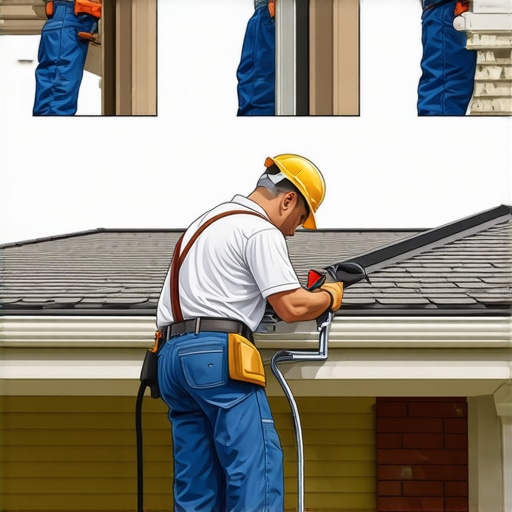
The Deceptive Drip: Why Your End Cap is a Structural Hazard
Most homeowners hear a steady ‘drip-drip-drip’ at the corner of their house and think it is a minor annoyance. As someone who has spent over two decades in the trenches of water management, I can tell you that sound is the timer on a bomb. A leaking end cap is not just a plumbing failure; it is a direct assault on your home’s skeleton. When water escapes the termination point of your gutter run, it does not just fall to the ground. Due to surface tension, that water often wicks backward, soaking into the fascia board and migrating into the soffit. From there, it finds the wall cavity. I have seen countless insurance claim assistance cases where a simple $10 component caused $15,000 in structural rot because the owner ignored the signs.
The Savannah Foundation Failure: A Cautionary Tale
I recall a specific project in Savannah where a homeowner called me because their garage door was sticking. Upon inspection, I found the corner of the foundation had settled nearly three inches. The culprit? An end cap on a long 50-foot run that had separated from the aluminum trough. For three years, every storm sent a concentrated stream of water directly against the corner of the slab, eroding the load-bearing soil. This is the reality of poor gutter overflow prevention. One small gap in your water management system can compromise the entire integrity of your property. We aren’t just talking about a wet lawn; we are talking about the very ground your house stands on.
“All gutters shall be sloped toward the downspout to provide positive drainage, and terminations must be sealed to prevent moisture infiltration into the building envelope.” – International Plumbing Code, Section 1106
Fix 1: Transitioning to EPDM Gutter Seals for Thermal Stability
The standard industry practice for years was to slop some tri-polymer sealant into the corner and hope for the best. The problem is that aluminum is a dynamic material. It expands and contracts significantly with temperature swings. In a high-heat environment like a Southern summer, a 40-foot gutter can grow by half an inch. Traditional caulk brittle-cracks under this stress. The professional solution for 2026 is the integration of EPDM gutter seals. EPDM, or ethylene propylene diene monomer, is a synthetic rubber that maintains elasticity from minus 40 to 300 degrees Fahrenheit. When we perform two-story gutter services, we prioritize mechanical EPDM gaskets over liquid sealants. We scuff the interior of the gutter with a heavy-grit abrasive, apply a primer, and then mechanically compress the EPDM seal into the end cap junction. This creates a flexible, watertight ‘lung’ that breathes with the metal rather than fighting it.
Fix 2: Correcting Fascia Gutter Mounting and Structural Pitch
Often, an end cap leaks not because the seal is bad, but because the pitch of the gutter is forcing water to pool against it. I often find that ‘professional’ installers only use a hanger every 32 inches. That is a recipe for disaster. In areas prone to heavy downpours, the weight of the water causes the aluminum to bow between brackets. This creates ‘dead spots’ where organic sludge and water sit. We advocate for a rigorous hanger spacing of no more than 16 inches, and in heavy-load zones, every 12 inches. By reinforcing the fascia gutter mounting, we ensure the 1/4 inch per 10 feet slope is maintained. If the water is moving at the correct velocity toward the outlet pipe connection, it never has the chance to exert hydrostatic pressure against the end cap seal. This is the cornerstone of effective gutter overflow prevention.
“End caps must be secured and sealed to withstand the hydraulic pressure of a full gutter during peak rainfall events, ensuring no bypass occurs at the termination.” – SMACNA Sheet Metal Manual
Fix 3: High-Flow Outlet Pipe Connection and Valley Management
In many modern home designs, a valley gutter installation dumps massive volumes of water into a single point. If that point is near an end cap, the turbulence alone will eventually vibrate the seal loose. To fix this, we often recommend enlarging the outlet pipe connection. Upgrading from a standard 2×3 leader to a 3×4 oversized downspout reduces the ‘back-pressure’ in the system. When the water can exit the trough faster than it enters, the end cap is never submerged. During our gutter cleaning services, we often see that the end cap area is the first place to collect silt. This silt acts as a sponge, holding moisture against the sealant 24/7, leading to premature failure. Regular gutter debris removal is not just about flow; it is about protecting the chemical bonds of your seals.
Extending the System: Pergolas and Secondary Structures
We are seeing a massive trend in pergola gutter addition projects. These structures are often attached to the main house fascia. If the pergola drainage is not perfectly synced with the house system, you end up with ‘cascading failures’ where one system overflows into the other. Every miter and every elbow must be calculated for the specific square footage of the roof it serves. In the South, where a ‘gully washer’ can drop three inches of rain in an hour, your drainage math has to be perfect. You cannot afford to guess on the capacity of your leaders. Always over-build. Always over-seal. And never trust a spike-and-ferrule setup; use heavy-duty screw hangers that bite deep into the rafter tails for a permanent hold.