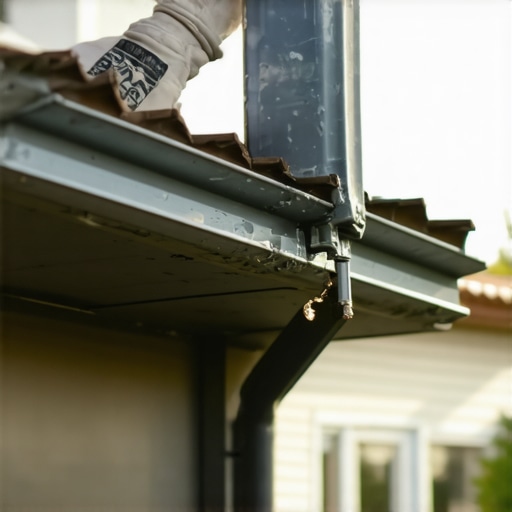
The Anatomy of a Failure: Why Seams Leak
I was standing on a ladder in the middle of a coastal gale two years ago, looking at a massive industrial gutter service job where the client complained of a ‘slight moistness’ in the warehouse corner. What I found was a foundation disaster in the making. A single miter joint had failed. Because the pitch was slightly off, water sat in that corner for years, slowly eating through the cheap hardware-store silicone the previous installer slapped on. By the time I arrived, the water had carved a channel directly under the slab, causing a three-inch sink. This is the reality of water management: it is a relentless force that exploits every microscopic gap in your defenses.
The Physics of the Flow: Why 2026 Standards Demand More
When we talk about gutters, most homeowners think of a simple trough. As a specialist, I see a hydraulic system. In a heavy downpour, water doesn’t just fall; it gains flow velocity. On a tile roof gutter support system, the weight of the tiles combined with the speed of runoff creates massive pressure at the seams. If your miter isn’t sealed with a high-performance tri-polymer, the vibration and thermal expansion of the metal will snap the bond. This is particularly critical for two-story gutter services and three-story access solutions where the height increases the kinetic energy of the water descending through the leader. We aren’t just stopping a drip; we are managing the thermal movement of aluminum which can expand and contract up to an eighth of an inch over a twenty-foot run.
“Downspouts shall be sized based on the rainfall intensity of the region and the roof surface area.” International Plumbing Code, Section 1106
Tip 1: The Molecular Clean Technique
You cannot seal over old gunk. Most DIY repairs fail because they apply new sealant over ‘bio-sludge’ or oxidized aluminum. To truly stop a leak in 2026, you must strip the joint back to the bare metal. This is vital for barn gutter repair where organic matter from hay and dust creates a film that prevents adhesion. I use a wire brush and then a high-flash-point solvent to ensure the surface is chemically hungry for the sealant. If you are dealing with industrial gutter services, you might even need a mechanical sander to scuff the surface. Without this, the sealant is just a temporary band-aid waiting to be peeled off by the next frost.
Tip 2: Choosing Tri-Polymer over Silicone
Silicone is for bathrooms, not for the exterior of a home facing 100-degree summers and sub-zero winters. For high-wind gutter anchors and heavy-duty joints, you need a sealant that maintains 500% elongation. This means the sealant can stretch and return to its original shape as the metal moves. In patio cover gutters, where the structure is often lighter and moves more in the wind, a rigid sealant will crack within six months. I always recommend a tri-polymer sealant that can be applied even in damp conditions. This is the only way to ensure the end cap and elbow connections remain watertight during a ‘gully washer’ in the South.
“Joints in gutters shall be lapped a minimum of 1 inch in the direction of flow and shall be sealed with a compatible sealant or soldered.” SMACNA Residential Sheet Metal Guidelines
Tip 3: The Mechanical Reinforcement Rule
Sealant alone isn’t a structural fix. If a seam is leaking, it’s often because the hanger spacing is too wide, allowing the gutter to sag and pull the joint apart. For rectangular downspout install projects, ensure you have a hanger within six inches of every seam. This prevents the weight of the water from stressing the chemical bond. If you are performing a kickout diverter installation, the mechanical flashing must do the heavy lifting, with the sealant acting only as the secondary barrier. Water should always be ‘lapped’—meaning the uphill piece of metal sits inside the downhill piece. If you rely on caulk to stop water from running ‘up’ a joint, you’ve already lost the battle.
Advanced Protection: Beyond the Seam
In high-risk areas, I often recommend an overflow alarm installation. This is a small sensor placed near critical seams or soffit transitions that alerts the homeowner via smartphone if water levels rise too high. It’s the ultimate insurance policy for expensive tile roof gutter support systems. Furthermore, in storm-prone regions, high-wind gutter anchors are no longer optional. They provide the lateral stability needed to keep those seams from twisting under the torque of 70mph gusts. Remember, your gutter system is only as strong as its weakest miter. Don’t let a five-dollar tube of cheap caulk be the reason your foundation fails. Invest in the right materials, respect the physics of water, and keep your splash block clear. That is how you protect a home for the long haul.